Herstmonceux Castle

CONTINUING my long overdue visitations of some Sussex sites (last week the Booth Museum, Brighton), I came upon Herstmonceux Castle, near Hastings in East Sussex. Actually, some Canadian students had recently attended a talk I had given on Maritime Archaeology at the Brighton Divers Club at Brighton Marina and I had met up with Dr Scott Mclean who teaches Archaeology and History at the Castle. Teaches at the Castle? Yes, in fact it’s the Bader International Study Centre of Queen’s University in Canada. In 1992, Alfred Bader wanted to buy the Castle for his wife (some people just buy their wives flowers) but she complained that there were too many rooms to clean!  And she would be cleaning them??  Bader, an alumni of Queen’s University, then liaised with the Principal of the University and ‘hey presto’, the International Study Centre was set up in 1994 (its name was changed to incorporate Bader’s name in 2009).

Herstmonceux Castle

The Castle’s name derives from the owners of the original building around the 12th century. A Norman nobleman, Ingelram de Monceaux, was married to one Idonea de Herst and the manor was called Herst de Monceux (makes sense). The Castle (although it’s not really a defensive castle – more of a palace) as it appears today in its red brick was built in the Tudor period in 1441  at the cost of £3000 by Sir Roger Fiennes (a familiar name), who was the Treasurer to Henry VII. 100 years later in 1541, Sir Thomas Fiennes, aka Lord Dacre, was unceremoniously hanged having been found guilty of the death of a gamekeeper of a neighbouring estate (naughty Sir Thomas had been poaching deer from his neighbour). Although the house/castle was confiscated by Henry VIII, it was returned to the Fiennes family after the King’s death and remained so until 1708 when Thomas Leonard, 15th Baron Dacre (and 1st Earl of Sussex) sold it to a lawyer, George Naylor. George’s half-brother, Robert, took possession of it in 1775 and began dismantling it leaving only its external walls (don’t even ask why).

 Fiennes,Thomas Baron Dacre.jpg

Naughty Sir Thomas Fiennes, 9th Baron Dacre (1515-1541)

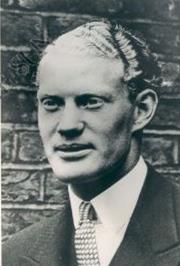
Whilst still a ruin in 1807, it was bought by Thomas Read Kemp whose father (Thomas Kemp Sr) owned a farmhouse in Brighton rented by the Prince of Wales – the same building which was to become the Royal Pavilion (quiz trivia for you). It (the castle not the Royal Pavilion) remained a ruin until 1911 when it was purchased by the MP Lt Colonel Claude William Henry Lowther who began to restore it. This restoration was not completed until 1933, when it was under the ownership of Sir (Herbert) Paul Latham (whose architect, Walter Godfrey, wrote various books and articles on Sussex history published by, among others, the Sussex Archaeological Society). Now Latham was an interesting – if that is the correct word – character. In 1931 he became MP for Scarborough and Whitby and, even though he was exempt from military service during WWII, he joined the army only to be arrested for ‘improper behaviour’ with three soldiers and a civilian. He was the first MP to be court-martialled for ‘indecent conduct’ (10 charges) for over 100 years. He attempted suicide by riding his motorbike into a tree – attempted suicide was illegal then and so he was charged and found guilty of that as well. He was dishonourably discharged from the army and spent two years in prison and, needless to say, resigned his seat in Parliament. Not a very successful career.

latham
Unsuccessful Sir (Herbert) Paul Latham (1905-1955) 

In 1946, the Admiralty purchased the Castle and, in 1957, made use of the observatory in the grounds. It remained the Royal Greenwich Observatory until that moved to Cambridge in 1988. The Castle then sat lonely and empty until its banner was taken up by Alfred Bader who refurbished it into the magnificent building it is today.

observ2

The Observatory in the grounds of the Castle

The Castle and grounds are also open to the public – click here. For more info on the Bader International Study Centre at the Castle, Click here

.

Next week: The Mary Rose


ASIDE

Spooky or what?

I was at a talk on the First World War the other day and it was mentioned that the number plate of the car in which Archduke Franz Ferdinand was in when he was assassinated was AIII 118.  That is A 11 11 18 – Armistice 11th November 1918


Artemus Smith’s Notebooks

I continue my research of the notebooks of Dr Artemus Smith, archaeologist of great courage, determination and fiction. Here is another extract:

I was visiting a jungle outpost to meet a retiring colonel CO. After a welcoming (gin and tonic), the retiring colonel said, “You must meet my Adjutant, Captain Jameson. He’s my right-hand man, and he’s really the strength of this office. His talent is simply boundless.”

Jameson was summoned and introduced to me and I was very surprised to meet a humpbacked, one eyed, toothless, hairless, scabbed and pockmarked specimen of humanity, a particularly unattractive man less than three feet tall.

The colonel said, “Jameson, old man, tell Smith about yourself.”

“Well, sir, I graduated with honours from Sandhurst, joined the regiment and won the Military Cross and Bar after three expeditions behind enemy lines. I’ve represented Great Britain in equestrian events, and won a Silver Medal in the middleweight division of the Olympics. I have researched the history of…..”

Here the colonel interrupted, “Yes, yes, never mind that Jameson, he can find all that in your file.  Tell him about the day you told the witch doctor he was a joke.”

art-smth

Thomas Edward Booth of the Booth Museum

I HAVE LIVED all my life in or around Brighton (give or take five years in the wild west of Wales) and only visited the Booth Museum last year to see what must be one of the finest collections of Victorian natural history taxidermy birds in the UK. I visited again last week to have a look at what is in storage hidden away at the back and upstairs. There is a phenomenal amount of stuffed animals and skeletal remains tucked away and it’s a fantastic collection idly waiting to be used in research.

The Booth Museum on Dyke Road, Brighton

The museum’s founder, Thomas Edward Booth, was a dedicated naturalist. He was born in Buckinghamshire in 1840 to wealthy parentage and moved to Hastings in East Sussex when he was 10 years old. Four years later the family moved to Brighton. He was educated at a private school in Brighton before going to Harrow and then Trinity College, Cambridge. He didn’t complete his degree at Trinity as it appears he was sent down (Oxbridge for thrown out). It’s not clear why but probably due to spending too much of his time on shooting birds on the Fens rather than studying at College. A matter of choice I suppose.

   booth 3

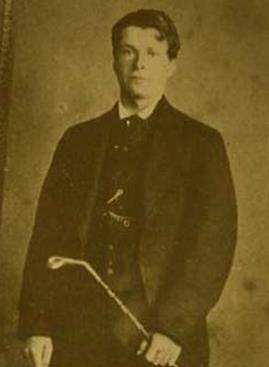
Young Edward Booth probably when he was at Cambridge

He moved to Dyke Road in Brighton with his first wife in 1865 (his second wife was his first wife’s nurse – keep it in the ‘family’) and built a house he called ‘Bleak House’ (one may assume he was a Dickens fan). In 1874 he built his museum for his British bird collection in the grounds of his house. He made copious notes and drawings of these birds (most of which still survive in the museum archive) and he had learned taxidermy as a child from a chap called ‘Kent’ from St Leonards in Sussex. The idea of the museum was to recreate birds in glass cabinets in their natural habitat and, at this, he was most successful, although the principal taxidermists were T.E. Gunn, George Saville, Pratt & Sons of Brighton, Brazenore of Brighton and Swaysland of Brighton (credit where credit is due I say). The museum was known as the ‘home of the dioramas’ (three-dimensional full-size models enclosed in glass showcases)

Shows a sepia photograph of the Victorian ornithologist Edward Booth, who is wearing a top hat, smart suit and holds a cane

Older Edward Booth (the ‘walking stick’ in his left hand is, in fact, a 410 gun)

Booth planned to collect every species of British bird and he did so by shooting them or capturing them by net or trap. He also raised fledglings only to kill them when they were the size he required for stuffing. I know what you are thinking – but he was a fanatic and it was legal then (killing birds, not being a fanatic – although that was also legal). He even had his own train carriage at Brighton station ready and waiting to link up to a train if he heard a rare or new species of bird had been spotted (that’s style if you can afford it). He was obviously eccentric and not averse to taking pot-shots at other bird-spotters imposing on his hunting territory.  He was also fond of the alcohol which may have had something to do with his premature demise in 1890 (aged 50).

The museum circa 1911

His museum was not a commercial enterprise and it was not open to the public (other than occasional special days). It was not until after his death that the museum was left to ‘the people of Brighton’. Booth’s house on Dyke Road has long since been pulled down and the land redeveloped but the museum remains intact. It is reported to house over half a million insects and animals; 50,000 fossils, minerals and rocks; 30,000 plants; and 11,000 books and maps; all dating back over three centuries. This is not to mention the many bones and complete animal skeletons which have been acquired from various donations (including Brighton Museum, and a collection confiscated from a burglar of the premises!). It is well worth a visit – for more info, click here

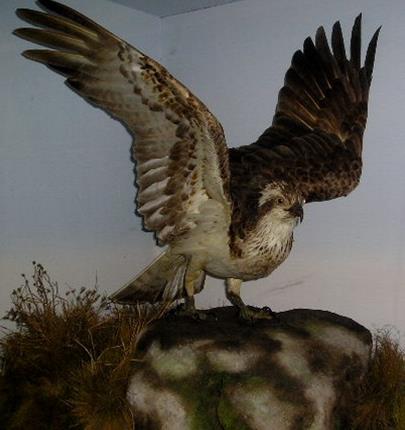
booth 4 osprey

 Stuffed Victorian Osprey by Booth


Next week: Herstmonceux Castle


Artemus Smith’s Notebooks

I continue my research of the notebooks of Dr Artemus Smith, archaeologist of great courage, determination and fiction. Here is another extract:

My neighbour, Travis Arbuthnot, had just bought a chainsaw and was somewhat displeased with the implement. He said to me, “Not sure what’s wrong with this darn thing. The salesman said it would cut around six trees in one hour. So far I’ve only managed one tree and it’s taken all day.” I enquired as to whether he would mind if I had a look and he handed me the item of concern. I pulled the cord and started the motor. Immediately he exclaimed, “What’s that noise?”

art-smth


Juries – a good thing or a bad thing?

IN THE FINAL scene of the final play of the Oresteia trilogy (The Eumenides) by the Greek playwright, Aeschylus, Orestes is at the Areopagus in Athens facing trial by a jury of twelve. The play was first performed in 458 BC and is probably the first reference to trial by jury in the history of man.

Aeschylus (525-456 BC)

Juries have been used in the English legal system for over 1000 years (set up in the 12th century by Henry II), representing a person’s right to trial by ‘the lawful judgement of his peers’. By the middle of the 15th century, juries had become independent assessors and assumed their modern role as deciders of fact. Well, I say ‘independent’, in the famous Bushell’s Case of 1670, it had to battle for such independence.

The case came about from a previous case involving two Quakers, William Penn and William Mead, who had been charged with unlawful assembly. The two Quakers were challenging the Conventicle Act, which restricted certain religious practices. The judge had charged the jury that they “shall not be dismissed until we have a verdict that the court will accept.” (note: ‘that the court will accept’!). When the jury decided to acquit, the judge was not willing to accept it and sent them back to reconsider, fining them in the process. Edward Bushel, one of the jurors, refused to pay the fine and so the judge threatened him with, “You shall be locked up without meat, drink, fire, and tobacco. You shall not think thus to abuse the court; we will have a verdict, by the help of God, or you shall starve for it.”

Bushel took the case to the Court of Common Pleas (sort of equivalent to the Queen’s Bench Division of the High Court today) where it was established by Sir John Vaughan that a jury could not be coerced into giving a particular verdict. This case established unequivocally the independence of the jury.

Sir John Vaughan (1603-1674)

Despite this, well into the 19th century, some jurors were locked up without ‘food or fire, water or candle’ until they reached a verdict – any verdict would do now , not necessarily as expected by the court. There are numerous interesting cases in which deliberations went on in this manner for so long that jurors fainted and doctors were summoned.

However, the very fact that a jury system is steeped in time has led to the debate over whether it has become outdated. Certainly we know of some pretty odd decisions being made – and many, I imagine, that we don’t know about. In one case, R v Young, in 1994, the jury found the defendant, Stephen Young, guilty of the murder of Harry Fuller and his wife, Nicola, after four of its members (during an overnight stay in the hotel …. and some alcohol) had contacted one of deceased victims by way of a séance and a Ouija Board! This only came to light because one of the jurors panicked and reported it. Generally we would not know how or why a jury comes to its decision and its deliberations are private – so you may be found guilty by the toss of a coin. Hardly in the spirit of justice. (Young was in fact retried and found guilty again, presumably without the assistance of either Harry or Nicola).

Ouija Board – win some, lose some!

In some instances juries completely ignore the law and go for what is called a decision of conscience. One such case was R v Ponting (1985) in which a civil servant was charged under the old Official Secrets Act 1911 for leaking information to an opposition MP about the sinking of the General Belgrano in the Falklands War. There was no doubt he had committed the offence and, despite the judge ruling that there was no defence, the jury refused to convict him seeing as he was acting for ‘public interest’.  In other words, the public had the right to know if the government was being economical with the truth – and rightly so. Who needs laws ….

Clive Ponting

Clive Ponting – in the public conscience …..

In his 1985 book, What Next in the Law?, that great judge, Lord Denning, said, “… the chances, by sheer weight of numbers, are loaded heavily against the jurors being sensible and responsible members of the community.” Far be it for me to comment further.  However, juries have made critical mistakes. Take R v Bentley for example. In that case the Court of Appeal decided in 1998 that Derek Bentley was not guilty of the murder of a policeman as decided by the jury in December 1952. Unfortunately, as a result of the jury’s decision, Bentley had been hanged in January 1953.

Lord Denning (1899-1999)

The American comedian, Norm Crosby observed, “When you go into court you are putting your fate into the hands of twelve people who weren’t smart enough to get out of jury duty.” Mind you, Grouch Marx once said, “I was married by a judge. I should have asked for a jury.”

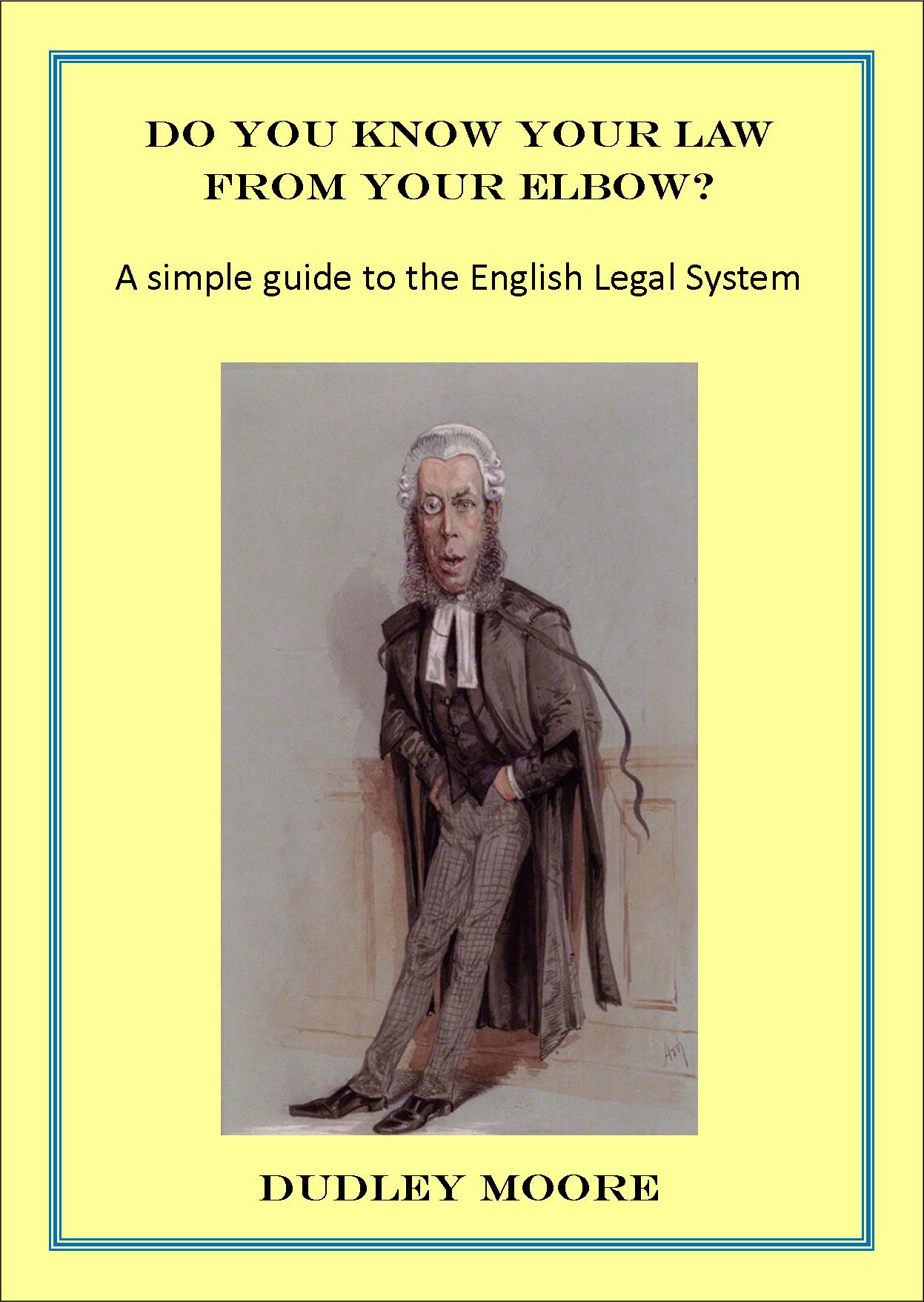
Want to know more about juries and the English Legal System? You should do. If you haven’t already (why not?), find out more by downloading onto your kindle, iPad, phone, or whatever, my fascinating e-book on the subject, Do you know your law from your elbow? Click here.  

CoverPage

.

Next week: Thomas Edward Booth of the Booth Museum, Brighton


Artemus Smith’s Notebooks

I continue my research of the notebooks of Dr Artemus Smith, archaeologist of great courage, determination and fiction. Here is another extract:

My good friend, the Very Reverend Uriah Doorstopp, told me of a tale of his cousin who was an archaeologist. Apparently he (the cousin) was in the deepest jungle and suddenly found himself surrounded by what he perceived to be a bloodthirsty group of headhunters. Upon surveying the situation, he said quietly to himself, “Oh God, I’m in big trouble.” There was a ray of light from heaven and a voice boomed out, “No you are NOT in big trouble. Pick up that stone at your feet and hit the head of the chief standing in front of you.”

So his cousin picked up the stone and proceeded to hit the chief over the head.  As he stood above the lifeless body, breathing heavily and surrounded by 100 possible headhunters with a look of shock on their faces, the voice from above boomed out again, “Okay, NOW you’re in big trouble.”

art-smth

The Parthenon – then and now

I WAS UP AT the British Museum last week and was, as usual, suitably fascinated by the Parthenon marbles. The Parthenon, on the Acropolis in Athens, has been under repair now since the Committee for the Conservation of the Acropolis Monuments was set up in 1975 and serious restoration work began on the Parthenon around 1985. That was 30 years ago and still there is much to do. Back in the 5th century BC it took the ancient Greeks 9 years to build it (447-438 BC) – there’s advancement for you! To be fair, since 1985 there has been a lot of dismantling of previously flawed repairs carried out by the likes of messrs  Kyriakos Pittakis (from 1842 to 1844) and Nicholaos Balanos (from 1895 to 1933). These guys, although well-meaning, used a lot of concrete and iron which has not proven to be a lasting success! It is not planned to restore the Parthenon to its original state, but just to a more appropriately safe ruin and restoring loose blocks to where they belong.

parthenon now

The Parthenon today (NW sides)

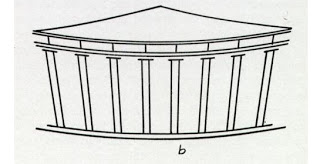
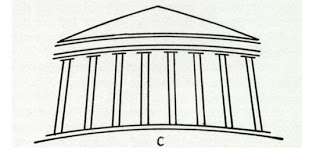
The construction of it (in pentelic marble from nearby Mount Pentelicus) back in the 5th century BC was clever stuff – its columns look uniform and straight but they are not. The building is, in fact, an optical illusion. If it had been built uniform, with all the columns straight and exactly the same size it would have been seen to the eye as shrunken in the middle. The columns on the ends are slightly larger than the others and bend inwards.

parthenon

Outside columns bend in

a illusion

Drawing a is how it should look to the eye

b illusion

Drawing b is how it would look to the eye if all the columns were uniform

c illusion

Drawing c is how it is actually built to look like (to the eye) drawing a

It’s had a somewhat ‘interesting’ history. Other than a fire in the 3rd century AD, which destroyed its roof and part of the inner sanctuary, it lasted quite well, complete with its massive golden statue of Athena. Then, in the 5th century AD, as part of the new Byzantine Empire, the statute was looted and taken to Constantinople, where it was later destroyed, probably around 1209 during the fourth Crusade.

Athena

Replica of the statute of Athena in Nashville, USA – big, huh!

Towards the end of the 6th century AD the Parthenon was converted to a Christian church and the main entrance changed from the east to the west, with an altar set up at the east-end with the addition of an apse. A bell tower with spiral staircase was built into the southwest corner.

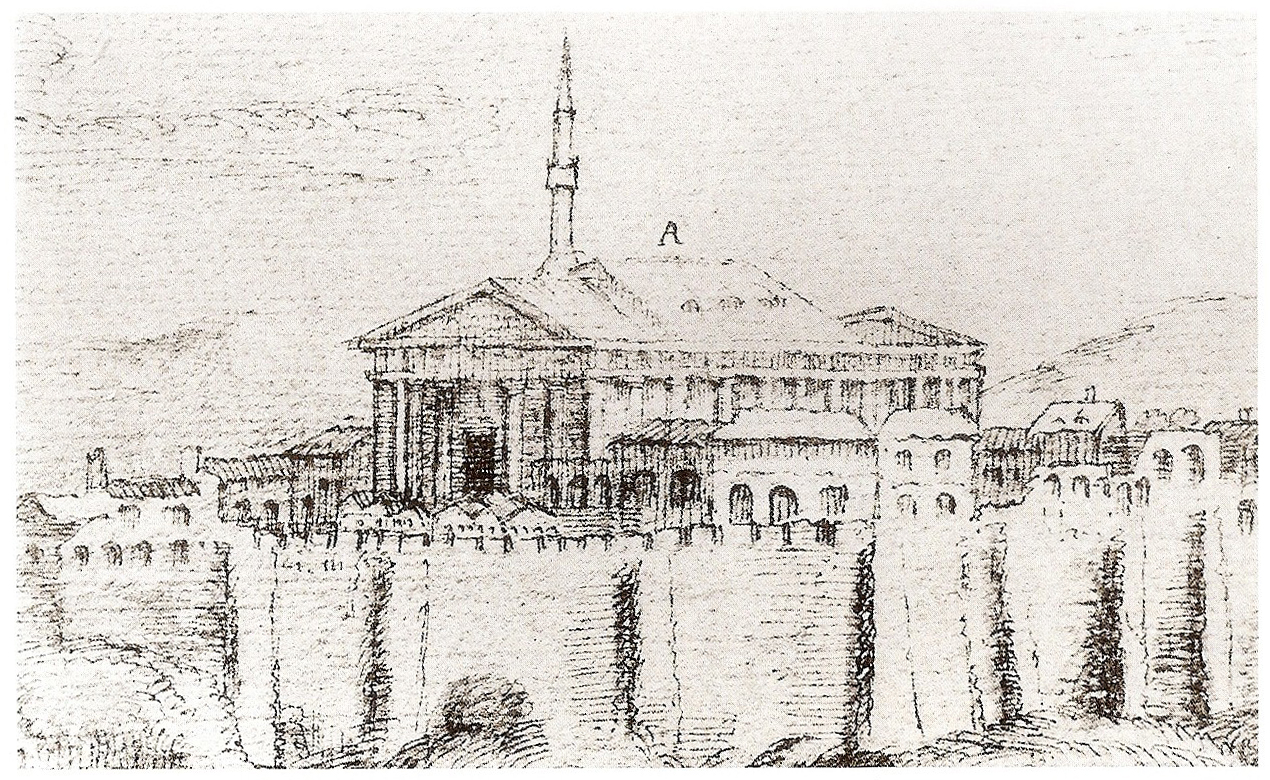
In 1458 the Ottoman Turks took control of Athens and some years later converted the Parthenon into a mosque. However, the basic external structure remained intact.

 parthenon mosque 1

Parthenon as a mosque complete with minaret

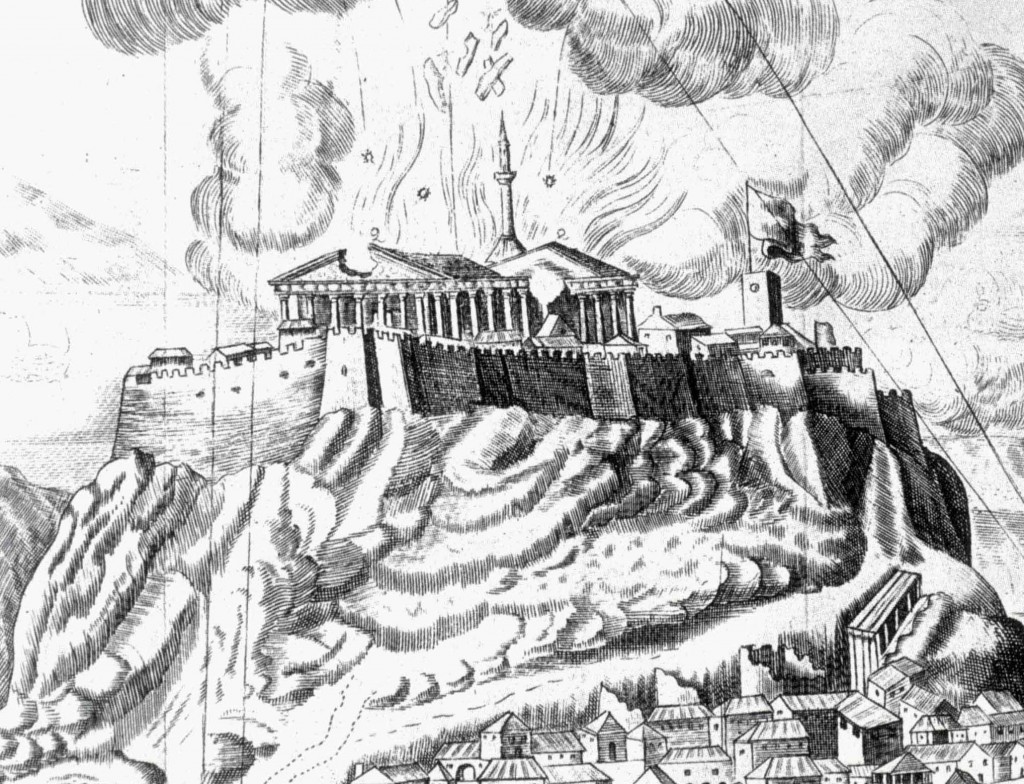
Then in 1687 came the Venetians and one Francesco Morosini. He lay siege to the Acropolis and began shelling it with mortar (shells not cement ….. yeah, ok). For some inexplicable reason the Turks were using the Parthenon as an ammunition store. A mortar shell landed directly on it and the whole lot exploded, killing around 350 Turks.

 Destruction-of-the-Parthenon-1687.

Exploding Parthenon – it’s never been the same since!

It’s not clear whether Morosini aimed at the Parthenon on purpose or it was (un)lucky shot. Presumably the Turks (naively) thought he would not fire on such an important building, but if he knew it was an ammunition store ……..well, what would you do in his shoes? Anyway, having taken the Parthenon, he tried to loot some of the sculptures and caused even more damage. The following year the Venetians left Athens and the Turks reoccupied the city. They built a small mosque within the ruins of the Parthenon and remained in power in Athens until Greek independence in 1832. The mosque was removed sometime after 1834, together with many other non-classical architecture on the Acropolis (an enthusiasm of classical Greece had taken hold by then).

 Parthenon 1715

Painting of mosque no 2 in the ruins of the Parthenon (c. 1715)

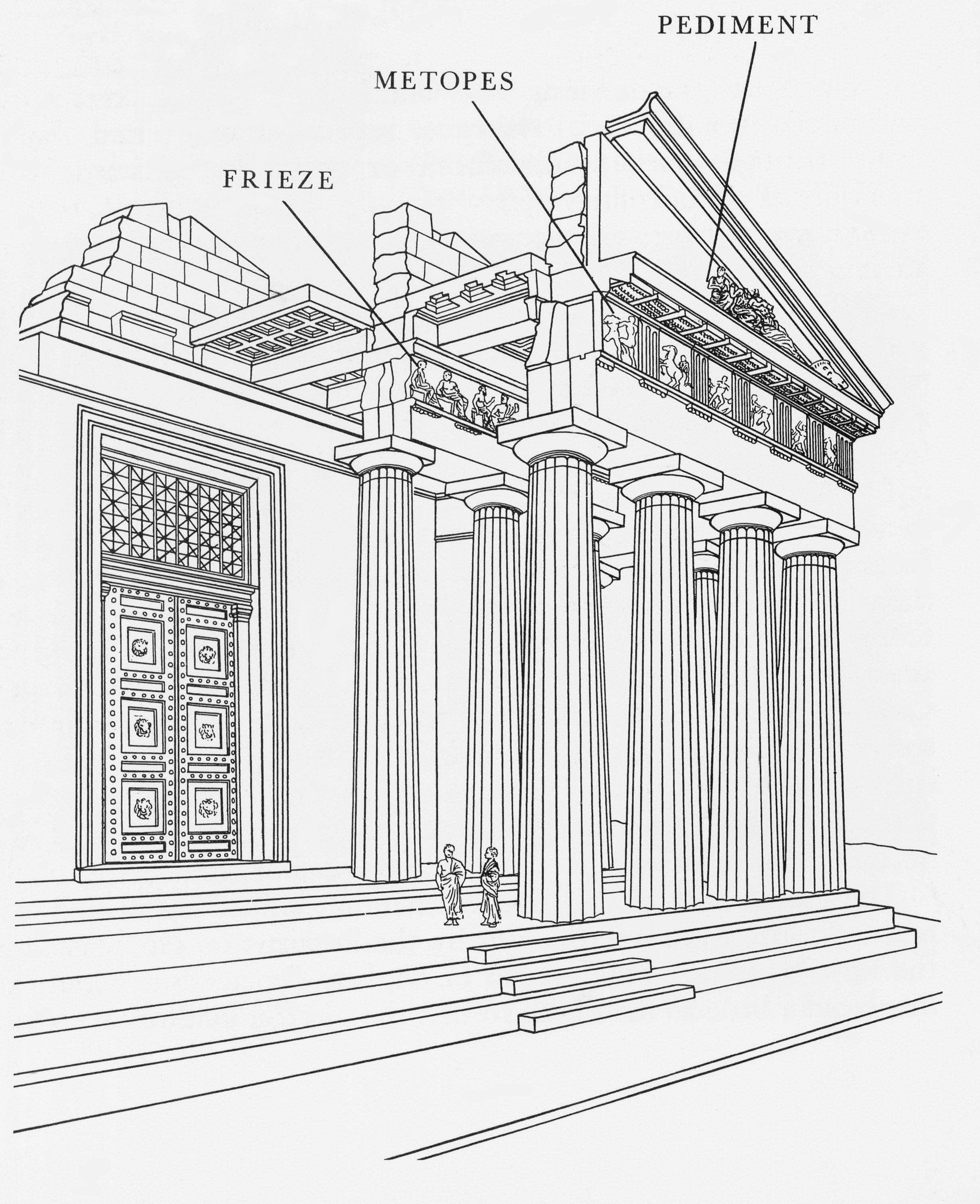
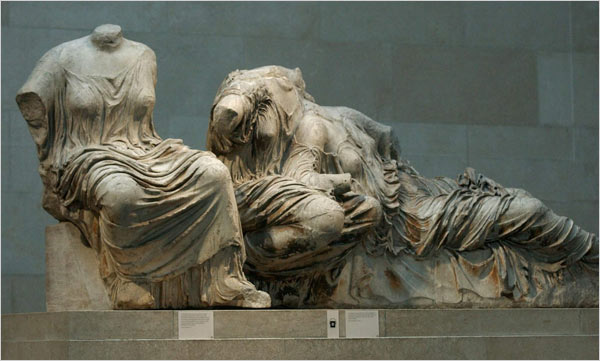
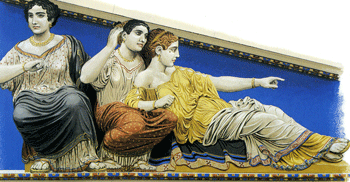
Prior to the Greek independence, in 1801 along came Lord Elgin with his dodgy firman (permission to draw the ruins and take casts). He decided to interpret the firman to allow him to remove sculptures (including those on the Parthenon from the east and west pediments, the high relief metopes around the outside, and the low relief frieze around the inside – see pic below). The Ottomans didn’t seem too bothered (not being very interested in ancient pagan worship) and no doubt money changed hands. The arguments will continue as to whether Elgin was right to do so. There is evidence that some remaining marbles did deteriorate being left unprotected, but it is doubtful whether that was Elgin’s real reason for removing what he did.

 parthn metopes etc

The different sculptures on the Parthenon 

pathenon 2

Example of female (goddesses) sculptures taken by Elgin from the east pediment

parth-ped-recon

Reconstruction of above sculptures – they would have been painted in colour

So, should the marbles be returned to Athens? Let’s not go there! Although I would say that my original thoughts were in the affirmative now Athens has its fabulous new museum. The problem is, where do you draw the line? Do we return everything to everyone? That wouldn’t leave much in our museums …….

parthenon at night

 Parthenon at night – pretty

.

Next week: Juries – a good thing or a bad thing?


Artemus Smith’s Notebooks

I continue my research of the notebooks of Dr Artemus Smith, archaeologist of great courage, determination and fiction. Here is another extract:

My good friend Archibald Lumbago was fairly depressed about the state of his farming business.  The Department of Employment (DoE) had heard that he was not paying proper wages to his helpers and sent one of its staff out to investigate him. He recounted the conversation to me:

“When the DoE chappie arrived he asked for a list of my employees and how much I pay them. I replied, ‘Well, there’s my farm hand who has been with me for 3 years. I pay him £200 a week plus free room and board.’ I continued, ‘Then there’s the mentally challenged worker. He works about 18 hours every day and does about 90% of all the work around here. He makes about £20 per week, pays his own room and board, and gets a bottle of whisky every Saturday night so he can cope with life.’

The DoE chappie said, ‘That’s the guy I want to talk to … the mentally challenged one.’

I replied, ‘That would be me.'”

art-smth

Wolf Hall, Anne Boleyn and all that

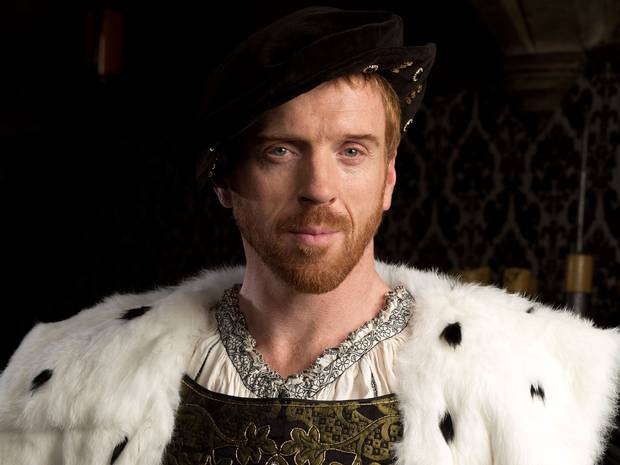
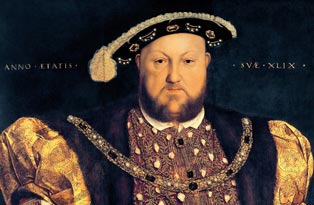
QUITE A FEW people have been following BBC’s Wolf Hall and it has received great reviews. I’ve read both books and found them most intriguing, but I was not sure how easy they would convert to TV – especially into just six episodes!  When I saw the first instalment  I think ‘rather slow’ came to my mind.  Also, Mark Rylance, I believe, is an undisputed great on the stage (and I’ve seen him there), but he appeared a little uncomfortable in front of the camera (or maybe that is how he thought Cromwell would be).  Saying that, he sort of reminds me of Michael Kitchen’s Foyle of Foyle’s War (and that’s a compliment – although it’s not exactly how I envisaged Cromwell). Then there’s Damian Lewis – yes, another fine actor and, although English himself, far too type-cast as an American to justify an impersonation of a king of England (in my opinion).  Despite that, and despite the fact that Henry the Large, Anne B, and Uncle Tom Cromwell and all have been somewhat flogged to death on the screen over the years, Wolf Hall still grabbed my attention.

Mark Rylance as Thomas Cromwell

Anyway, if I haven’t already alienated you with my opinion of the TV Prog/actors, and if you haven’t seen it yet and don’t want the plot ruined (well, not so much Wolf Hall plot, but the general Anne B intrigue), STOP READING NOW and return into hibernation.

damian-lewis

Damian Lewis as Henry USA style (okay, Eton then ….)

So who was to blame for Anne’s downfall in 1536?  Henry?  Cromwell? Or Anne herself?  The scriptwriters, in general, will have it down to Cromwell with much help from Anne.  A villain is always needed and Cromwell is convenient. Violence is also a need but that was already there – heads rolling around … but not with laughter.  All the film/TV makers now needed was the sex.  Enter adultery and incest . Yummy – money in the bank.  But did Anne really commit all those naughty acts? Who was really to blame for her demise?

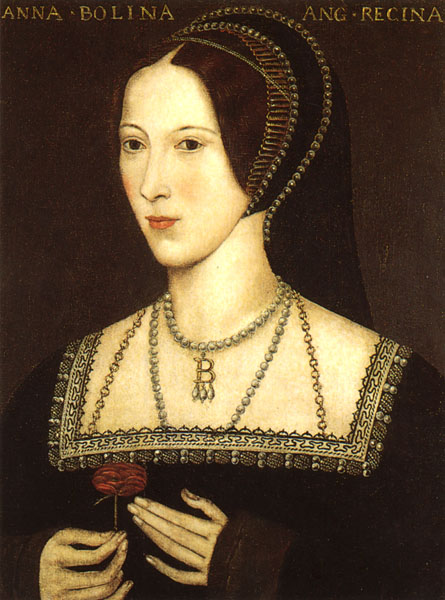
First, let’s blame Anne. She came from an ambitious family, notorious for scheming and so it was in her blood. She was clever – perhaps too clever – and ruthless, but not, I think, so much so to cross that line into incest with her brother, George.  The Countess of Worcester was accused of ‘hanky panky’ with courtiers and claimed she was no worse that the Queen (or words to that effect).  Then there was the overheard damning conversation with Sir Henry Norris in Queen Anne’s chamber. She had asked Norris why he hadn’t married and he replied he would wait awhile. Anne responded with, “You look for dead men’s shoes for if ought came to the king but good, you would look to have me.”  Treasonous words!!  But who reported hearing them?  Anne’s lady-in-waiting, Madge Shelton? Well, Norris was supposed to be courting her, so a woman scorned perhaps? Or maybe it was  the gossipy Lady Worcester diverting her own infidelities.  If Anne had been messing about with others she must have realised she was playing with fire – it just doesn’t add up.

Anneboleyn2

Anne Boleyn (1499-1536) complete with head 

So, let’s blame Henry.  Anne couldn’t give him the male heir he was so desperate for and he was nearly 45 years old and …. well, not that old, but was getting worried.  He had wasted some 24 years waiting in vain for Catherine of Aragon to do the noble ‘thing’. ‘Been there, done that’, he may have been thinking. He also had taken a fancy to one Jane Seymour (she of Wolf Hall in case you were wondering where the name came from) but that was nothing new and she would have been fine as a mistress one may think. So, how to rid himself of Anne?

One suggestion was that he accused her of witchcraft.  It was a Medieval theory that miscarriages only happened to evil women – women who committed adultery, incest or even witchcraft.  This was Anne’s second miscarriage (well, stillborn … and male) and Henry may have caught on to this Medieval bunkum and preferring the witchcraft route (adultery suggested he wasn’t ‘up to it’), he spread rumours that Anne had cast a spell on him to marry her so it was without his consent.  Yeah, right.  He was obviously hoping his Ecclesiastical court would wave a magic wand to relieve the spell with the magic words, “I divorce thee”. (Actually Canon Law in England at the time did not recognise divorce – both Henry’s ‘divorces’ were, in fact, annulments).

What is rather strange is that it has been reported that Henry and Anne appeared to be contented with each other a couple of weeks before her arrest. This may have meant Henry was faking it (contentment that is) or possibly implying some third party intervention……….

Henry

Henry the Ate (a lot)

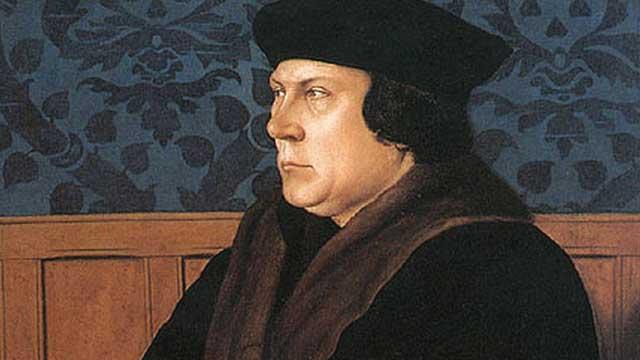
Okay, let’s blame Cromwell.  But why?  Well he has the villain’s black hat for a starters. But what had he to gain from the downfall of Anne?  In fact, if he was the instigator and he had failed, his head would have been on the block, as they say, literally (I know it was later but that was …… later).  He already had as much power as he needed and I don’t believe Anne was a threat to that.  Alternatively, was he simply told to compound evidence against Anne by Henry?  Cromwell took sick-leave for a couple of days (21-22 April) just after Anne’s miscarriage, and shortly after his return he had Mark Smeaton, the king’s musician, arrested for adultery with Anne. She was arrested just after that on the 2nd May.

thomas_cromwell

Thomas Cromwell (1485-1540) …. in villainous black hat

What is the conclusion then? We can never be sure, of course, but I’ll put my money on Henry commissioning Cromwell to find the evidence of adultery.  Henry needed to move on to seek his male heir elsewhere and quickly.  Jane Seymour was in the ‘right place at the right time’ (unless you were Jane Seymour – see footnote below).  I don’t think Cromwell wanted the job of bringing Anne down or to be in such an unenviable position, but he had to follow the king’s bidding. There is a letter he wrote to Eustace Chapuys, the ambassador of Charles V, ruler of the Holy Roman Empire, saying that he (Cromwell) had been commissioned by the king to conspire and think up the affair of Anne’s adultery. Cromwell duly obtained a confession of carnal cavorting with Anne from Smeaton (how, we don’t know – torture maybe ….. threat of several weeks of listening to the king sing perhaps?).

 chapuys

Eustace Chapuys (1490-1556)

Spoiler alert – if you don’t  want to know what happened TURN AWAY NOW:               Anne got the chop (yes, I knew you knew that).  Despite denials, two others were found guilty of ‘dallying’ with the Queen, Sir Francis Weston and Sir William Brereton, who, along with Norris and Anne’s brother, George, also went to the executioner. Everyone else lived happily ever after ….. well, not quite – in fact, nothing like.


POSTSCRIPT

The day Anne was executed, Henry was out riding with Jane Seymour. You can imagine the conversation:

Seymour: “How has your morning been my Lord?”

Henry:  “Such turmoil. First I lost my cod-piece; then I lost my wallet; oh, and my wife lost her head.”

Two weeks after Anne’s departure, Henry married wife number three, Seymour … and then they all live happily ever after. Well, no. Mind you, what was Jane Seymour thinking?  Henry’s first marriage with Cathy of Aragon had been annulled against all odds and she died in January 1836. Henry’s second wife, Anne, died four months later.  Was this a ‘Jonah marriage’ or what?  Indeed, Jane died in October the following year (having dutifully produced the required male heir, Edward [VI to be, albeit briefly]).  But still there were game young fillies out there prepared to marry Henry the Unlucky (three of them anyway). It all reminds me of Nat King Cole’s  song, ‘Let’s Face the Music and Dance’ which would have been more appropriate for Henry to have composed, particularly with its very first line, ‘There may trouble ahead’.

.

Next week: The Parthenon at Athens – now and then


Artemus Smith’s Notebooks

I continue my research of the notebooks of Dr Artemus Smith, archaeologist of great courage, determination and fiction. Here is another extract:

I heard of an arrangement my good friend, Rev. Arbuthnot Smythe-Harcourt, had had with his son. The boy had just passed his driving test and inquired of his father as to when they could discuss his use of the family car.
His father said he’d make a deal: “You bring your grades up from a C to a B average, study your Bible a little, and get your hair cut. Then we’ll talk about the car.”
The boy thought about that for a moment, decided he’d settle for the offer, and they agreed upon it.
After about six weeks his father said, “Son, you’ve brought your grades up and I have observed that you have been studying your Bible, but I’m disappointed you have not had your hair cut.”
The boy said, “You know, Dad, I’ve been thinking about that, and I’ve noticed in my studies of the Bible that Samson had long hair, John the Baptist had long hair, Moses had long hair… and there is even strong evidence that Jesus had long hair.”
His father thought for a minute and then replied:
“Did you also notice that they all walked everywhere they went?”

art-smth


.

Thomas Spratt – antiquarian traveller to Crete

LAST WEEK I introduced you to Robert Pashley who had been sent to investigate antiquities in Crete by Francis Beaufort in 1834. On Pashley’s return to England, Beaufort was worried how to replace him. On the 1st October 1834, he wrote to Richard Copeland, who commanded the ship, HMS Beacon, on which Pashley had travelled to Crete, saying:

“My endeavours to get a proper person to succeed Mr Pashley have not yet succeeded – but I trust that before Spring you will be joined with some one with equal zeal and learning – I do not believe it would be easy to find anyone who could exceed Mr P in these qualities.”

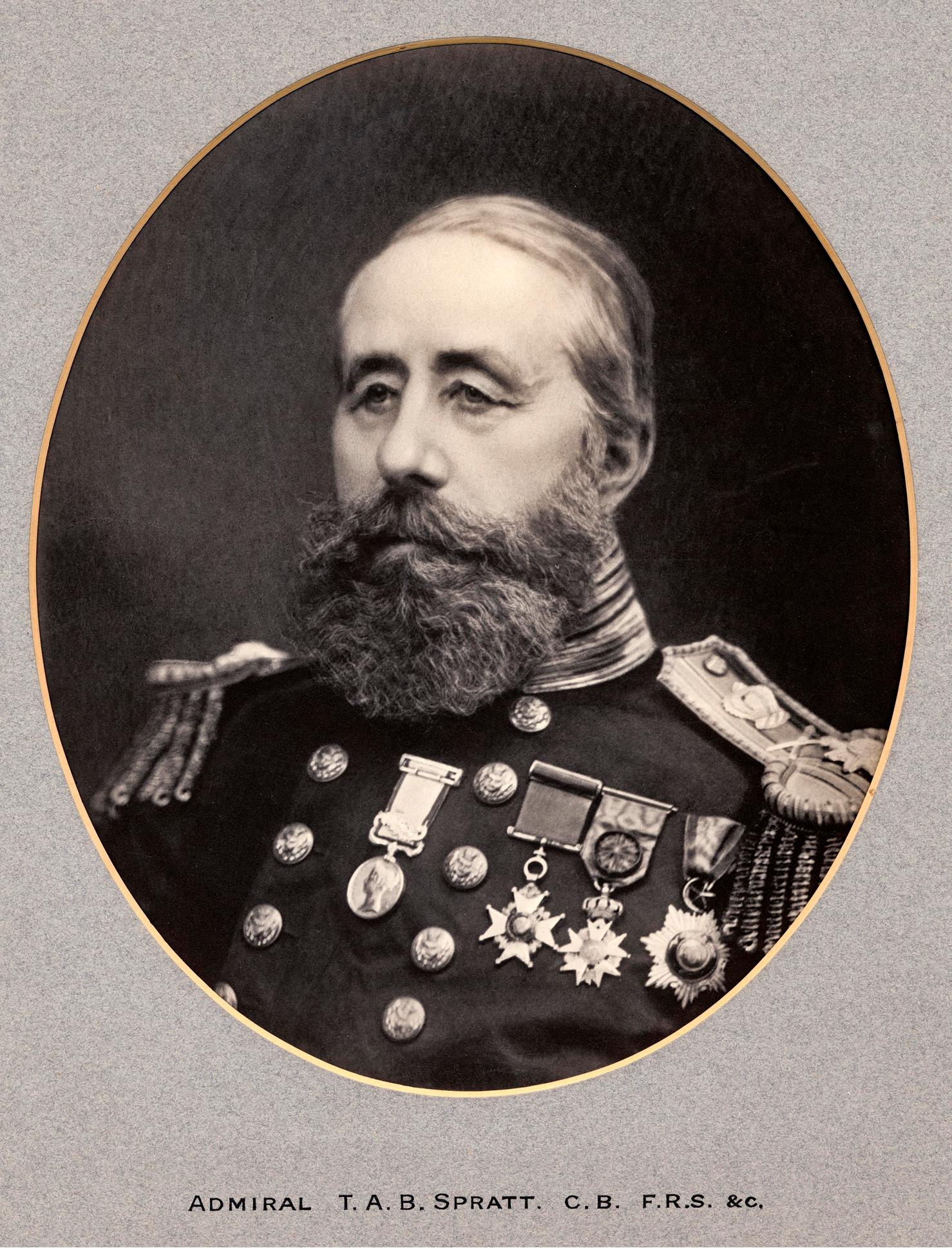
Well, he had to wait awhile (17 years in fact) but that replacement came in the guise of Thomas Able Brimage Spratt who was a Royal Naval hydrographer. In the introduction of his book, Travels and Researches in Crete (1865), he commented that he was there to survey but also to collect reliable information regarding ancient cities, many of which were yet undiscovered and this would be of importance to the island’s geography and topography. As with Pashley, I’m just going to reveal interesting correspondence and ancillary facts around his travels; if you want more, read my book Dawn of Discovery (or check one of my blogs in June which featured Spratt in Crete, ‘The island that tipped’).
Picture5

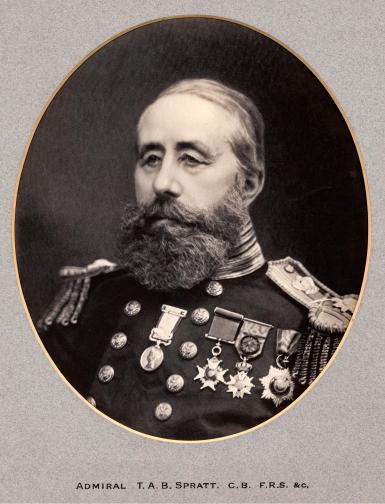
 Thomas Abel Brimage Spratt RN (1811-1888)

Last week I made mention of one Lt Thomas Graves surveying in the Mediterranean (Beaufort had written to him about Pashley). Well, Graves’ midshipman on that trip was none other than Thomas Spratt. In fact, in 1836, Spratt was appointed to HMS Beacon, under Graves, the very same ship that Pashley had sailed to Crete on under Richard Copeland two years before (small world, eh?).

Spratt’s relationship with Francis Beaufort did not run smoothly at first as Spratt, when back in England, obviously failed to attend Beaufort with a report of Graves’ activities in the Mediterranean. Beaufort wrote to Graves (19th January 1848):

“Sir, I hoped that ‘ere this Spratt would have made an appearance in this room, and have furnished me with matter about which I should have to write to you – that not being the case I have only to express a hope that he will bring me a large harvest of your usually excellent work.”

However, he must have impressed Beaufort somewhere along the line as, in May 1851, he was sent to Malta and given command of his own ship, the paddle steamer HMS Spitfire, with instructions to continue Graves’ survey of Crete. Beaufort wrote to him confirming his daily (diem) pay (12th May 1851):

“With reference to the future survey pay of yourself and assistant surveyors, I hereby authorise you to draw on the Accountant General the undermentioned sums, to commence from the date of your arrival at Malta

Cmmdr TAB Spratt – 20s per diem   [£365 a year]

Lieut AL Mansell –  8/   – do –   [£146 a year]

Mr John Stokes – Master –  5/   – do –   [£91.25 a year]

GB Wilkinson – Mids –  5/    – do –   [£91.25 a year]”
spitfire

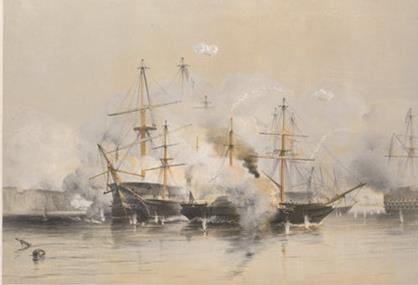
HMS Spitfire in foreground in Crimea War 1854 (my thanks to Steve Thorp for this)

From Malta, on the 30th May 1851, Graves reported (without punctuation) Spratt’s arrival to Beaufort adding his disapproval of the Spitfire and general conditions (in a later letter Graves referred to the ship as HMS Spiteful):

“Spratt has arrived with his staff but as he has I know reported progress I will say nothing more about his establishment to whom I will give every assistance and information in my power than that his “Spitfire” is the worst miserable time out I ever beheld and that with all my love for hydrographical pursuits I am only too glad to be clear of and unconnected with the petty economy and annoyances surveyors are now subject to.”
gems

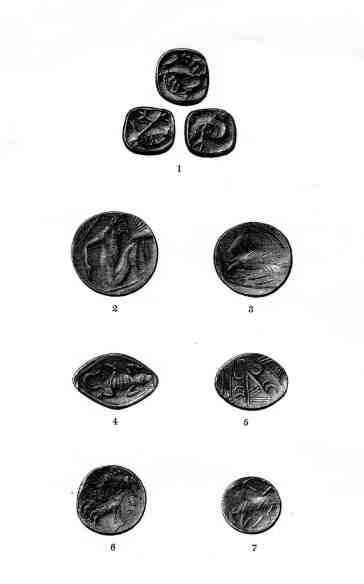
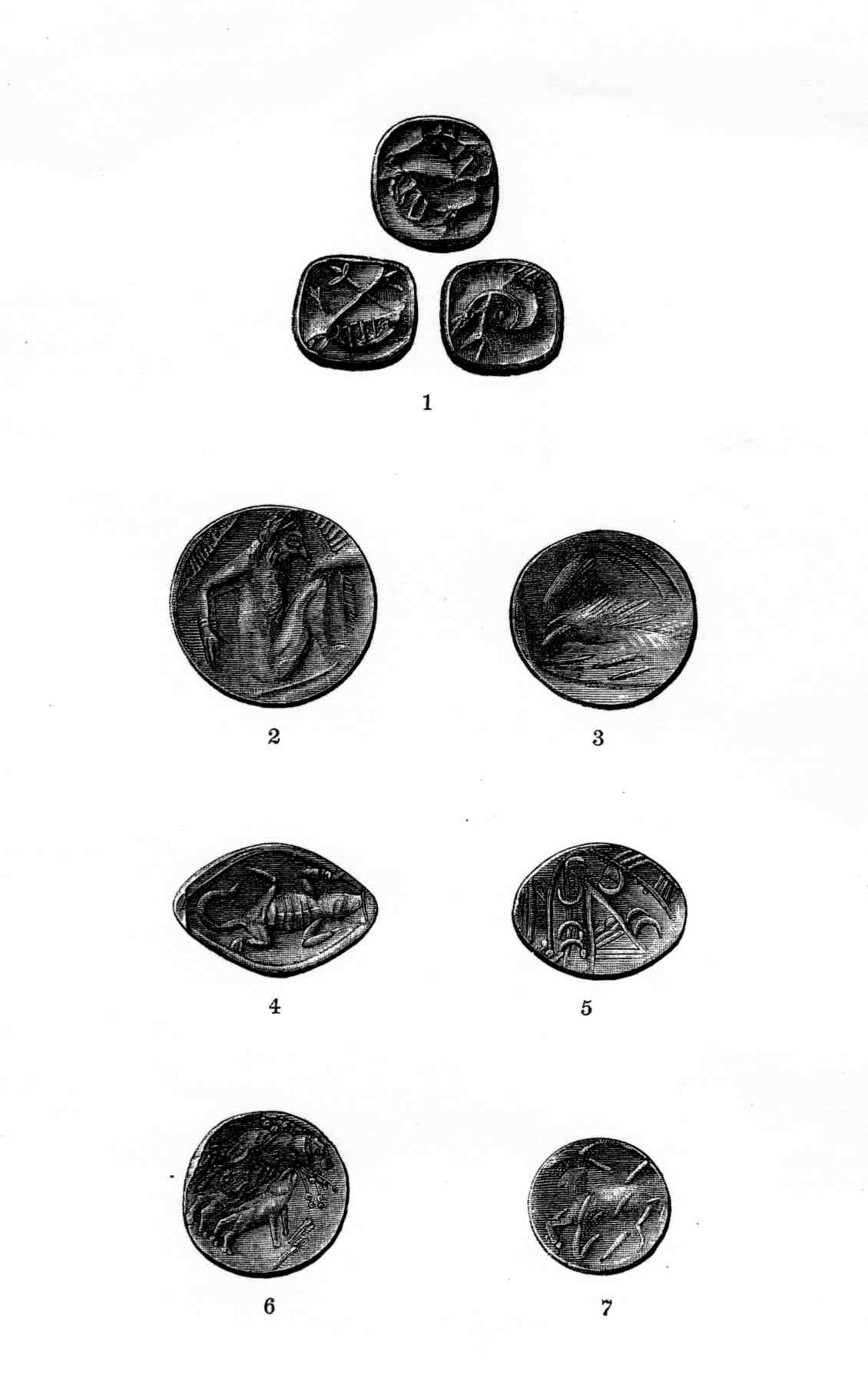
‘Minoan’ seal-stones found by Spratt in Crete between 1851-3 – some 40 years before Arthur Evans found similar Cretan seal-stones in Athens which led him on his quest and discovery of ancient Minoan Crete

On 7th July 1851, Beaufort instructed to Spratt to proceed to Crete to search out antiquities, he reminded him to read Pashley’s book:

“I have no doubt you will rapidly go on – but not too rapidly to do full justice to your work. I am a great admirer of zealous & eager workman, but still more [admiration] of those who leave nothing for subsequent workman to glean … Do not forget all I said to you about variations on shore & on board – Pick up inscriptions and antiquities – Read Mr Pashley as you go along the coast …”

On the 4th December 1851, Beaufort wrote to Pashley sending him a copy of a letter from Spratt reporting on Crete and asked what Spratt should look out for on the island. Beaufort then wrote to Spratt on the 19th December, not really giving Pashley much time to respond, saying, “I sent your letter of Oct 15 to Mr Pashley who is I suppose out of town as he has not replied nor returned it [Spratt’s letter].” In the end Pashley did not reply until 20th May the following year which clearly upset Beaufort as he wrote to Spratt on the 8th June 1852, “I have just retrieved from Mr Pashley’s hand your letter of Oct but without any remarks wh[ich] could be of use to you or wh[ich] cd[could] alone to me for the wanton rudeness of not answering my note for 6 months …”. What Beaufort failed to mention to Spratt was that Pashley did say in his reply (to Beaufort, 20th May), albeit somewhat late, that his papers had been destroyed by fire in Inner Temple (Pashley was a barrister – remember?).
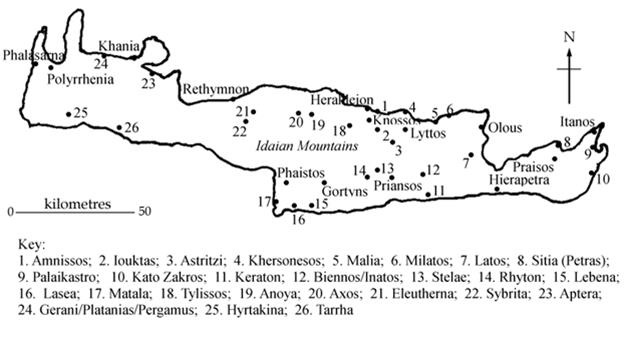
spratt map

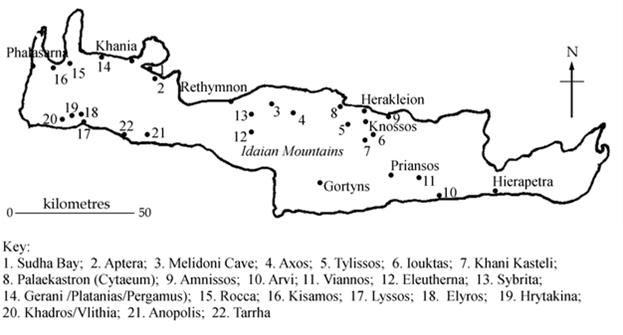
Ancient sites visited by Spratt in Crete

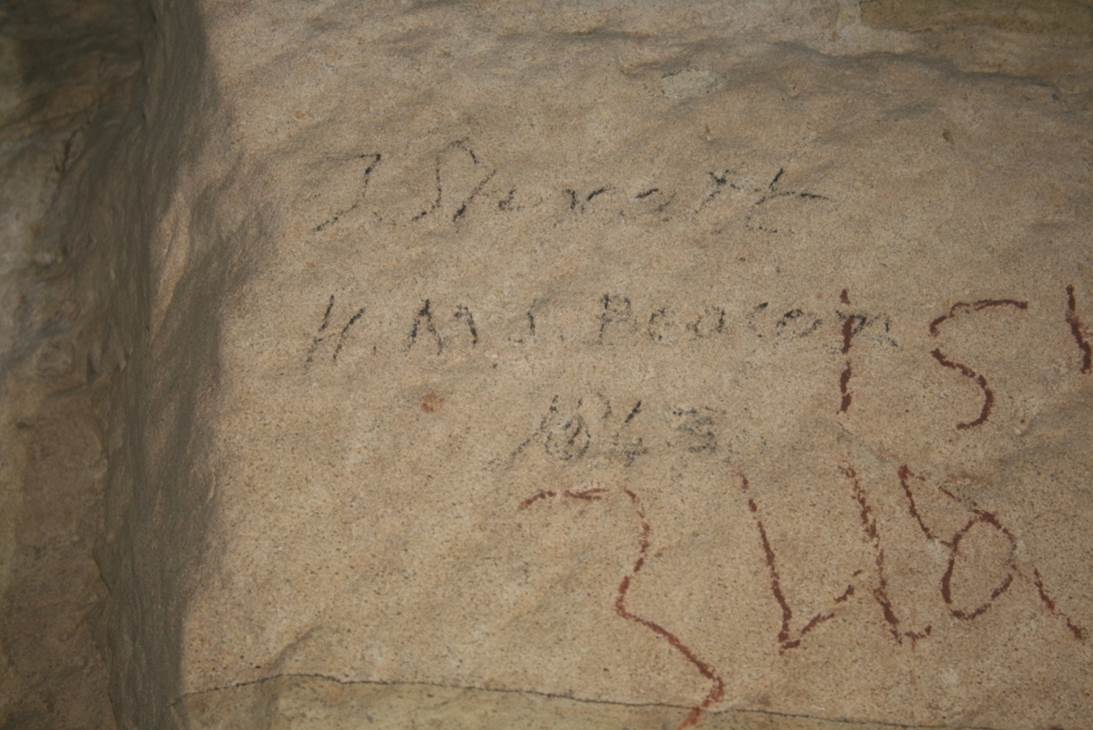
Okay, I know I said I wasn’t going to refer to what Spratt saw in Crete, but just one exception – mainly because I’ve mentioned it before (another blog in June ‘The Labyrinth of Crete’). Spratt visited the labyrinth near Gortyns in 1843, during his first trip to the island. We know this because in true schoolboy fashion he ‘graffitied’ his name on the cave wall.
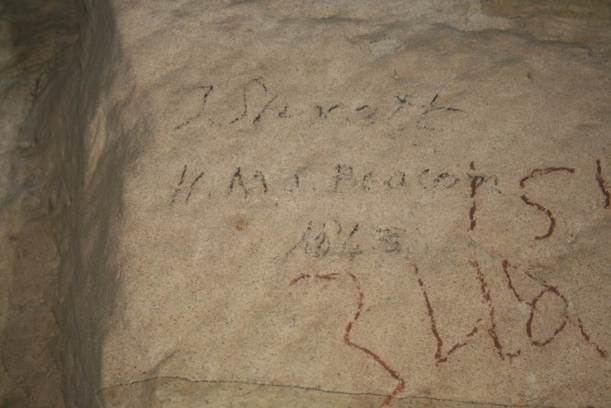
graffitiSpratt’s graffiti in the labyrinth: T Spratt, HMS Beacon, 1843

On his second visit(1851) he went in search of what he actually believed might have been the ‘mythical’ labyrinth of King Minos. He looked to the ridge on the east side of the Makryteichos (Makriteikron/Makroteikho) village, over the rivulet of the Kairatos river just east of Knossos, and reported:

“… that [Makryteichos hills] is said by the natives to be the entrance to extensive catacombs, which, however, have become choked up by falling in of its sides, and cannot be explored … This entrance to the supposed Labyrinth or Catacombs of Gnossos has the same character as that of the entrance to the Labyrinth of Gortyna, excepting that the Gnossian excavations have been used as sepulchres, but whether originally or subsequently to Minos cannot be determined so as to identify it as the true Labyrinth, of which the tradition only existed for twenty-five centuries.”

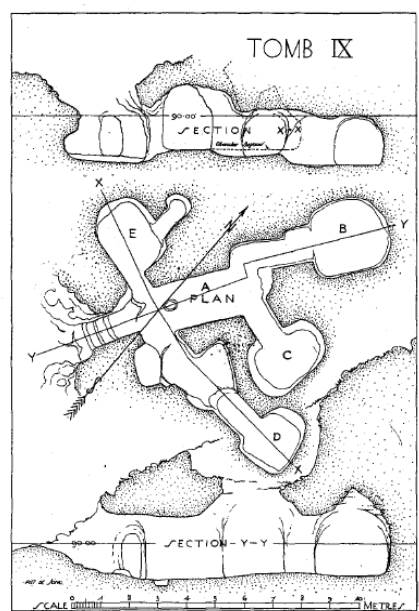
It is not entirely clear what he was looking at but it is most likely the ‘labyrinthian’ tomb in the Mavro Spilio (black cave) cemetery, Tomb IX.
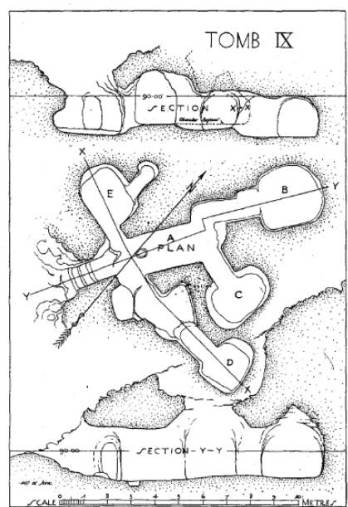
mavro

Tomb IX, Mavro Spilio cemetry

Spratt remained in Crete on the second visit from 1851 to summer of 1853 when he was recalled to take part in the Crimean War. He returned to Crete on HMS Medina to complete his investigations in July 1859.
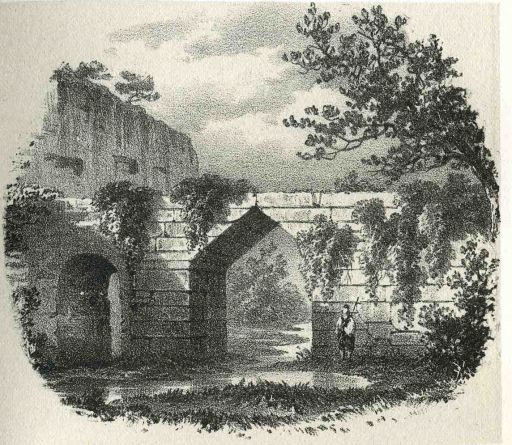
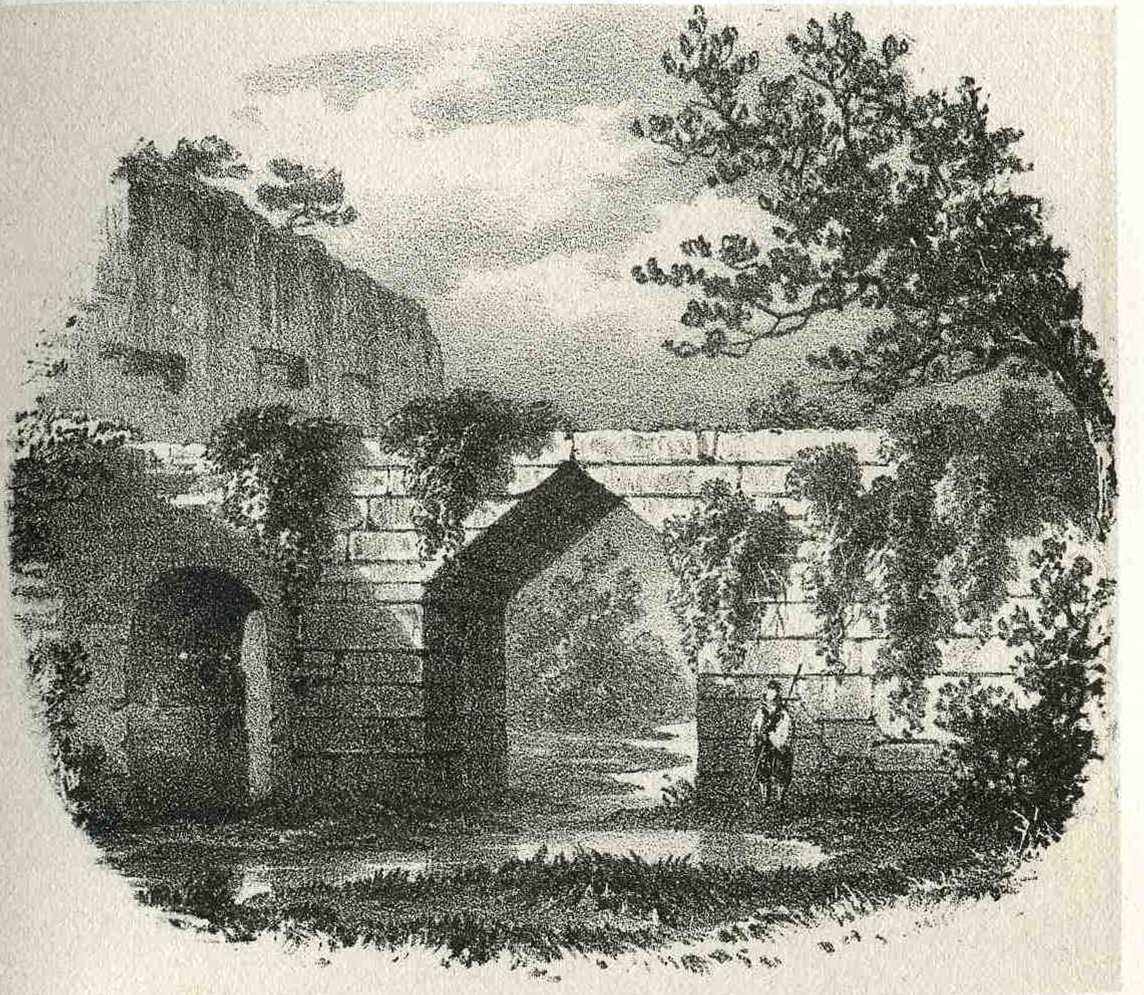
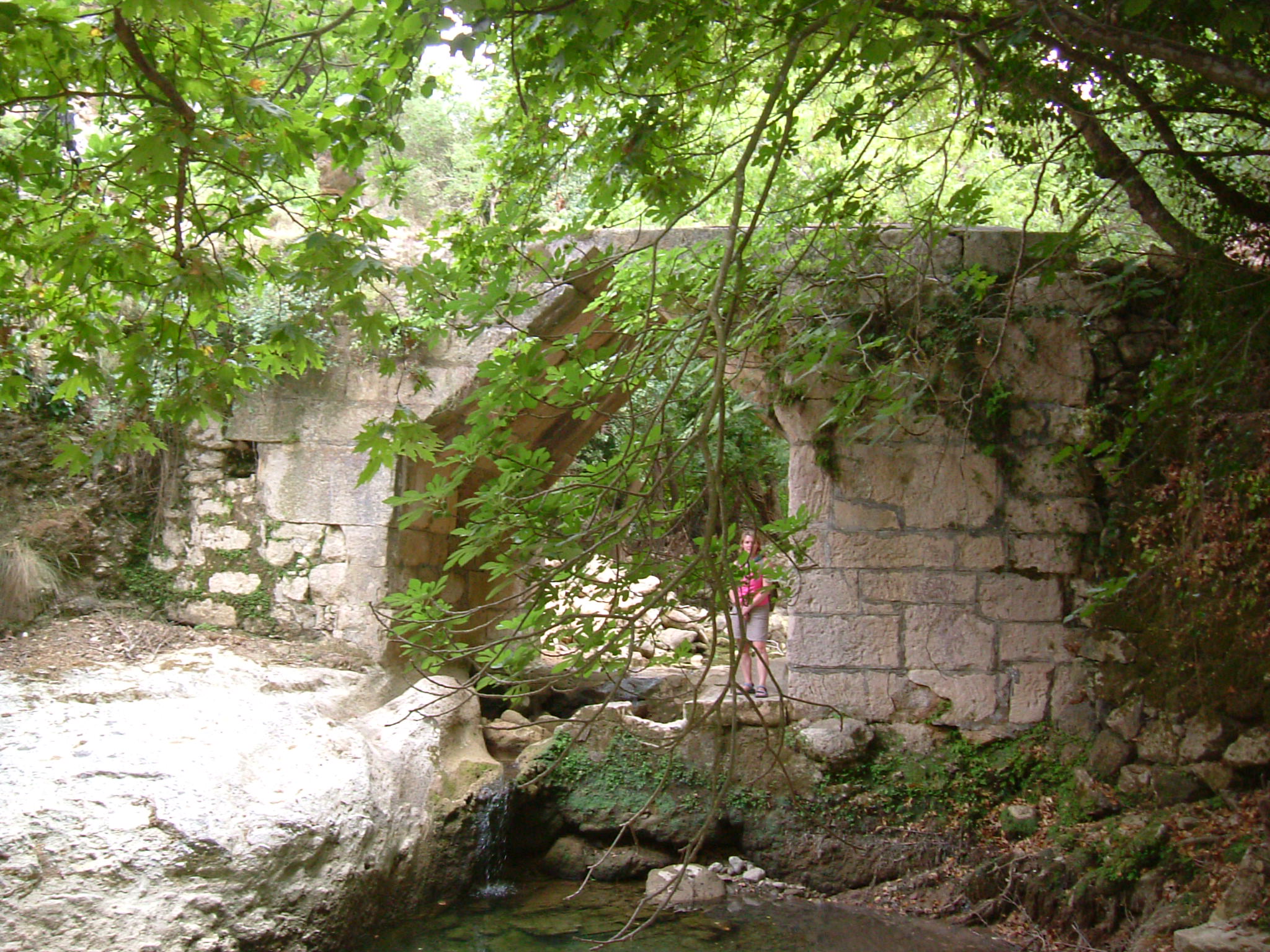
bridge3

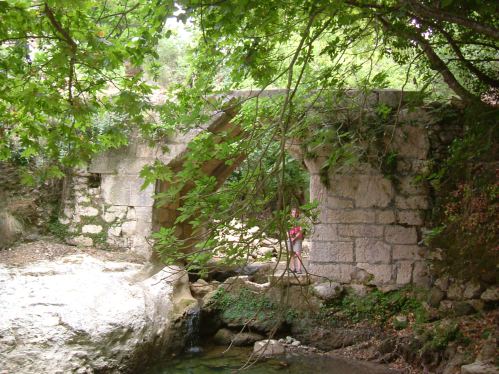
Spratt’s drawing of the Hellenistic (4th century BC) bridge at Eleutherna, Crete
bridge2

The bridge today (well, 2007) – the circular arch drawn by Spratt has been filled in (to the left) – the tree is still there and growing! (I put these pictures in as a matter of triumph because I set out to find this bridge in summer 2006 but didn’t succeed until summer 2007 – now, through much woodland, it’s a long way from anywhere and in the middle of nowhere)

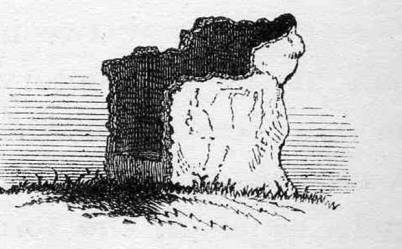
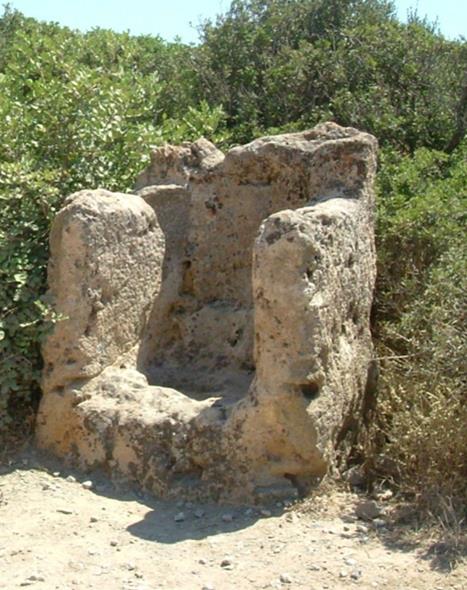
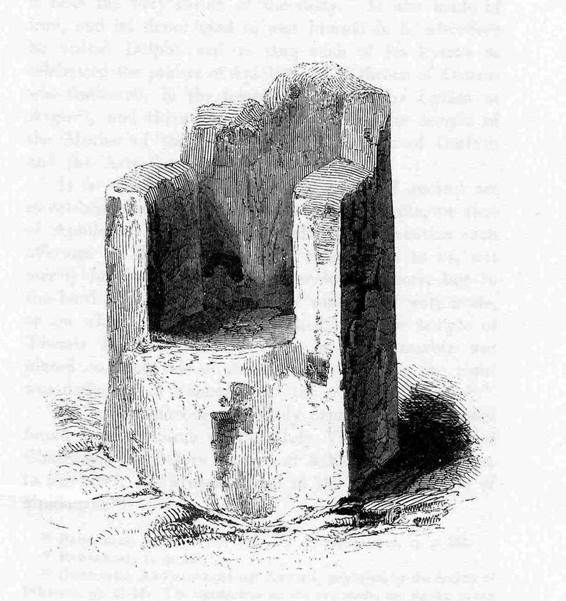
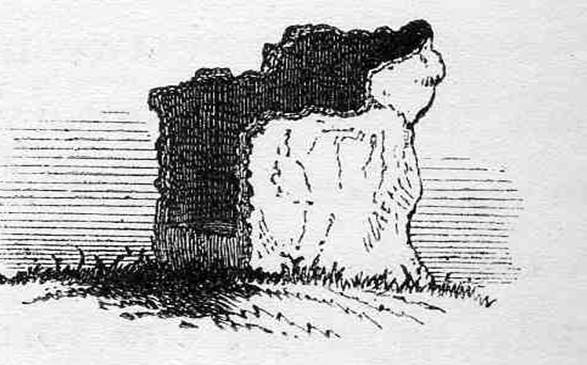
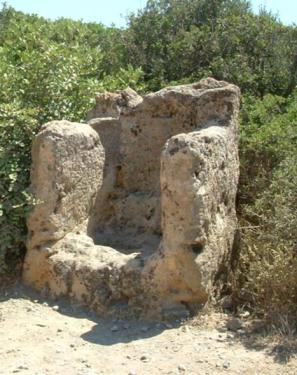
Oh, just one more exception of what Spratt saw in Crete – the ‘bema’ at Phalasarna, on the west coast. Not quite sure what it is but it’s just outside the harbour area, so perhaps a guard post. Immediately below is a photo of what it looks like now; below that is Pashley’s drawing of it; and below that is Spratt’s drawing of it. I include these because Spratt’s comment of Pashley’s effort amuses me. He said, “‘Pashley’s drawing was not a true representation of what it was like”. Well, I’m no art critique but what do you think?
thrne1

The bema (scale: about 1.5m high)

thrne

Pashley’s drawing of it

thrne 3

Spratt’s drawing of it ….. more of a true representation?!!

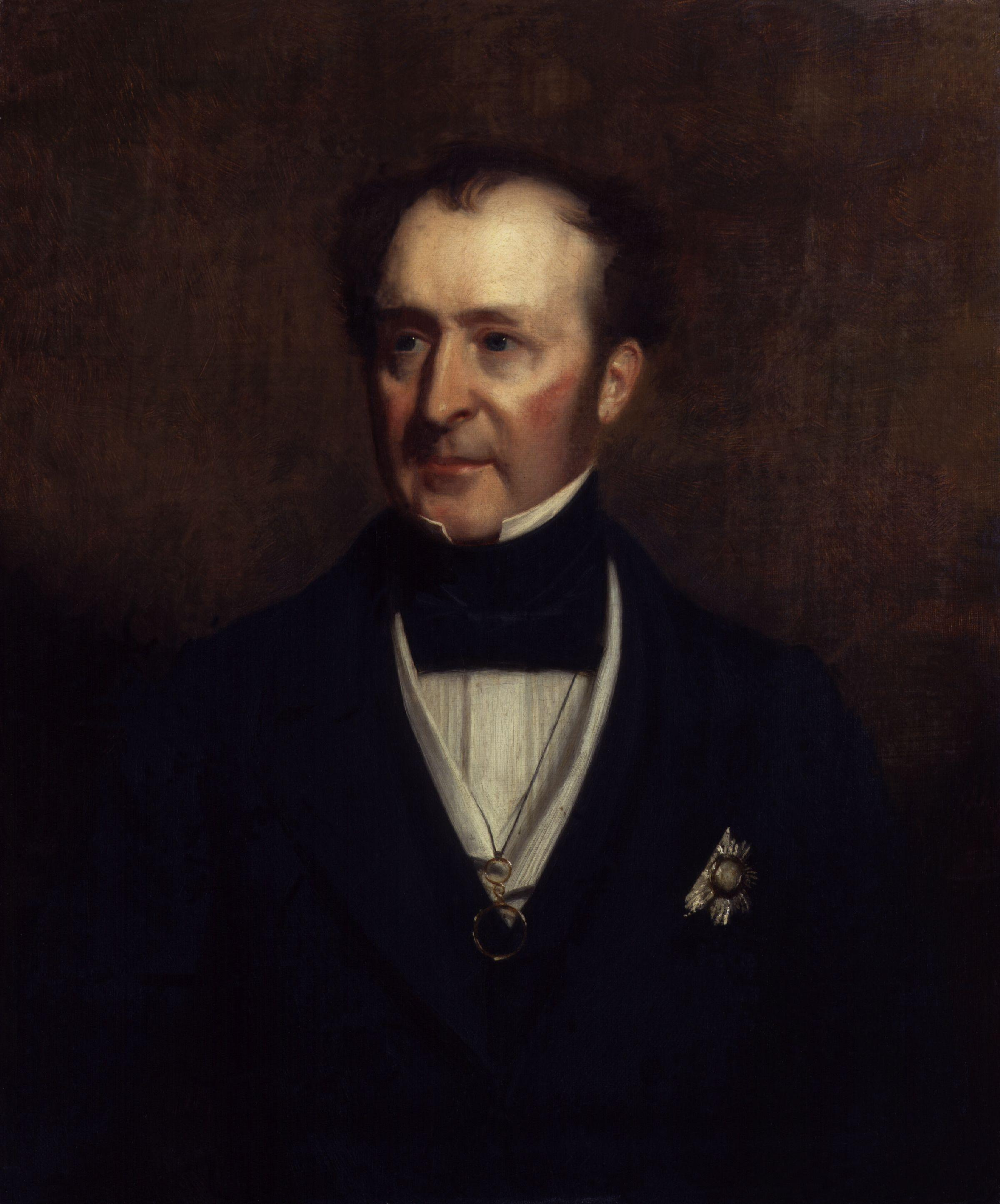
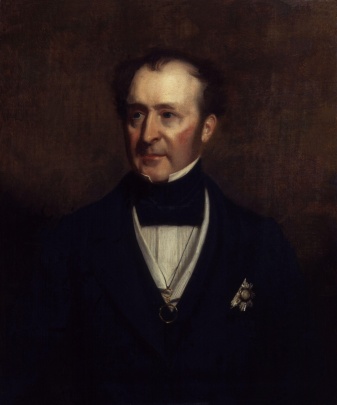
Finally, Sir Roderick Murchison, in an address to the Royal Geographical Society, said of Spratt’s book on his travels in Crete:

The Travels and Researches in the Island of Crete by Captain T.A.B. Spratt, RN., is a work which will rivet the attention and enrich the minds of various readers, whether they be antiquaries and scholars, or geographers and men of the sciences … for here we see produced by one of them [Royal Naval surveyors] a masterly illustration of the physical geography, geology, archaeology, natural history, and scenery of the diversified Island of Crete.”
Sir_Roderick_Impey_Murchison,

Sir Roderick Murchison (1792-1871)


Postscript 1: I came across an article written in Lippincott’s Magazine in 1878 by E.S., an otherwise unnamed English naval officer, regarding his journey from Crete to Smyrna and Ephesus. It is not known whether Spratt had read this but he was certainly alive when it was written so it is possible. If he had it would have been interesting to have witnessed his reaction to the officer’s comment albeit of Roman Ephesus:

“It is rather a difficult thing to acknowledge, in face of the great ruins then about us, with all their associations, that the thought of our dinner was by this time uppermost in the minds of nearly all our company. I have generally found, however, in much journeying about this wicked world, the condescension and interest with which one looks upon ancient remains depends very much upon the company in which one finds one’s self, the state of the weather and the state of one’s stomach.”


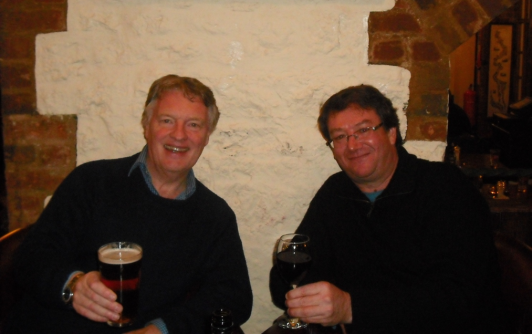
Postscript 2: I received an email from a chap who had found my work on Spratt via the internet. He was over from Australia for a year and studying at Oxford University. I got in touch with him and we meet up in Oxford in November 2010. His name was Michael Spratt, great great grandson of Thomas. More recently Steve Thorp contacted me (also from Aus) and referred me to the above pic of the Spitfire and informed me that his ‘many greats grandfather’ was Spratt’s 1st Lieutenant in the Crimea (great stuff the internet!).
Picture7

 Me and Michael Spratt (right)

.

Next week: Wolf Hall, Anne Bolelyn and all that


Artemus Smith’s Notebooks

I continue my research of the notebooks of Dr Artemus Smith, archaeologist of great courage, determination and fiction. Here is another extract:

I always remember my first day at my new office at the University. I sat there with absolutely nothing to occupy my time. There was a knock at my door. “Enter” I said, and I grabbed the telephone and began speaking into it to pretend to my visitor I was a busy and important man. As I spoke into the phone I beckoned the visitor to sit and he did so. I continued my conversational charade over the phone for a couple of minutes ‘discussing’ a fictitious oncoming project. When I had decided I had suitably impressed my visitor with this fake conversation, I put the telephone down, greeted him, and enquired as to the purpose of his visit.   He replied in a casual manner, “I’ve come to connect your phone.”
art-smth

Robert Pashley – antiquarian traveller to Crete

ROBERT PASHLEY (1805-1859) was a barrister of Lincoln’s Inn and Inner Temple but became an intrepid traveller of Crete in 1834. This is not a ‘blow by blow’ account of his travels around the island (you can find that in my book Dawn of Discovery), but more of a look at how Pashley came to be there and the supporting correspondence.

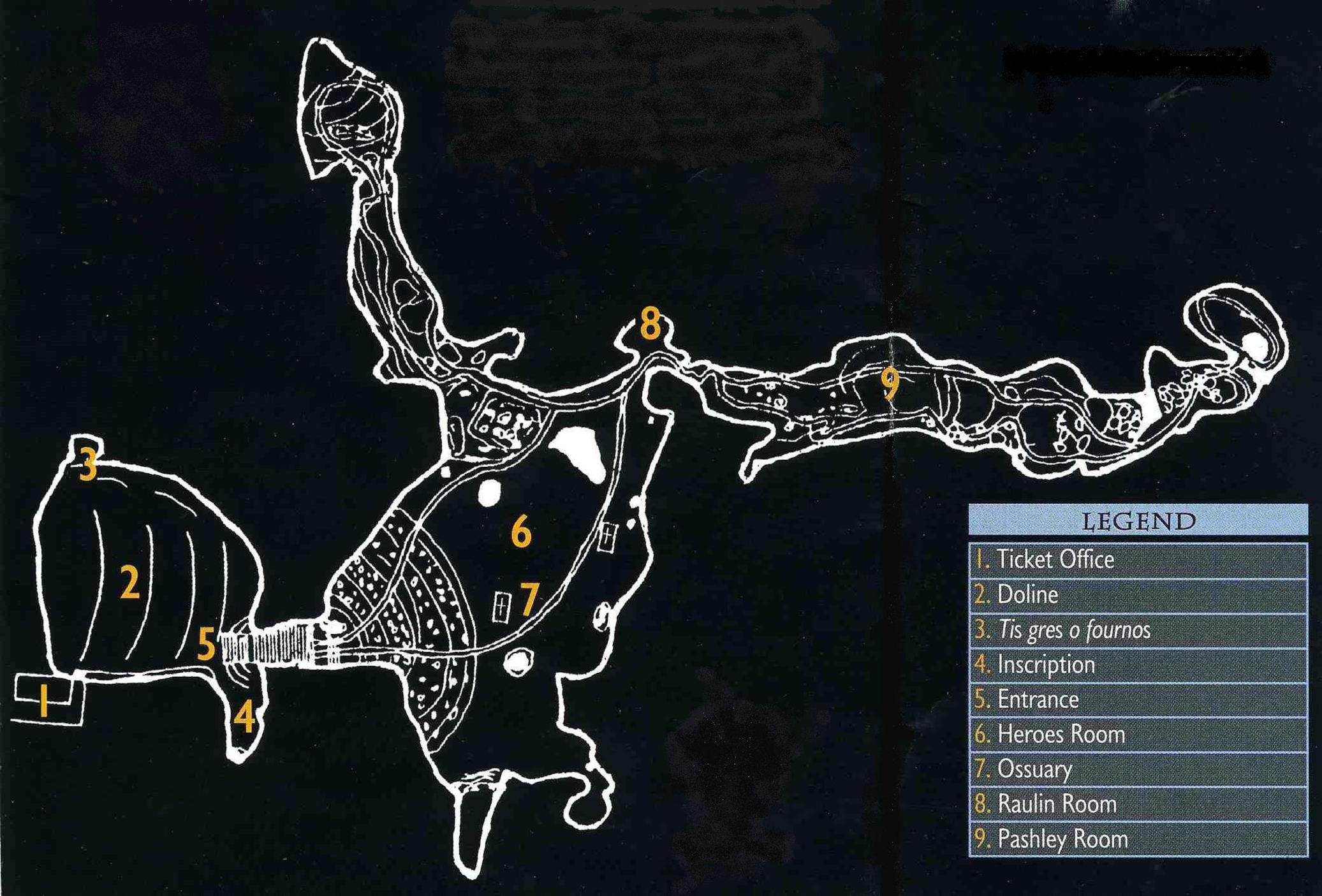
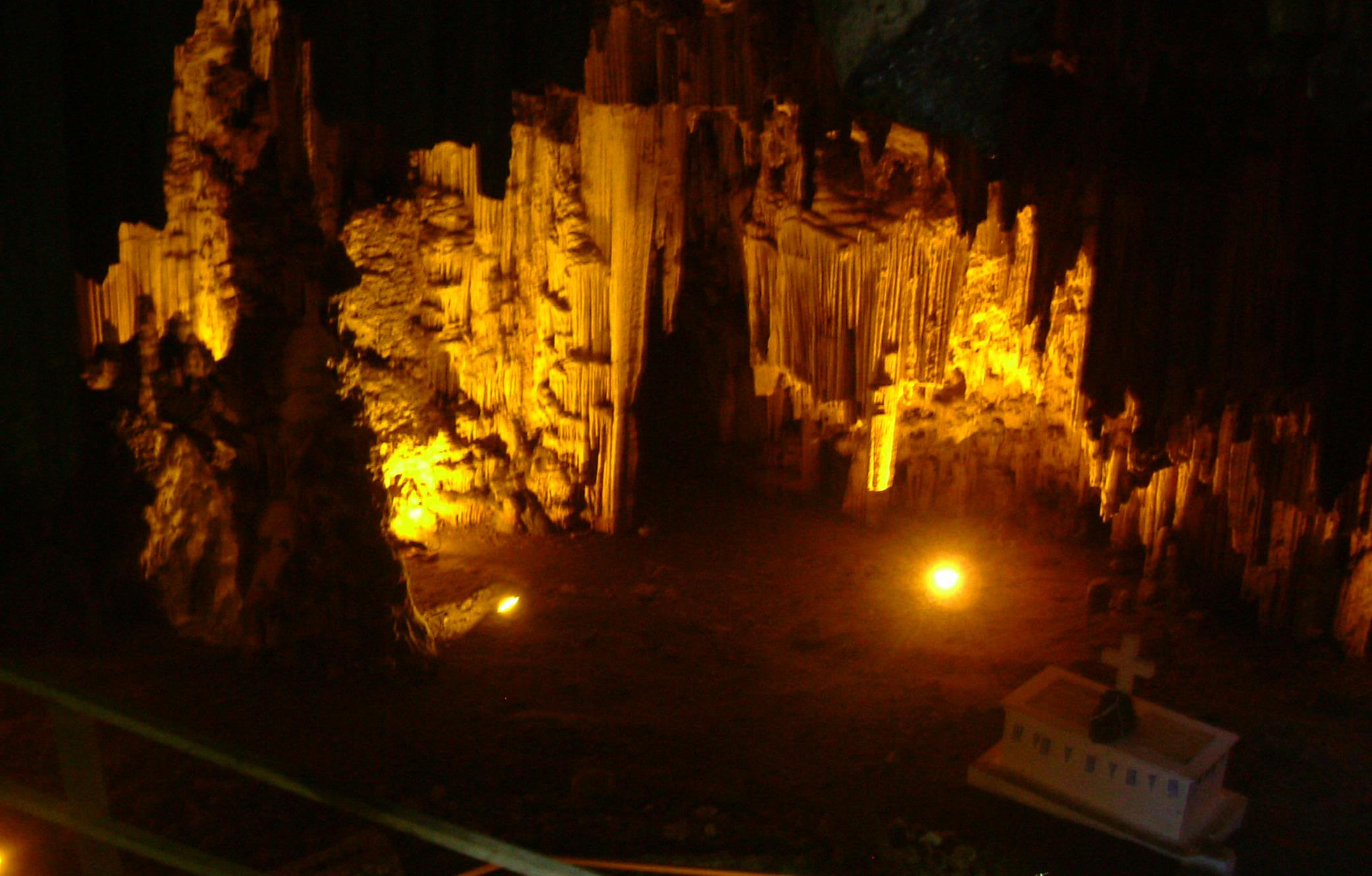
In saying that, I would just mention that one of the most interesting places he encountered was the Melidoni (Melidhoni) cave wherein a room which he discovered was named after him (see pics further below). During the 1824 Revolution against the Turks, following a three month siege of the cave, some 250 unarmed villagers, including women and children, were suffocated when the entrance was sealed and fires, lit by the Turks, thrown in to the cave. It was not until Pashley visited the cave in 1834, did Manolis Kirmizakis, the only survivor of the events, inspect it and discover the bones of the martyrs. They were put in a large sarcophagus which is in the cave today and defines the independent Cretan character. Later finds in the cave gave evidence to its usage for worship by the ‘Minoans’ of Bronze Age Crete (2100-1600 BC – see my very last paragraph below).

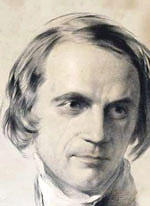
I’ve not been able to find an image of Pashley but below could be a sketch of him from his own book, Travels in Crete (1837), most likely by his companion and illustrator, Antonio Schranz, but not acknowledged.

pashPossibly Pashley (on the right)

Despite the work of Richard Pococke (see last blog), prior to Pashley, Crete had no known ancient historical ancestry and the historian, Sir Moses Finley, said of Pashley:

“The first important breakthrough [in Crete] was made in 1834 by a young man from Trinity College, Cambridge, named Robert Pashley … he joined that remarkable constellation of nineteenth-century British explorers and archaeologists who were opening up vast new and exotic fields of inquiry … a modern expert could say of his seven-odd months work [in Crete] that Pashley identified most of the important sites with accuracy which had never before been attained and has in few cases since been challenged.”

 Moses-I-Finley_5346

Sir Moses Finley (1912-1986)

The Royal Naval hydrographer, Captain (later Rear Admiral) Francis Beaufort (of the ‘Beaufort Scale’) was keen to investigate the ancient antiquities of the Aegean and was fully supportive of any persons wishing to join a ship for the purpose of antiquarian research. It was Beaufort who proposed Pashley for such a venture in Crete.

beauft

Sir Francis Beaufort (1774-1857)

On the 18th July 1832, Beaufort wrote to Captain Richard Copeland of HMS Beacon, prior to the latter’s departure for a hydrographic survey of the eastern Mediterranean, enquiring:

“Would you like to have a classical traveller in the Beacon to hunt for antiquities while engaged on the coast of Asia Minor? I have no one in my eye nor do I know whether their Lordships [at the Admiralty] would permit it but before I ask them or enquire at the universities I wished to ascertain your candid opinion of the utility of the scheme, and still more your personal feeling about it.”

Copeland obviously agreed as Beaufort wrote to him again (26th July 1832), “I am much pleased that you approve of the idea of having a savant to accompany to you.” In fact Pashley was not Beaufort’s first choice as he added in his letter to Copeland, “… and I will take care that none but a 1st rate man, and gentleman, [be] sent out. There is somewhere in Italy the son of the Master of Trinity College Camb[ridge] who I understand would likely to jump at such an offer.”  The man he had in mind was the son of Christopher Wordsworth brother of the poet). It is not clear which son, John, Charles or Christopher Jr., he was thinking of but none of them did ‘jump at such an offer’. (As the letter was written in July 1832, Beaufort was most likely referring to Christopher Jr as he was in Greece between 1832-33, whereas John and Charles did not travel to Europe until 1833).

CWordsworthA-sm

Christopher Wordsworth Jr (1807-1885)

Sir John Barrow, Second Secretary of the Admiralty, wrote to Pashley in December 1832 informing him that their Lordships of the Admiralty had approved him to investigate “the antiquities, the geology and the botany at the parts of the Coast of Asia Minor and Greece on which he [Copeland] may be employed surveying.” The Admiralty obviously got the idea that Pashley was a geologist or naturalist from Beaufort who was covering his options. Beaufort informed Copeland of Pashley’s appointment (17th December 1832):

“I have at last the great pleasure of introducing Mr Pashley to you – he is a Fellow of Trinity College Cambridge – not only a distinguished scholar, but imbued with a proper zeal for antiquity hunting. That zeal will I am quite sure meet with every possible encouragement and assistance at your hands … and the important aid you will derive from the company of such a person on the interesting service in which you are engaged” (my italics – see next paragraph).

The ‘antiquity hunting’ is a clear reference to the intention of seeking antiquities. The ‘important aid’, as Beaufort told Pashley (17th December 1832), would be the “determining of the ancient names and places as may be included in his Survey.”  This was Beaufort’s excuse for the usefulness of Pashley’s attendance. The ‘interesting service’ is possibly a reference to Beaufort’s own frustration at failing to secure antiquities on his own visit to the Mediterranean as he commented to Pashley (17th December 1832), “… as I well recollect the provoking opportunities I lost on the coast of Asia Minor, and the feebleness of  my last efforts to rescue a few vestiges of ancient geography from oblivion.”

mel 1

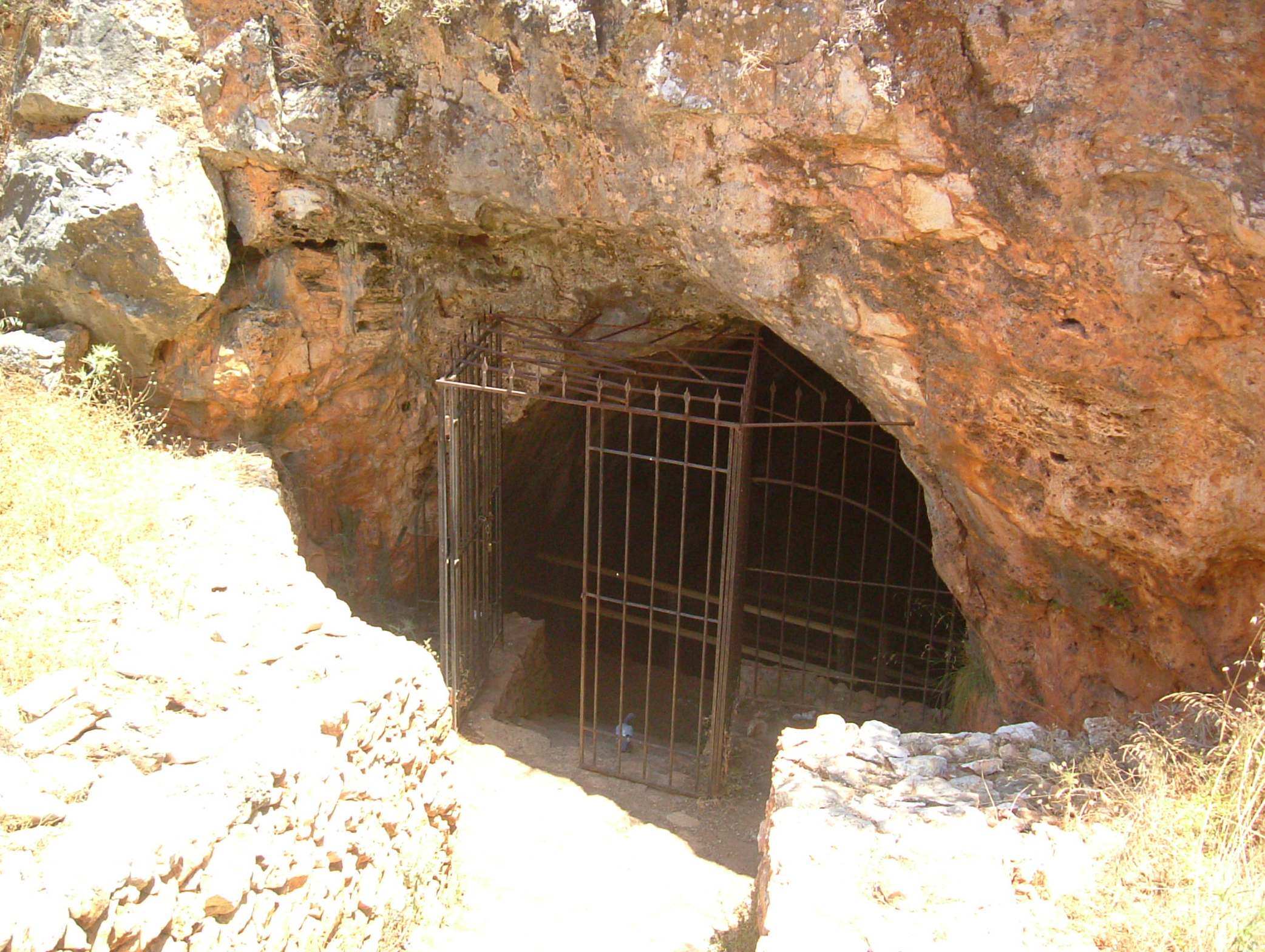
Entrance to Melidoni cave when I was there in 2006 (pigeon on step gives an idea of scale….)

According to Beaufort, in a letter to Lt Thomas Graves (surveying in the Mediterranean) (also 17th December 1832), Copeland “welcomed a classical scholar Robert Pashley of Cambridge to help him identify ancient sites [in the Aegean].”

Picture3

Plan of Melidoni cave (room discovered by Pashley on right [9] – now closed off)

Pashley set out on his extensive exploration of antiquities on the island of Crete with the aid of Captain Manias (a guide from Sfakia in the southwest of Crete), Antonio Schranz (an illustrator) and a mule. He was very enthusiastic about the early undiscovered history of Crete and shortly after his arrival on the island he wrote to Beaufort (15th February 1834):

“I believe we know but little indeed in England of the value and capabilities of this island. I must say a word of its history, which is so very interesting from the earliest dawn of Grecian civilization down to the present hour. You know how it is connected with many of the ancient theogonies & myths with the origin of laws, of the fine & useful arts, in fact with everything of any importance in the progress of society before the wars of Troy.”
However, his search for ancient cities was not an easy task and he remarked in his book (above), “Crete has been so little explored that it was necessary to enquire everywhere for ancient ruins.” He reported back to Beaufort on his findings of ancient sites with mixed feelings as he did not always find sites where he had anticipated them to be from references to his maps but was pleased with what he had seen (3rd April 1834):
“I have visited the sites of nearly twenty ancient cities, most of which I am sorry to say are either not placed at all or are placed entirely out of their proper places in all the maps I have seen. Many of the remains are extensive, most of them interesting, & some are very singular… I consider the two months I have spent here as more profitability employed as worth more in every point of view than all the rest of my eastern travels.”

mel 4

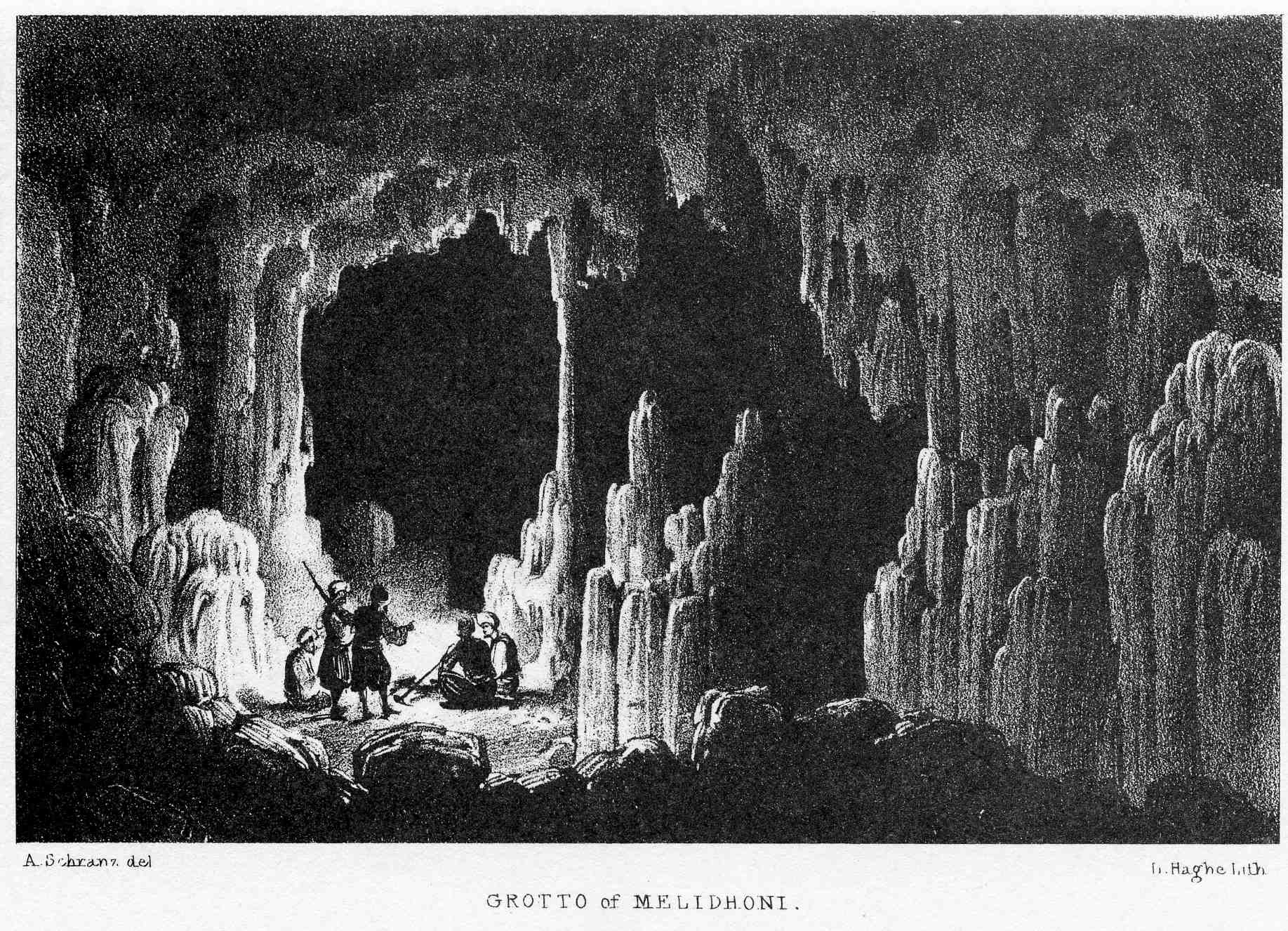
Drawing of Melidoni cave by Schranz from Pashley’s book

When he had completed his travels he was convinced that he had seen nearly all the cities of ancient Crete and informed Beaufort accordingly (9th October 1834), “… as for Crete, you will find … that I have visited most of the ancient sites.” That was quite correct as there were many more awaiting discovery.

mel 3

Melidoni cave (with the sarcophagus containing the bones of the 250 who died in 1824) 

Of Pashley’s venture, the historian Llewellyn Smith rather short-sightedly wrote in 1973, “A large part of his book is wasted in speculation about topography of the ancient Cretan cities: a fashionable game at the time, but exceedingly boring for the reader today.” No pleasing some people. Although he did add, “Skip the topography, for the rest is pure gold.”

pash map

Ancient sites visited by Pashley in Crete

As a final word on Pashley, in his work on Edward Lear in 1995, Peter Levi commented, “Crete was more or less unexcavated until Sir Arthur Evans’ dig at Knossos in 1900, though its innumerable ancient sites were charted by Pashley.” So Pashley had discovered Minoan Crete before Evans who happily received the credit for it – okay he did good work at Knossos.

.

Next week: I’m on a roll now – Thomas Spratt RN, another antiquarian traveller to Crete (if you have been paying attention you will have met Spratt before – a June blog, ‘Crete: the island that tipped’)


Artemus Smith’s Notebooks

I continue my research of the notebooks of Dr Artemus Smith, archaeologist of great courage, determination and fiction. Here is another extract:

My good friend and mentor, Idley Blanchwater, had farmed all his life and was a great amateur archaeologist. Now, at the age of 98, he was sadly departing from us. His son and I were at his bedside shortly before his demise. To make his last journey more comfortable his son tried giving him warm milk to drink. “It’s from one of your own cows, father,” his son said. But Idley refused it. With a wink, the son gave the glass to his father’s nurse and she took it to the kitchen and poured a generous amount of whisky into the warm milk and returned with it insisting Idley try a little. So persuaded, he took a sip – then drank the whole glass – and his eyes brightened.

His son took this as a good opportunity to ask him for some final words of wisdom before he passed away. Idley raised himself up in bed on one elbow, looked at his son and said,

“Don’t sell that cow.”

art-smth

Richard Pococke – antiquarian traveller to Crete

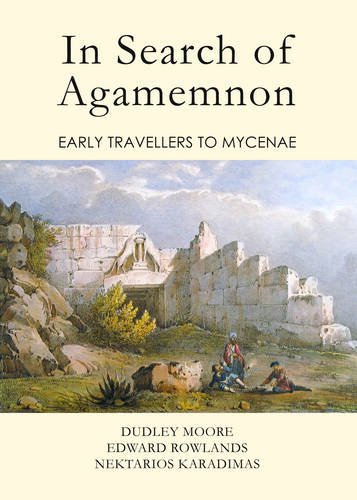
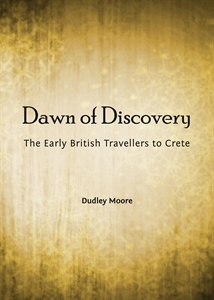
IF YOU HAVE been reading my past bogs you will realize that one of my passions is Crete. I’m also interested in the early travellers to the island and what they found there before archaeological became ‘fashionable’ following Sir Arthur Evans’ excavations at Knossos in the early 1900s. Most of these early pioneers were either members of the clergy, the legal profession or the military,  maybe because they had nothing better to do (but let’s not go there). Anyway, I like to bring some of these fellows to the fore as I fear their names have been lost in the passages of time (see my books, In Search of Agamemnon and Dawn of Discovery on MY PUBLICATIONS on this blog – go on, buy one, you know you want to …..).

book 1                  book2

Click here                                                             Click here

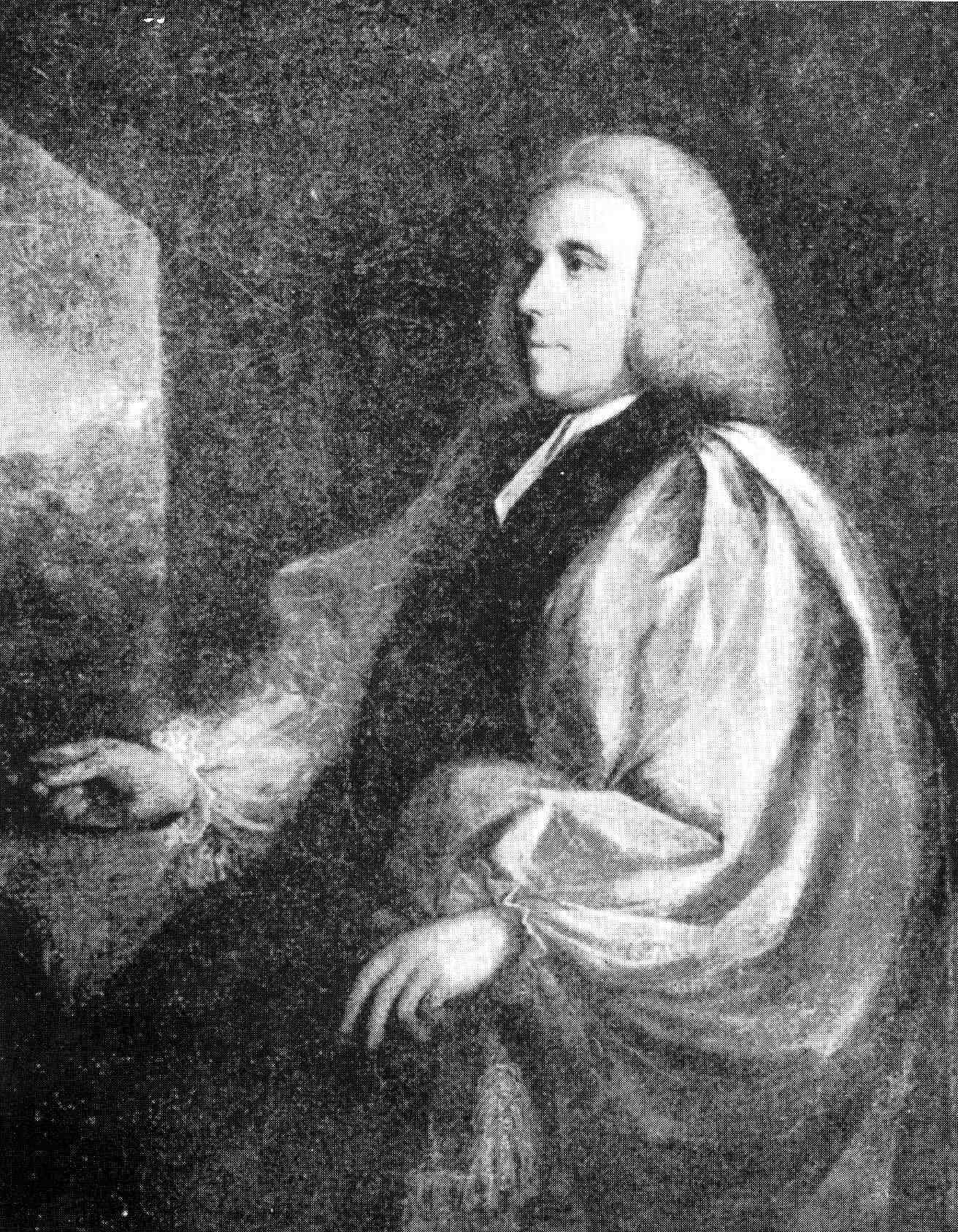
One such traveller was Richard Pococke. He was a member of the clergy and he visited Crete in 1739. Archaeology was not ‘something’ one did in the 18th century but Pococke was in search of ancient cities. He was, perhaps, the first British/Irish travel to the island to consider the existence of an ancient civilization. I was looking to see if he had found anything of the Bronze Age – then not a term used – before Arthur Evans’ great discoveries.

 pococke 2Richard Pococke (1704-1765)

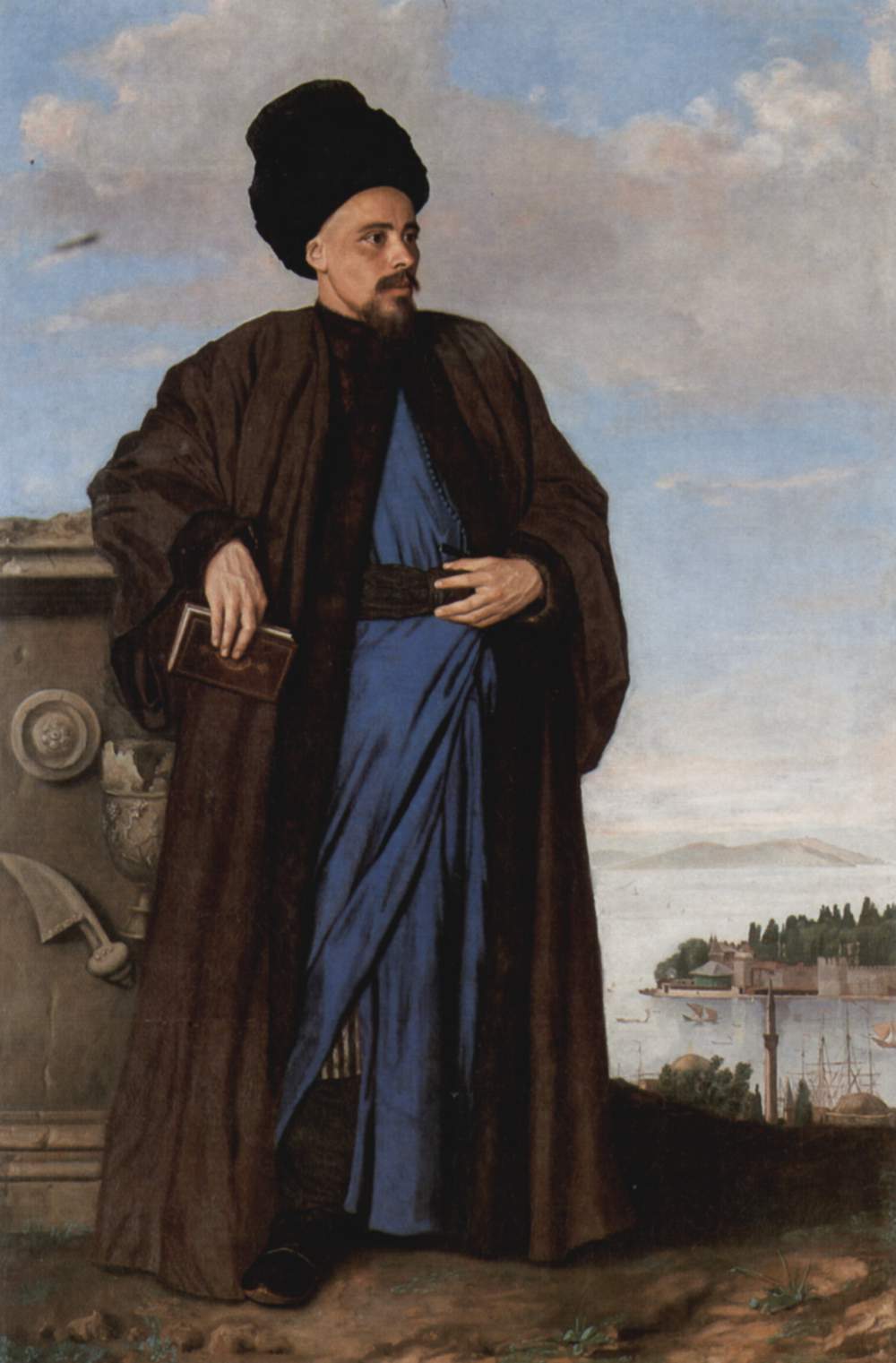
There have been certain interesting views of Pococke. He was believed to be a man of “mild manners and primitive simplicity … In his carriage and deportment he seemed to have contracted something of the Arab character [see pic below], yet there was no austerity in his silence, and though his air was solemn, his temper was serene” (Cumberland, from Kemp, 1887, Tours in Scotland, 1747, 1750, 1760, Edinburgh University Press).

In 1761, a Mrs Delaney described Pococke as “the dullest man that ever travelled …” (Quane, 1950, ‘Pococke School, Kilkenny’ Journal of the Royal Society of Antiquaries of Ireland). This may have been because he had no time for small talk or tittle-tattle at her tea parties (‘woman scorned’ …..). Whatever her view, Pococke was certainly not dull with regard to his travels. Kemp, the 19th century biographer of Pococke’s tour of Scotland (above), reported that “His [Pococke’s] contemporary, Bishop Forbes, has preserved a pen-picture of Dr Pococke … and represents him rather as a pleasant, genial, jocular man, able to adapt himself to every circumstance and society – qualities essential to travel.”

pococke 1

Pococke in his ‘Arab’ attire

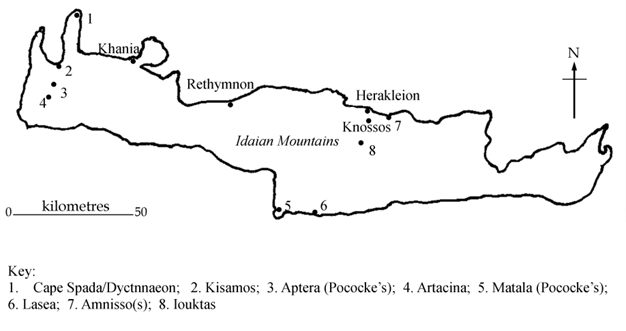
On arriving in Khania (Canea) on the northwest coast of Crete he called upon the “only English house on the island” – that of the English Consul General. With the Consul and the Bishop of Kisamos, he set off to see the sites on the western part of the island. His first encounter with the ancients was on Cape Spada at Dictynnaeon but the first ancient remains seen by him at Magnia were small and of marble, possibly of the Dictynnaeon Temple mentioned by Strabo (Geography, 10.12).

 pococke 8Ancient sites visited by Pococke in Crete

Pococke found a ruined city at Aptera (Palicastro), some five miles from the port of Kisamos. He wrote to his mother on 29th September 1739 about Palicastro:

“Came near to the sea west of Cape Spada … and went south west about 4 miles to Palaio Castro, the old ruined city of Aptera on a high hill, at the foot of which, the muses and the sirens had a trial of musick & the sirens being vanquished lost their wings. We viewed the Antiquities.”

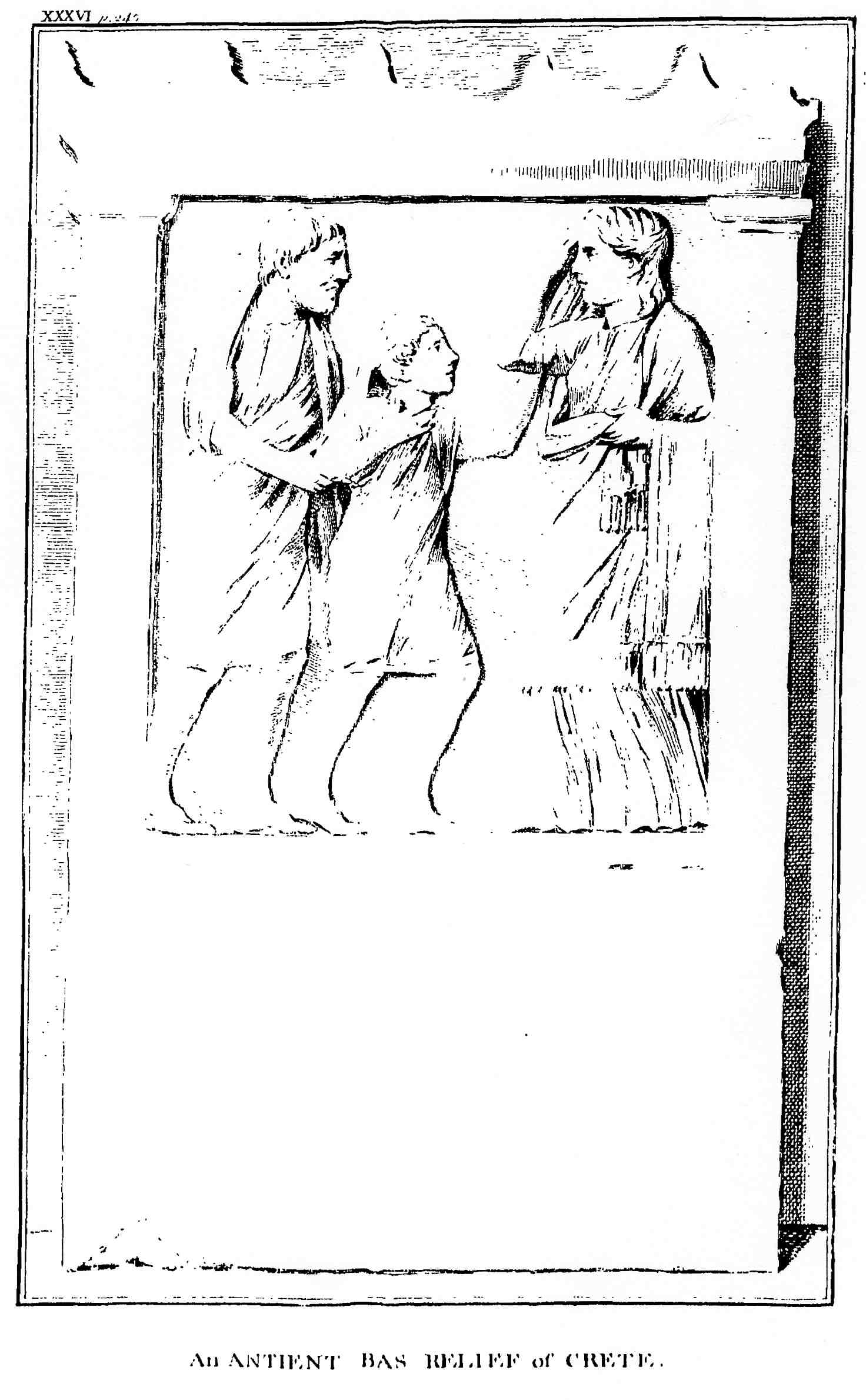
This reference to the ‘trial by musick’ relates to the mythological tale of the victory of the Muses over the Sirens following a musical contest which took place at the city and after which the Sirens plucked off their feathers in sorrow and threw themselves into the sea – Aptera is Greek for ‘Featherless’. The antiquities he viewed included a very antique bas relief (a sepulchral monument) which he purchased.

 bas

Bas relief procured by Pococke (1 ft, 9 ins in length, 13 ins wide)

At Artacina, or Rocca, he saw the remains of some rooms which, he said, “the people say belong to the ancient Greeks, and they have some fables relating to it of a giant whom they call Ienes.” Unfortunately his lack of description does not help identify these rooms in any manner.

Pococke left Khania and headed eastward to Retimo (Rethyminon) in order to “make a tour round the island” although he was not to achieve this intention. He then headed south east to Matala where he came across some ruins of Castro Matala and cut into the rocks semicircular niches “hollowed in like graves, and a stone laid over them” but gave no indication of date of the site. He then observed, “In searching for Lebena further to the west, I found a place which I thought to be of greater consequence … that is the fair havens, near unto the city of Lasea; for there is a small bay about two leagues east of Matala, which is now called … Fair Havens.” This is confusing as Lasea (Lisia) is about 6 miles south east of where Matala is today and Lebena is the same distance east of Lasea. He was misplacing these sites – putting Lasea (‘Fair Havens’) where Lebena is today and Matala where Lasea is and Lebena where Matala is now situated (get it? ……. never mind).

 Fair Havens

Fair Havens

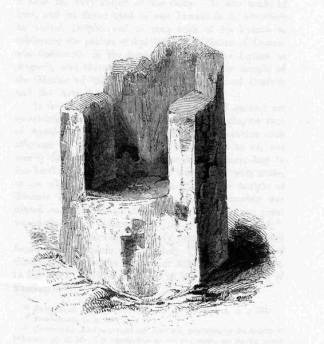
At Gortyns (not on the above map but just north of Lasea – 6 on map), Pococke was aware of its early origins, referring to Homer’s mention of it as a walled city (Iliad 2.646) and that “the walls were afterwards destroyed”. Indeed, there are no Bronze Age walls remaining at the city, although it does date back to this period (having been inhabited without interruption since 4000 BC). He described several ruins which would have been most likely Roman, including a theatre.  He did mention the ‘labyrinth’ (see blog in June) but believed it to be “nothing more than a quarry, out of which Gortynia was built … and they might choose to hollow out such a large grotto, rather than work this quarry in the common way, that their families might retire to it on any invasion, and secure their riches.”

 labrnth gortyns

Gortyns labyrinth/quarry

At Knossos, Pococke came upon what he thought was the ancient city and observed that it was the place of the labyrinth of King Minos and “In the time of Minos, Amniso was used as its (Knossos) harbour.” Certainly this reference to Amniso(s) as port of Minos perhaps supports the idea that he believed in – and recognized – an early civilization. He did then go on to describe some ruins that he saw, including several large arches which he described as platforms for seats of a theatre.

Not far from Knossos, to the south, is Mount Iouktas (Joukta), the supposed burial place of Zeus. It is not clear whether Pococke actually visited the top of the mountain – probably not as he talked of what the modern Greeks said was up there (a temple and tomb) rather than what he saw for himself, “They relate (my italics) that there was a temple dedicated to him [Zeus] on this hill …”. Turning north he headed for Candia (Herakleion), but other than assuming it may have also been a port to Knossos, he made no ancient discoveries around the town.

ioukts

Cyclopean remains on Mount Iouktas – what Pococke missed!

He did ascend the Idaian Mountains (Mount Ida), the site where Zeus was said to have grown up, hiding from his father, Cronos, but Pococke was not impressed.  He made a mere reference to a small rough grotto on the north side of the mountain but the cave that was later to reveal many Bronze Age Minoan artifacts was not a ‘small grotto’ (see pic below).

 Publication1

The cave of Mount Ida

On his return to Khania he announced, “Having seen everything that was curious, I returned to Canea [Khania].” This was to be proven not the case by the likes of Robert Pashley (1830s), Thomas Spratt (1850s) and Sir Arthur Evans (1900s) – much more was to be discovered.

pck map

Pococke’s map of Crete, 1745

.

Next week: Whilst on the subject of antiquarian travellers to Crete, let me introduce you to Robert Pashley, barrister.


Artemus Smith’s Notebooks

I continue my research of the notebooks of Dr Artemus Smith, archaeologist of great courage, determination and fiction. Here is another extract:

A crazy place America. I spent some time living and excavating on a farm in Arizona. One day a DEA (Drugs Enforcement Administration) officer called in on me and said, “I need to inspect your farm for illegally grown drugs.” I said, “Okay, but do not go in that field over there,” and pointed out the location.

The DEA verbally exploded and said, “Mister, that’s exactly where I’m gonna start. Reaching into his rear trouser pocket, he removed his badge and proudly displayed it to me.  “See this badge?  This badge means I’m with the Federal Government and I am allowed to go wherever I wish . . . . on any land.  No questions asked or answers given.  Have I made myself clear?  Do you understand?”

I nodded politely, apologized, and went about my business.

A short time later, I heard loud screams and saw the DEA officer running for his life chased by my big Santa Gertrudis bull.  With every step the bull was gaining ground on the officer, and it seemed likely that he would be gored before he reached safety. I threw down my tools, ran to the fence and yelled at the top of my lungs . . . . .

 “Your badge, show him your badge!”

 art-smth

Eadweard Muybridge: moving picture-maker and murderer – or not…..

LET US START with the ‘moving picture-maker’. Supposedly motion pictures began in 1890 with the introduction of the first motion-picture camera. In fact, Eadweard Muybridge was there first in 1878. He was born Edward James Muggeridge in England in 1830 but that spelling (his name not the country) was too boring for him so he changed it (several times, in fact).

MuybridgeBig

 Eadweard Muybridge (1830-1904) – ‘Edweard the beard’!

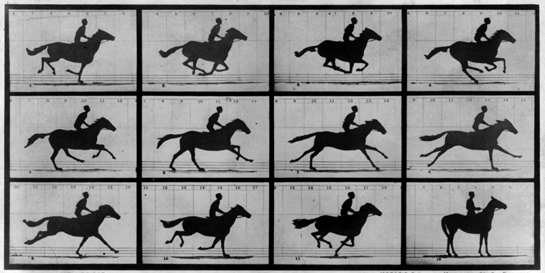
Anyway, he was very interested in photography and there was this chap, an America (ex-governor of California in fact) named Leland Stanford who owned race horses. Now, one of the great questions of the day was whether all four of a horse’s feet ever left the ground all at once (no, I don’t know why it was such a great question either – bored curiosity I expect). In 1872 Stanford commissioned Muybridge to resolve the question through photography – and this he did: the answer proved to be yes, at one point a horse is airborne with no feet on the ground when at the trot and gallop. Muybridge did this by setting numerous large glass-plate cameras in a line along the edge of the track and the shutter of each was triggered by a thread as the horse passed.

muybridge_galloping_horse

Muybridge’s photos showing the horse in motion – top sequence, pics 2 & 3, show the horse airborne

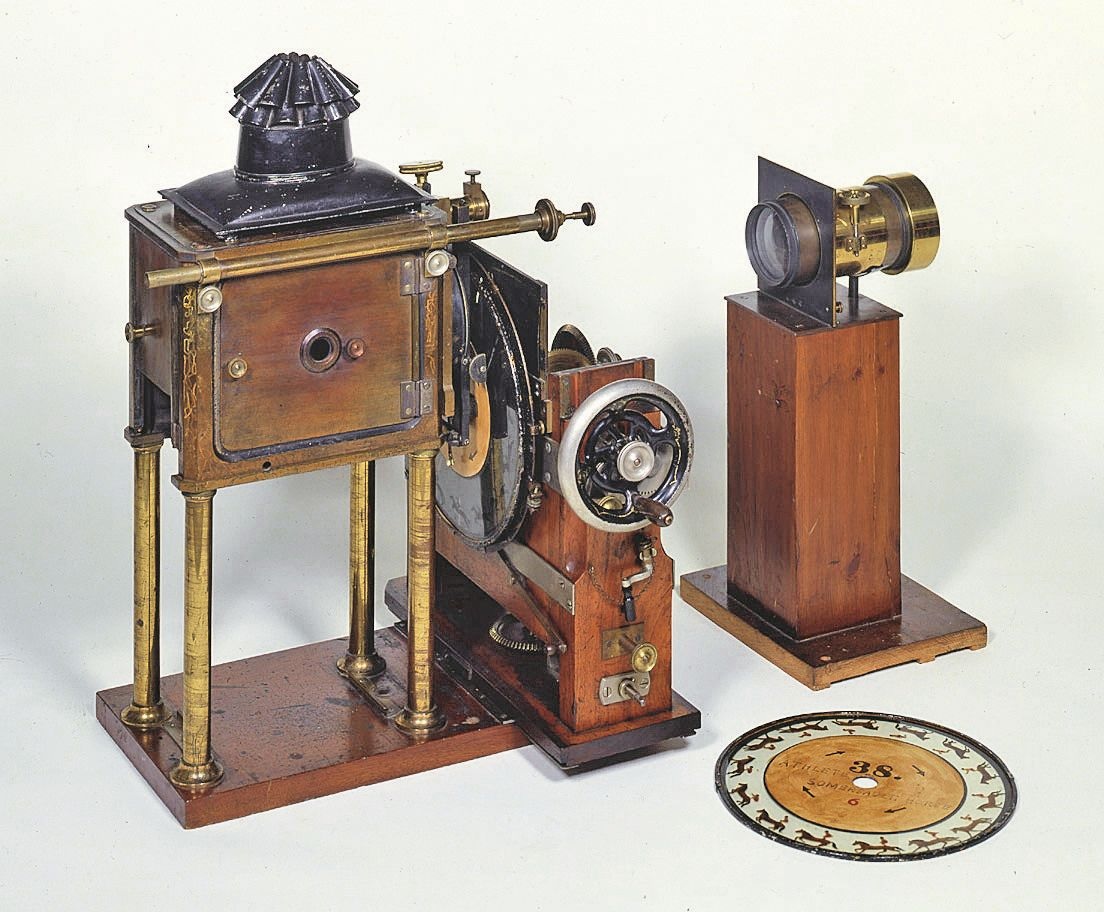
He then copied the images in the form of silhouettes onto a disc to be viewed in a machine invented by him which he called a zoopraxiscope (see below). This was later regarded as an early movie projector – motion pictures were not far away!

Muybridge’s horse on the move as viewed through the zooprxiscope – this is was produced in 2006 using Muybridge’s photos

So what about getting away with murder? Well, let’s first go back to 1860. Muybridge was travelling in a stage coach in Texas when it crashed and he suffered head injuries and, in particular, to the orbitofrontal cortex  (front of the brain, okay) which was the likely cause of his later eccentricity and strange behaviour. One such ‘strange behaviour’ was to shoot dead his wife’s alleged lover, Major Harry Larkyns (well, perhaps it wasn’t so strange – depends on one’s point of view I suppose). Apparently, having previously ‘given her child’, Larkyns had written to Muybridge’s wife, Flora. Muybridge had obviously seen the letter and visited Larkyns in Calistoga in California and said to him, “Good evening, Major, my name is Muybridge and here’s the answer to the letter you sent my wife,” and shot him.

floraMUY

Flora Muybridge (1872)

Muybridge was put on trial and pleaded not guilty due to insanity caused by his above mentioned head injury. Four colleagues gave evidence to say that his personality had indeed changed from genial to erratic since the accident. Muybridge’s own behaviour in court whilst giving evidence was both contrary and explosive. The jury rejected insanity but found him not guilty on the grounds of ‘justifiable homicide’. So he got away with it, jammy … fellow (don’t try this at home as ‘crimes of passion’ are not deemed justifiable as a defence to murder in the UK – unreasonable, I know).

Muybridge went on to make many more motion studies being sponsored by the University of Pennsylvania. He returned to England in 1894 and died in Kingston-upon-Thames in 1904.

muybridge

Muybridge’s zoopraxiscope

Phenakistoscope_3g07690u

     Phenakistoscope_3g07690b

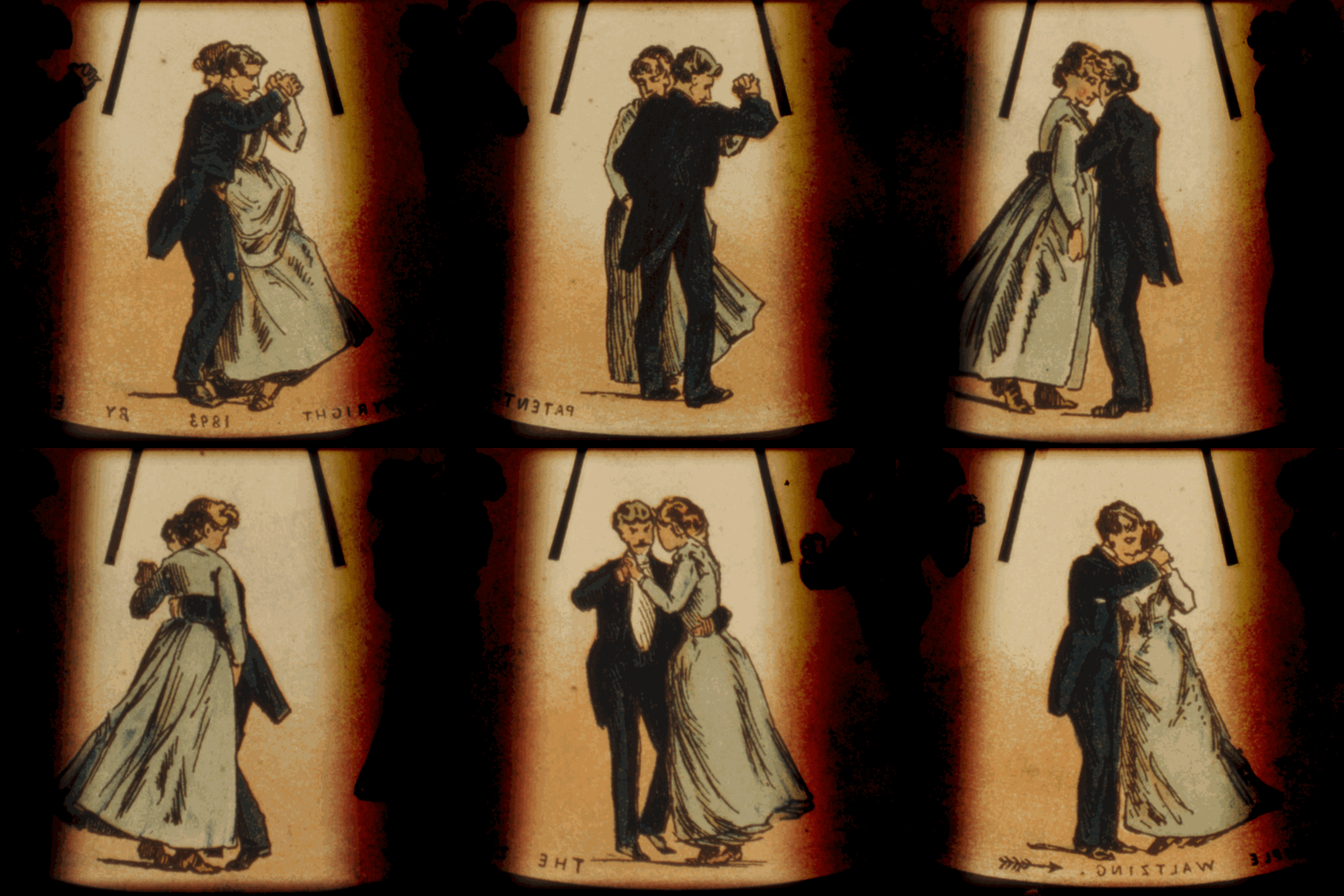
                  Muggeridge’s dancing phenakistoscope disc (1893)

.

Next week:  Richard Pococke – 18th century antiquarian traveller


Artemus Smith’s Notebooks

I continue my research of the notebooks of Dr Artemus Smith, archaeologist of great courage, determination and fiction. Here is another extract:

I was digging in the Negev Desert in Israel and came upon a casket containing a mummy. After examining it, I called the curator of the local museum.

“I’ve just discovered a 3,000 year old mummy of a man who died of heart failure,” I told him.

To which the curator replied, “That’s a very quick assumption regarding date and cause of death. Bring him in and we’ll check it out.”

A week later, the amazed curator called me. “You were right about the mummy’s age and cause of death. How in the world did you know?”

“Easy,” I replied, and showed him a piece of papyrus that I had found in the mummy’s hand. It read, ‘10,000 Shekels on Goliath’.

art-smth

William Price – the druid who created cremation

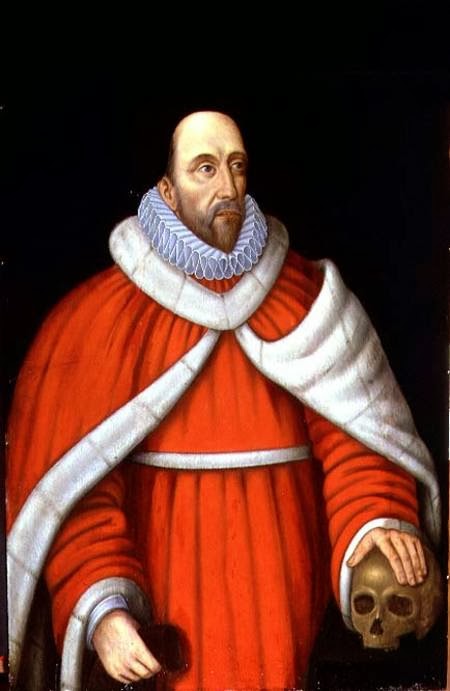
SO THERE I WAS preparing a talk on ‘Human Bones and the Law’ when I came upon this case R v Price 1884. Now the law on ownership of bones dates way-back. Basically no one owns bones, not even if they belong to a member of your family. Sir Edward Coke, Chief Justice in the 17th century, pontificated, “The burial of the cadaver [corpse], that is caro data vermibus [flesh given to the worms] is nullius in bonis [among the property of no person] and belongs to the ecclesiastical cognizance.” [1]

 Coke

Sir Edward Coke (pronounced ‘Cook’) C.J. (1552-1634)

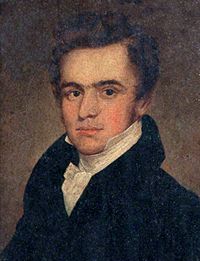
Well, there was this Welshman, William Price (1800-93), who had qualified as a medical doctor and became a member of the Royal College of Surgeons of England (having trained in London). He returned to Wales to work as a GP and, in 1823, became the chief surgeon at the Brown Lenox Chainworks in Pontypridd. So far so good.

William_Price_(physician)

Dr William Price in 1822 as a respectable medical student – ‘so far so good’

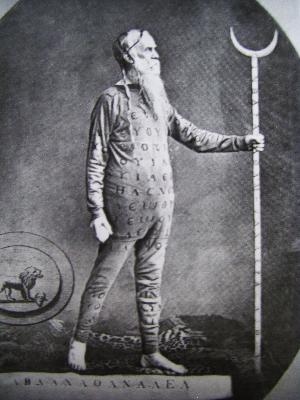
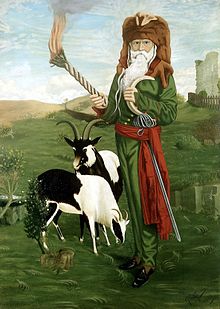
He then became involved in the Chartist movement (believing in votes for all men regardless of status – next there will be votes for women!) which led to an uprising which led to Price escaping to France. In Paris, at the Louvre Museum, he experienced his ‘turning point in his religious life’ when he saw an ancient Greek inscription which, for some bizarre reason, he interpreted as a Celtic bard addressing the moon. Yeah, okay. This was a sign to him to spread the word of the ‘true secrets’ of the Welsh language and free the Welsh from English dominance. Nothing new there. Anyway, as a result he became a druid and founded a new Druidic group which gained many followers. Just to give you an idea of some of his antics: he christened his daughter Gwenhiolan Iarlles Morganwg – meaning ‘Gwenhiolan, Countess of Glamorgan’; he organised an eisteddfod at Pontypridd but no one turned up (bad marketing); he held a Welsh nationalist parade along with a half-naked man called Myrddin (the Welsh name for Merlin) and a goat … of course.

William_Price_1884

Price in his druid gear in 1884

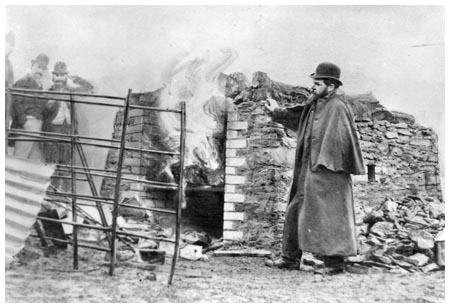
So wacky or what? But I digress, so now to the point. In 1883, when Price was 83 years old, his second wife, who was in her mid twenties (let’s not go there), gave birth to a son whom he named  Iesu Grist (the Welsh for Jesus Christ) as he had ‘great expectations’ for him. Sadly the child died after 5 months. Price’s religious belief prevented him from burying the corpse as it would pollute the earth. So he decided to cremate him on the hill outside his village of Llantrisant which was ‘not the done thing’ then. In fact, many of the villagers saw the smoke of the fire and attacked him. He was rescued by the police and the child was taken from the pyre before it had been engulfed in flames.

William_Price_painting_(2)

Painting of Price in his famous fox-skinned headdress 

Price was then arrested for illegal disposal of a corpse (the police were satisfied that the child had died of natural causes prior to the cremation attempt). At his trial at Cardiff Crown Court, whilst he accepted that cremation was not legal, he argued that there was no law against it either. Going back to Sir Edward Coke (above), the principle here is that if no one owns a body how can it be illegal to do what one wishes with it?  The judge, Mr Justice Stephen, agreed with Price and he was released from custody to much cheering from the people (not the ones from his village obviously). It would appear that cremation was here to stay and on the 14th March Price did, indeed, cremate his son. This led to the newly founded Cremation Society of Great Britain which put sufficient pressure on the government to introduce the Cremation Act 1902 (of which there have been several amended versions since).

Restricted useage

Cremation of William Price

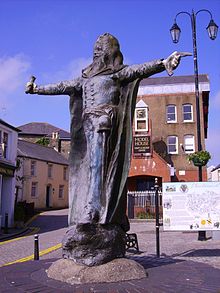
The case made Price famous, so much so that a statute of him was erected in Llantrisant in 1982 by the Cremation Society of Great Britain. His wife produced another boy who was also named Iesu Grist for the same reason as his first, the coming of the second (or third) Jesus Christ – he wasn’t (but that is no surprise). William Price was cremated in 1893 on the same hillside as his first son and was watched by some 20,000 people (see pic above). He certainly made an impression!

220px-Dr_William_Price_-_Statue

Statute of Price at Llantrisant

Footnote

[1] Unless they have “acquired different attributes by virtue of the application of skill, such as dissection or preservation techniques, for exhibition or teaching purposes. It thereby acquires a usefulness or value. It is capable of becoming property in the usual way, and can be stolen.” (See the case of R v Kelly & Lindsay 1998 – stealing bones used for educational purposes by a hospital).

.

Next week: Odd bods: Eadweard Muybridge ….. ‘moving picture-maker’ who got away with murder


Artemus Smith’s Notebooks

I continue my research of the notebooks of Dr Artemus Smith, archaeologist of great courage, determination and fiction. Here is another extract:

 My neighbour, George Shortbrain, came into the public house and sat next to me. An unfortunate name but similar to his nature – a man of limited intelligence. The public house had a television set and was showing the 10:00 PM news. The news crew was covering a story of a man on a ledge of a large building preparing to jump.

George said, “Do you think he’ll jump?”

“Yes he will,” I answered.

“Well, I bet he won’t,” said George. “In fact, I bet you a five pounds he won’t.’”

I agreed to the bet.

Just then the chap on the ledge did a swan dive off the building, falling to his demise.

George was very upset but willingly handed me the five pounds.

I said, “I can’t take your money, George, I saw this earlier on the 6:00 PM news and so I knew he would jump.'”

George replied, “I did too, but I didn’t think he’d do it again.”

I took the money.           


art-smth