Thomas Edward Booth of the Booth Museum

I HAVE LIVED all my life in or around Brighton (give or take five years in the wild west of Wales) and only visited the Booth Museum last year to see what must be one of the finest collections of Victorian natural history taxidermy birds in the UK. I visited again last week to have a look at what is in storage hidden away at the back and upstairs. There is a phenomenal amount of stuffed animals and skeletal remains tucked away and it’s a fantastic collection idly waiting to be used in research.

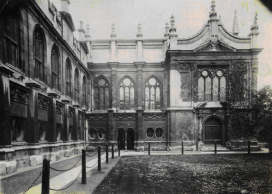
The Booth Museum on Dyke Road, Brighton

The museum’s founder, Thomas Edward Booth, was a dedicated naturalist. He was born in Buckinghamshire in 1840 to wealthy parentage and moved to Hastings in East Sussex when he was 10 years old. Four years later the family moved to Brighton. He was educated at a private school in Brighton before going to Harrow and then Trinity College, Cambridge. He didn’t complete his degree at Trinity as it appears he was sent down (Oxbridge for thrown out). It’s not clear why but probably due to spending too much of his time on shooting birds on the Fens rather than studying at College. A matter of choice I suppose.

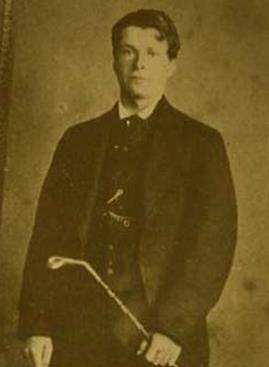
   booth 3

Young Edward Booth probably when he was at Cambridge

He moved to Dyke Road in Brighton with his first wife in 1865 (his second wife was his first wife’s nurse – keep it in the ‘family’) and built a house he called ‘Bleak House’ (one may assume he was a Dickens fan). In 1874 he built his museum for his British bird collection in the grounds of his house. He made copious notes and drawings of these birds (most of which still survive in the museum archive) and he had learned taxidermy as a child from a chap called ‘Kent’ from St Leonards in Sussex. The idea of the museum was to recreate birds in glass cabinets in their natural habitat and, at this, he was most successful, although the principal taxidermists were T.E. Gunn, George Saville, Pratt & Sons of Brighton, Brazenore of Brighton and Swaysland of Brighton (credit where credit is due I say). The museum was known as the ‘home of the dioramas’ (three-dimensional full-size models enclosed in glass showcases)

Shows a sepia photograph of the Victorian ornithologist Edward Booth, who is wearing a top hat, smart suit and holds a cane

Older Edward Booth (the ‘walking stick’ in his left hand is, in fact, a 410 gun)

Booth planned to collect every species of British bird and he did so by shooting them or capturing them by net or trap. He also raised fledglings only to kill them when they were the size he required for stuffing. I know what you are thinking – but he was a fanatic and it was legal then (killing birds, not being a fanatic – although that was also legal). He even had his own train carriage at Brighton station ready and waiting to link up to a train if he heard a rare or new species of bird had been spotted (that’s style if you can afford it). He was obviously eccentric and not averse to taking pot-shots at other bird-spotters imposing on his hunting territory.  He was also fond of the alcohol which may have had something to do with his premature demise in 1890 (aged 50).

The museum circa 1911

His museum was not a commercial enterprise and it was not open to the public (other than occasional special days). It was not until after his death that the museum was left to ‘the people of Brighton’. Booth’s house on Dyke Road has long since been pulled down and the land redeveloped but the museum remains intact. It is reported to house over half a million insects and animals; 50,000 fossils, minerals and rocks; 30,000 plants; and 11,000 books and maps; all dating back over three centuries. This is not to mention the many bones and complete animal skeletons which have been acquired from various donations (including Brighton Museum, and a collection confiscated from a burglar of the premises!). It is well worth a visit – for more info, click here

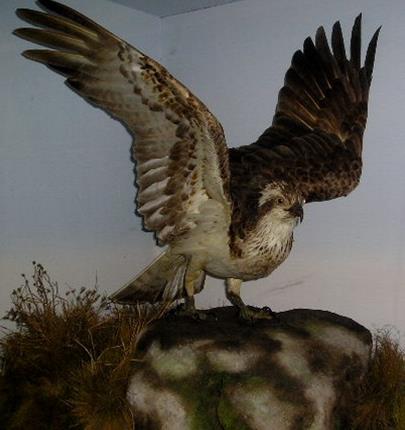
booth 4 osprey

 Stuffed Victorian Osprey by Booth


Next week: Herstmonceux Castle


Artemus Smith’s Notebooks

I continue my research of the notebooks of Dr Artemus Smith, archaeologist of great courage, determination and fiction. Here is another extract:

My neighbour, Travis Arbuthnot, had just bought a chainsaw and was somewhat displeased with the implement. He said to me, “Not sure what’s wrong with this darn thing. The salesman said it would cut around six trees in one hour. So far I’ve only managed one tree and it’s taken all day.” I enquired as to whether he would mind if I had a look and he handed me the item of concern. I pulled the cord and started the motor. Immediately he exclaimed, “What’s that noise?”

art-smth


The Parthenon – then and now

I WAS UP AT the British Museum last week and was, as usual, suitably fascinated by the Parthenon marbles. The Parthenon, on the Acropolis in Athens, has been under repair now since the Committee for the Conservation of the Acropolis Monuments was set up in 1975 and serious restoration work began on the Parthenon around 1985. That was 30 years ago and still there is much to do. Back in the 5th century BC it took the ancient Greeks 9 years to build it (447-438 BC) – there’s advancement for you! To be fair, since 1985 there has been a lot of dismantling of previously flawed repairs carried out by the likes of messrs  Kyriakos Pittakis (from 1842 to 1844) and Nicholaos Balanos (from 1895 to 1933). These guys, although well-meaning, used a lot of concrete and iron which has not proven to be a lasting success! It is not planned to restore the Parthenon to its original state, but just to a more appropriately safe ruin and restoring loose blocks to where they belong.

parthenon now

The Parthenon today (NW sides)

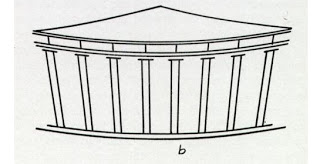
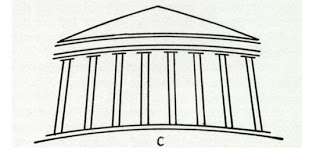
The construction of it (in pentelic marble from nearby Mount Pentelicus) back in the 5th century BC was clever stuff – its columns look uniform and straight but they are not. The building is, in fact, an optical illusion. If it had been built uniform, with all the columns straight and exactly the same size it would have been seen to the eye as shrunken in the middle. The columns on the ends are slightly larger than the others and bend inwards.

parthenon

Outside columns bend in

a illusion

Drawing a is how it should look to the eye

b illusion

Drawing b is how it would look to the eye if all the columns were uniform

c illusion

Drawing c is how it is actually built to look like (to the eye) drawing a

It’s had a somewhat ‘interesting’ history. Other than a fire in the 3rd century AD, which destroyed its roof and part of the inner sanctuary, it lasted quite well, complete with its massive golden statue of Athena. Then, in the 5th century AD, as part of the new Byzantine Empire, the statute was looted and taken to Constantinople, where it was later destroyed, probably around 1209 during the fourth Crusade.

Athena

Replica of the statute of Athena in Nashville, USA – big, huh!

Towards the end of the 6th century AD the Parthenon was converted to a Christian church and the main entrance changed from the east to the west, with an altar set up at the east-end with the addition of an apse. A bell tower with spiral staircase was built into the southwest corner.

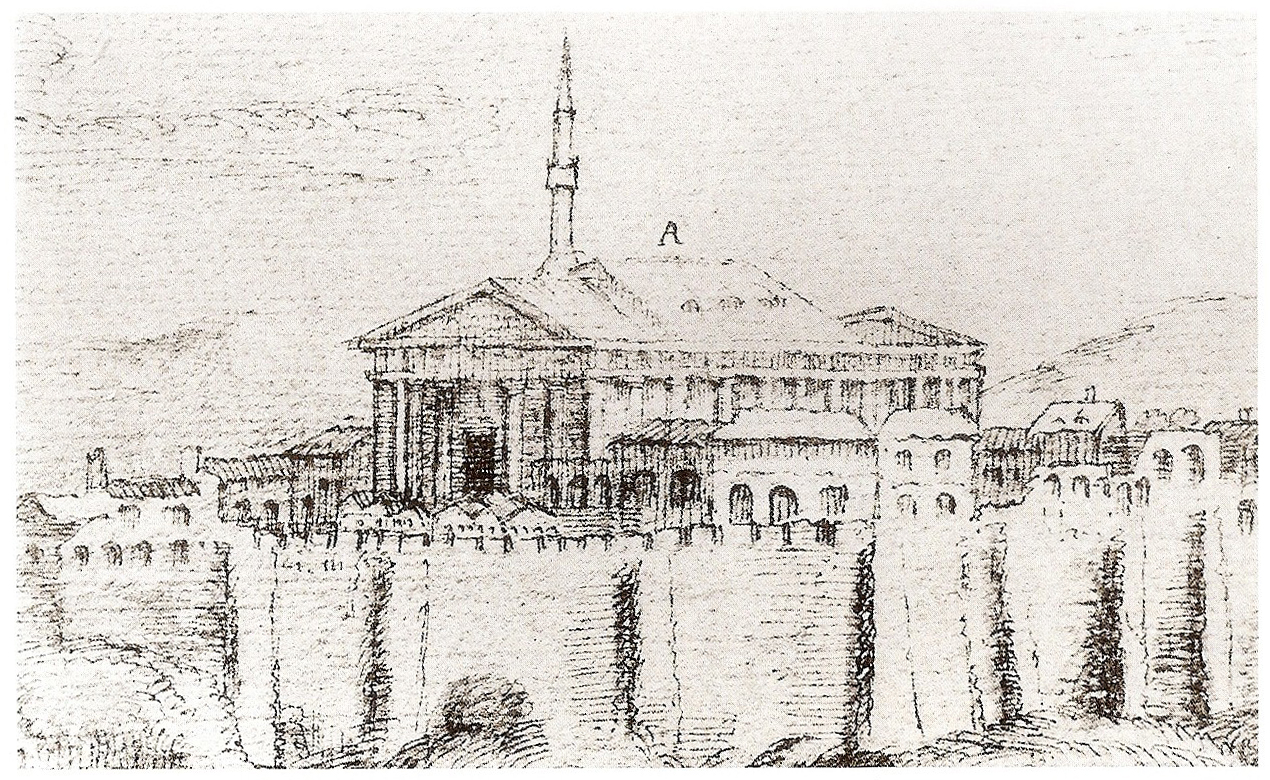
In 1458 the Ottoman Turks took control of Athens and some years later converted the Parthenon into a mosque. However, the basic external structure remained intact.

 parthenon mosque 1

Parthenon as a mosque complete with minaret

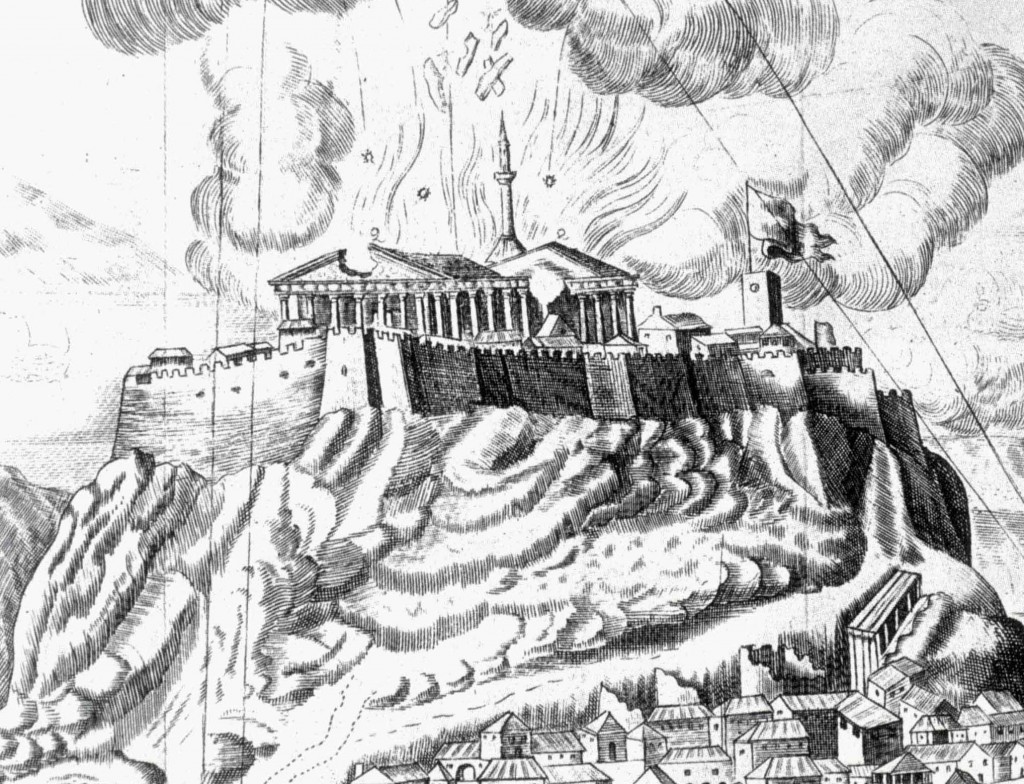
Then in 1687 came the Venetians and one Francesco Morosini. He lay siege to the Acropolis and began shelling it with mortar (shells not cement ….. yeah, ok). For some inexplicable reason the Turks were using the Parthenon as an ammunition store. A mortar shell landed directly on it and the whole lot exploded, killing around 350 Turks.

 Destruction-of-the-Parthenon-1687.

Exploding Parthenon – it’s never been the same since!

It’s not clear whether Morosini aimed at the Parthenon on purpose or it was (un)lucky shot. Presumably the Turks (naively) thought he would not fire on such an important building, but if he knew it was an ammunition store ……..well, what would you do in his shoes? Anyway, having taken the Parthenon, he tried to loot some of the sculptures and caused even more damage. The following year the Venetians left Athens and the Turks reoccupied the city. They built a small mosque within the ruins of the Parthenon and remained in power in Athens until Greek independence in 1832. The mosque was removed sometime after 1834, together with many other non-classical architecture on the Acropolis (an enthusiasm of classical Greece had taken hold by then).

 Parthenon 1715

Painting of mosque no 2 in the ruins of the Parthenon (c. 1715)

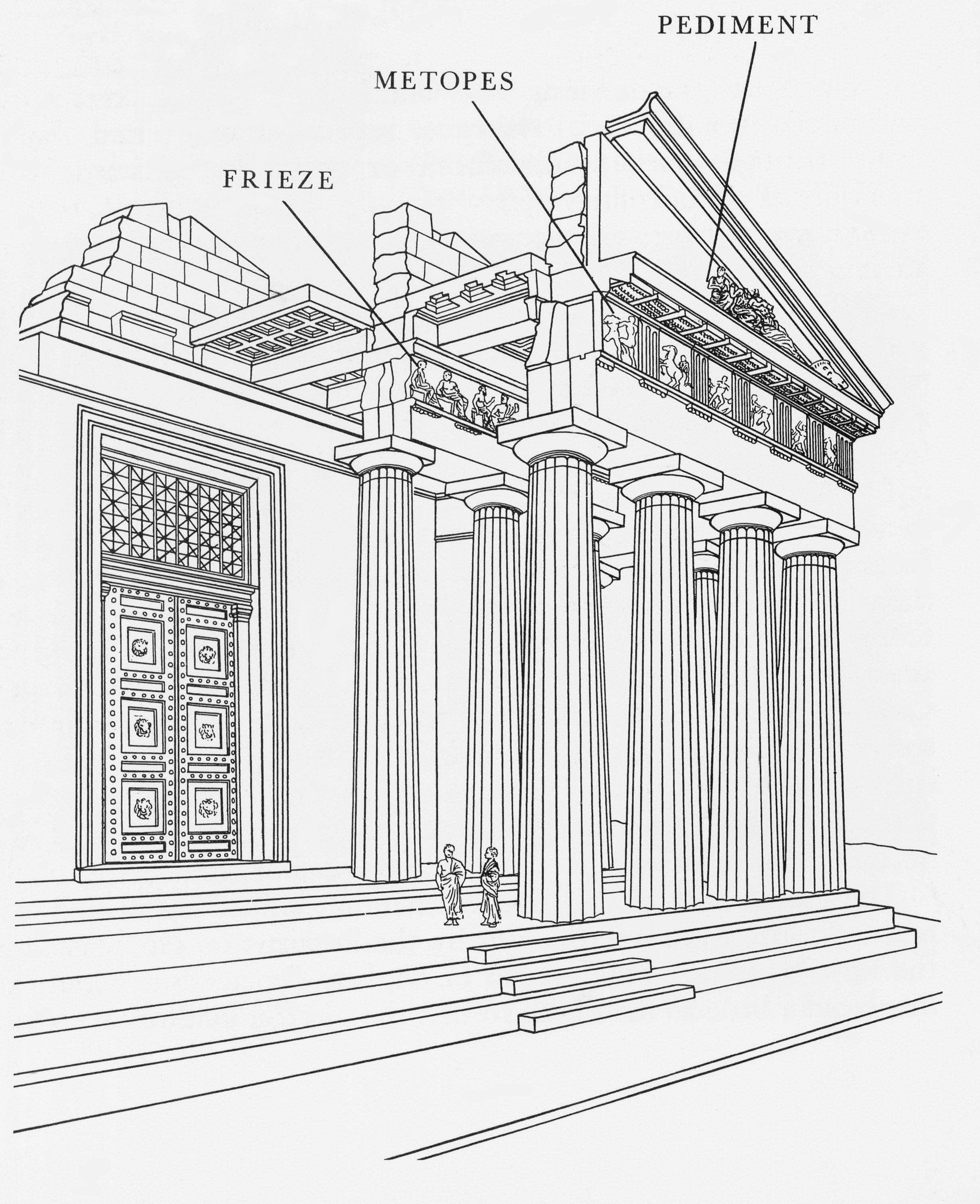
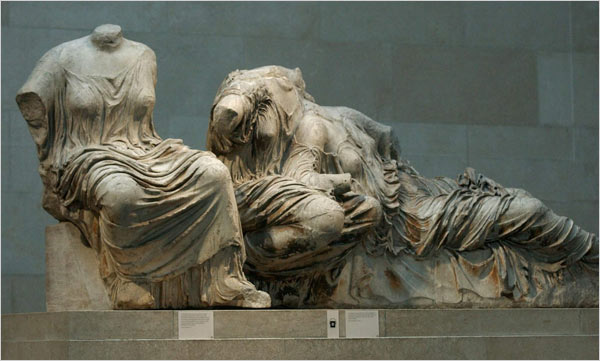
Prior to the Greek independence, in 1801 along came Lord Elgin with his dodgy firman (permission to draw the ruins and take casts). He decided to interpret the firman to allow him to remove sculptures (including those on the Parthenon from the east and west pediments, the high relief metopes around the outside, and the low relief frieze around the inside – see pic below). The Ottomans didn’t seem too bothered (not being very interested in ancient pagan worship) and no doubt money changed hands. The arguments will continue as to whether Elgin was right to do so. There is evidence that some remaining marbles did deteriorate being left unprotected, but it is doubtful whether that was Elgin’s real reason for removing what he did.

 parthn metopes etc

The different sculptures on the Parthenon 

pathenon 2

Example of female (goddesses) sculptures taken by Elgin from the east pediment

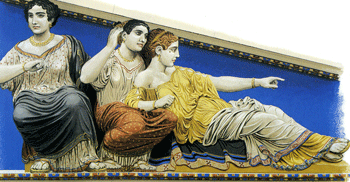
parth-ped-recon

Reconstruction of above sculptures – they would have been painted in colour

So, should the marbles be returned to Athens? Let’s not go there! Although I would say that my original thoughts were in the affirmative now Athens has its fabulous new museum. The problem is, where do you draw the line? Do we return everything to everyone? That wouldn’t leave much in our museums …….

parthenon at night

 Parthenon at night – pretty

.

Next week: Juries – a good thing or a bad thing?


Artemus Smith’s Notebooks

I continue my research of the notebooks of Dr Artemus Smith, archaeologist of great courage, determination and fiction. Here is another extract:

My good friend Archibald Lumbago was fairly depressed about the state of his farming business.  The Department of Employment (DoE) had heard that he was not paying proper wages to his helpers and sent one of its staff out to investigate him. He recounted the conversation to me:

“When the DoE chappie arrived he asked for a list of my employees and how much I pay them. I replied, ‘Well, there’s my farm hand who has been with me for 3 years. I pay him £200 a week plus free room and board.’ I continued, ‘Then there’s the mentally challenged worker. He works about 18 hours every day and does about 90% of all the work around here. He makes about £20 per week, pays his own room and board, and gets a bottle of whisky every Saturday night so he can cope with life.’

The DoE chappie said, ‘That’s the guy I want to talk to … the mentally challenged one.’

I replied, ‘That would be me.'”

art-smth

Wolf Hall, Anne Boleyn and all that

QUITE A FEW people have been following BBC’s Wolf Hall and it has received great reviews. I’ve read both books and found them most intriguing, but I was not sure how easy they would convert to TV – especially into just six episodes!  When I saw the first instalment  I think ‘rather slow’ came to my mind.  Also, Mark Rylance, I believe, is an undisputed great on the stage (and I’ve seen him there), but he appeared a little uncomfortable in front of the camera (or maybe that is how he thought Cromwell would be).  Saying that, he sort of reminds me of Michael Kitchen’s Foyle of Foyle’s War (and that’s a compliment – although it’s not exactly how I envisaged Cromwell). Then there’s Damian Lewis – yes, another fine actor and, although English himself, far too type-cast as an American to justify an impersonation of a king of England (in my opinion).  Despite that, and despite the fact that Henry the Large, Anne B, and Uncle Tom Cromwell and all have been somewhat flogged to death on the screen over the years, Wolf Hall still grabbed my attention.

Mark Rylance as Thomas Cromwell

Anyway, if I haven’t already alienated you with my opinion of the TV Prog/actors, and if you haven’t seen it yet and don’t want the plot ruined (well, not so much Wolf Hall plot, but the general Anne B intrigue), STOP READING NOW and return into hibernation.

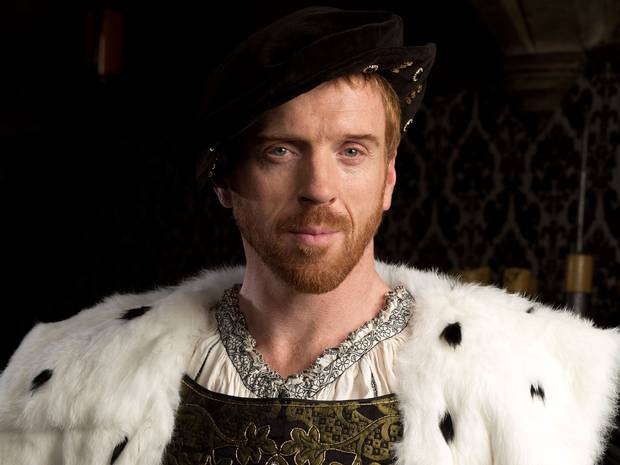
damian-lewis

Damian Lewis as Henry USA style (okay, Eton then ….)

So who was to blame for Anne’s downfall in 1536?  Henry?  Cromwell? Or Anne herself?  The scriptwriters, in general, will have it down to Cromwell with much help from Anne.  A villain is always needed and Cromwell is convenient. Violence is also a need but that was already there – heads rolling around … but not with laughter.  All the film/TV makers now needed was the sex.  Enter adultery and incest . Yummy – money in the bank.  But did Anne really commit all those naughty acts? Who was really to blame for her demise?

First, let’s blame Anne. She came from an ambitious family, notorious for scheming and so it was in her blood. She was clever – perhaps too clever – and ruthless, but not, I think, so much so to cross that line into incest with her brother, George.  The Countess of Worcester was accused of ‘hanky panky’ with courtiers and claimed she was no worse that the Queen (or words to that effect).  Then there was the overheard damning conversation with Sir Henry Norris in Queen Anne’s chamber. She had asked Norris why he hadn’t married and he replied he would wait awhile. Anne responded with, “You look for dead men’s shoes for if ought came to the king but good, you would look to have me.”  Treasonous words!!  But who reported hearing them?  Anne’s lady-in-waiting, Madge Shelton? Well, Norris was supposed to be courting her, so a woman scorned perhaps? Or maybe it was  the gossipy Lady Worcester diverting her own infidelities.  If Anne had been messing about with others she must have realised she was playing with fire – it just doesn’t add up.

Anneboleyn2

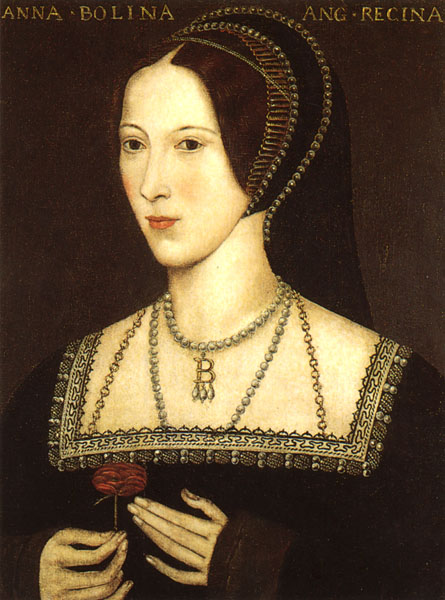
Anne Boleyn (1499-1536) complete with head 

So, let’s blame Henry.  Anne couldn’t give him the male heir he was so desperate for and he was nearly 45 years old and …. well, not that old, but was getting worried.  He had wasted some 24 years waiting in vain for Catherine of Aragon to do the noble ‘thing’. ‘Been there, done that’, he may have been thinking. He also had taken a fancy to one Jane Seymour (she of Wolf Hall in case you were wondering where the name came from) but that was nothing new and she would have been fine as a mistress one may think. So, how to rid himself of Anne?

One suggestion was that he accused her of witchcraft.  It was a Medieval theory that miscarriages only happened to evil women – women who committed adultery, incest or even witchcraft.  This was Anne’s second miscarriage (well, stillborn … and male) and Henry may have caught on to this Medieval bunkum and preferring the witchcraft route (adultery suggested he wasn’t ‘up to it’), he spread rumours that Anne had cast a spell on him to marry her so it was without his consent.  Yeah, right.  He was obviously hoping his Ecclesiastical court would wave a magic wand to relieve the spell with the magic words, “I divorce thee”. (Actually Canon Law in England at the time did not recognise divorce – both Henry’s ‘divorces’ were, in fact, annulments).

What is rather strange is that it has been reported that Henry and Anne appeared to be contented with each other a couple of weeks before her arrest. This may have meant Henry was faking it (contentment that is) or possibly implying some third party intervention……….

Henry

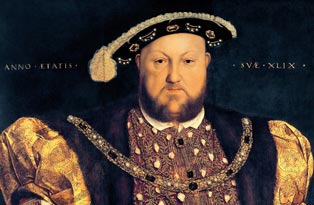
Henry the Ate (a lot)

Okay, let’s blame Cromwell.  But why?  Well he has the villain’s black hat for a starters. But what had he to gain from the downfall of Anne?  In fact, if he was the instigator and he had failed, his head would have been on the block, as they say, literally (I know it was later but that was …… later).  He already had as much power as he needed and I don’t believe Anne was a threat to that.  Alternatively, was he simply told to compound evidence against Anne by Henry?  Cromwell took sick-leave for a couple of days (21-22 April) just after Anne’s miscarriage, and shortly after his return he had Mark Smeaton, the king’s musician, arrested for adultery with Anne. She was arrested just after that on the 2nd May.

thomas_cromwell

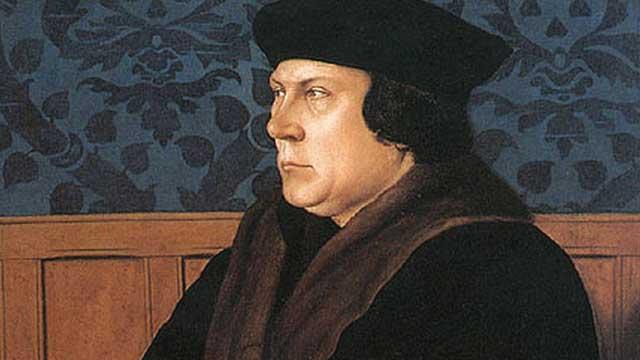
Thomas Cromwell (1485-1540) …. in villainous black hat

What is the conclusion then? We can never be sure, of course, but I’ll put my money on Henry commissioning Cromwell to find the evidence of adultery.  Henry needed to move on to seek his male heir elsewhere and quickly.  Jane Seymour was in the ‘right place at the right time’ (unless you were Jane Seymour – see footnote below).  I don’t think Cromwell wanted the job of bringing Anne down or to be in such an unenviable position, but he had to follow the king’s bidding. There is a letter he wrote to Eustace Chapuys, the ambassador of Charles V, ruler of the Holy Roman Empire, saying that he (Cromwell) had been commissioned by the king to conspire and think up the affair of Anne’s adultery. Cromwell duly obtained a confession of carnal cavorting with Anne from Smeaton (how, we don’t know – torture maybe ….. threat of several weeks of listening to the king sing perhaps?).

 chapuys

Eustace Chapuys (1490-1556)

Spoiler alert – if you don’t  want to know what happened TURN AWAY NOW:               Anne got the chop (yes, I knew you knew that).  Despite denials, two others were found guilty of ‘dallying’ with the Queen, Sir Francis Weston and Sir William Brereton, who, along with Norris and Anne’s brother, George, also went to the executioner. Everyone else lived happily ever after ….. well, not quite – in fact, nothing like.


POSTSCRIPT

The day Anne was executed, Henry was out riding with Jane Seymour. You can imagine the conversation:

Seymour: “How has your morning been my Lord?”

Henry:  “Such turmoil. First I lost my cod-piece; then I lost my wallet; oh, and my wife lost her head.”

Two weeks after Anne’s departure, Henry married wife number three, Seymour … and then they all live happily ever after. Well, no. Mind you, what was Jane Seymour thinking?  Henry’s first marriage with Cathy of Aragon had been annulled against all odds and she died in January 1836. Henry’s second wife, Anne, died four months later.  Was this a ‘Jonah marriage’ or what?  Indeed, Jane died in October the following year (having dutifully produced the required male heir, Edward [VI to be, albeit briefly]).  But still there were game young fillies out there prepared to marry Henry the Unlucky (three of them anyway). It all reminds me of Nat King Cole’s  song, ‘Let’s Face the Music and Dance’ which would have been more appropriate for Henry to have composed, particularly with its very first line, ‘There may trouble ahead’.

.

Next week: The Parthenon at Athens – now and then


Artemus Smith’s Notebooks

I continue my research of the notebooks of Dr Artemus Smith, archaeologist of great courage, determination and fiction. Here is another extract:

I heard of an arrangement my good friend, Rev. Arbuthnot Smythe-Harcourt, had had with his son. The boy had just passed his driving test and inquired of his father as to when they could discuss his use of the family car.
His father said he’d make a deal: “You bring your grades up from a C to a B average, study your Bible a little, and get your hair cut. Then we’ll talk about the car.”
The boy thought about that for a moment, decided he’d settle for the offer, and they agreed upon it.
After about six weeks his father said, “Son, you’ve brought your grades up and I have observed that you have been studying your Bible, but I’m disappointed you have not had your hair cut.”
The boy said, “You know, Dad, I’ve been thinking about that, and I’ve noticed in my studies of the Bible that Samson had long hair, John the Baptist had long hair, Moses had long hair… and there is even strong evidence that Jesus had long hair.”
His father thought for a minute and then replied:
“Did you also notice that they all walked everywhere they went?”

art-smth


.

Eadweard Muybridge: moving picture-maker and murderer – or not…..

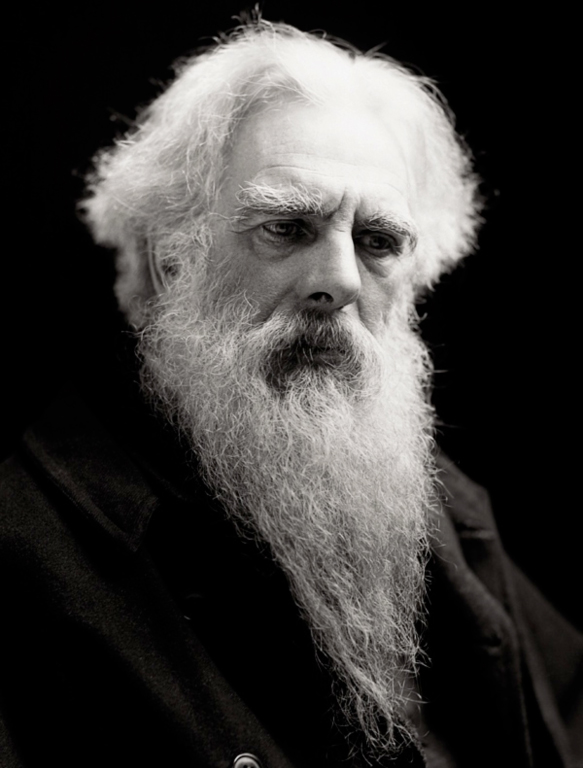
LET US START with the ‘moving picture-maker’. Supposedly motion pictures began in 1890 with the introduction of the first motion-picture camera. In fact, Eadweard Muybridge was there first in 1878. He was born Edward James Muggeridge in England in 1830 but that spelling (his name not the country) was too boring for him so he changed it (several times, in fact).

MuybridgeBig

 Eadweard Muybridge (1830-1904) – ‘Edweard the beard’!

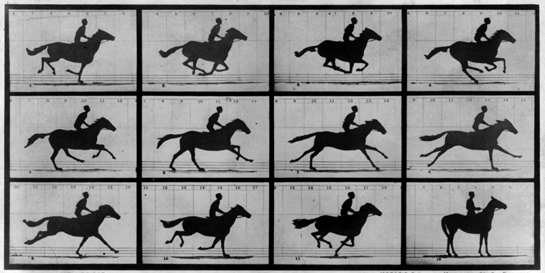
Anyway, he was very interested in photography and there was this chap, an America (ex-governor of California in fact) named Leland Stanford who owned race horses. Now, one of the great questions of the day was whether all four of a horse’s feet ever left the ground all at once (no, I don’t know why it was such a great question either – bored curiosity I expect). In 1872 Stanford commissioned Muybridge to resolve the question through photography – and this he did: the answer proved to be yes, at one point a horse is airborne with no feet on the ground when at the trot and gallop. Muybridge did this by setting numerous large glass-plate cameras in a line along the edge of the track and the shutter of each was triggered by a thread as the horse passed.

muybridge_galloping_horse

Muybridge’s photos showing the horse in motion – top sequence, pics 2 & 3, show the horse airborne

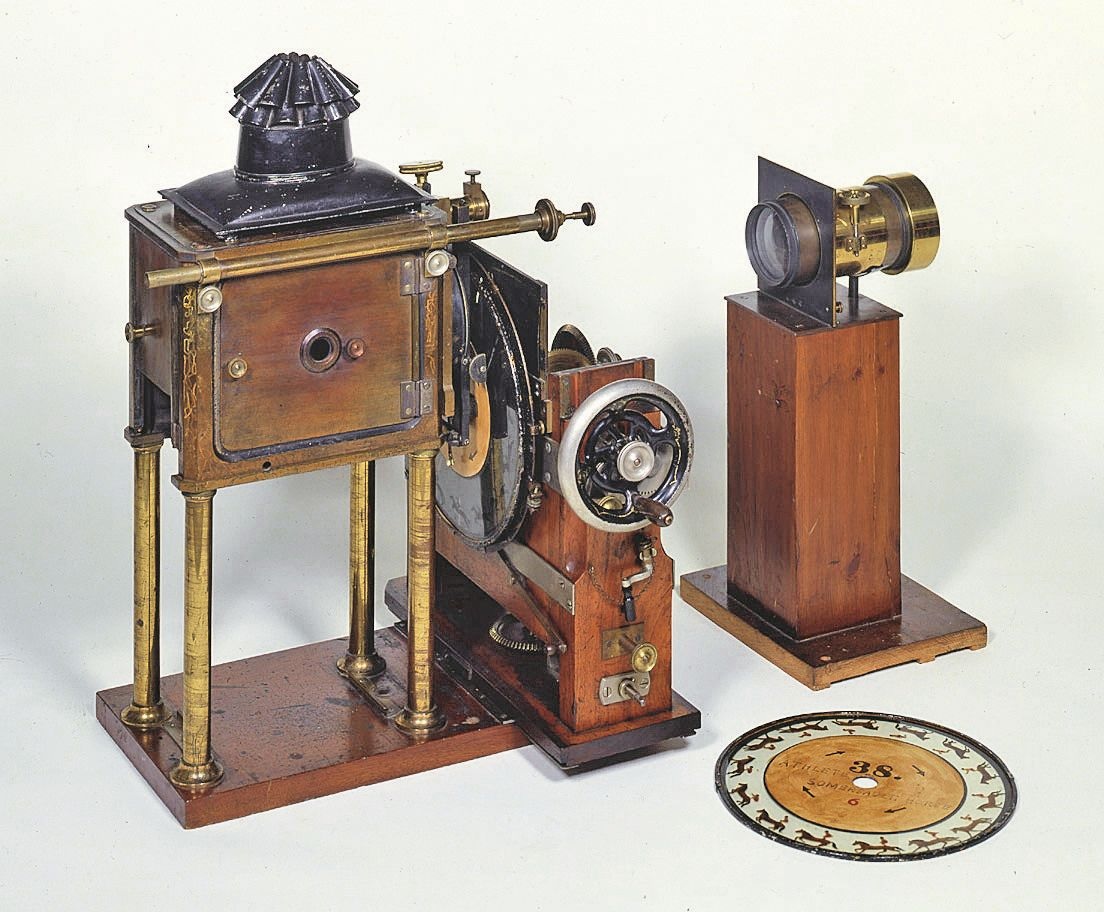
He then copied the images in the form of silhouettes onto a disc to be viewed in a machine invented by him which he called a zoopraxiscope (see below). This was later regarded as an early movie projector – motion pictures were not far away!

Muybridge’s horse on the move as viewed through the zooprxiscope – this is was produced in 2006 using Muybridge’s photos

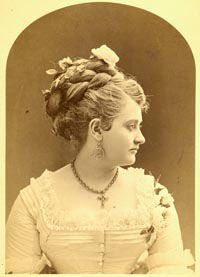
So what about getting away with murder? Well, let’s first go back to 1860. Muybridge was travelling in a stage coach in Texas when it crashed and he suffered head injuries and, in particular, to the orbitofrontal cortex  (front of the brain, okay) which was the likely cause of his later eccentricity and strange behaviour. One such ‘strange behaviour’ was to shoot dead his wife’s alleged lover, Major Harry Larkyns (well, perhaps it wasn’t so strange – depends on one’s point of view I suppose). Apparently, having previously ‘given her child’, Larkyns had written to Muybridge’s wife, Flora. Muybridge had obviously seen the letter and visited Larkyns in Calistoga in California and said to him, “Good evening, Major, my name is Muybridge and here’s the answer to the letter you sent my wife,” and shot him.

floraMUY

Flora Muybridge (1872)

Muybridge was put on trial and pleaded not guilty due to insanity caused by his above mentioned head injury. Four colleagues gave evidence to say that his personality had indeed changed from genial to erratic since the accident. Muybridge’s own behaviour in court whilst giving evidence was both contrary and explosive. The jury rejected insanity but found him not guilty on the grounds of ‘justifiable homicide’. So he got away with it, jammy … fellow (don’t try this at home as ‘crimes of passion’ are not deemed justifiable as a defence to murder in the UK – unreasonable, I know).

Muybridge went on to make many more motion studies being sponsored by the University of Pennsylvania. He returned to England in 1894 and died in Kingston-upon-Thames in 1904.

muybridge

Muybridge’s zoopraxiscope

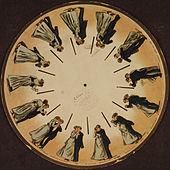
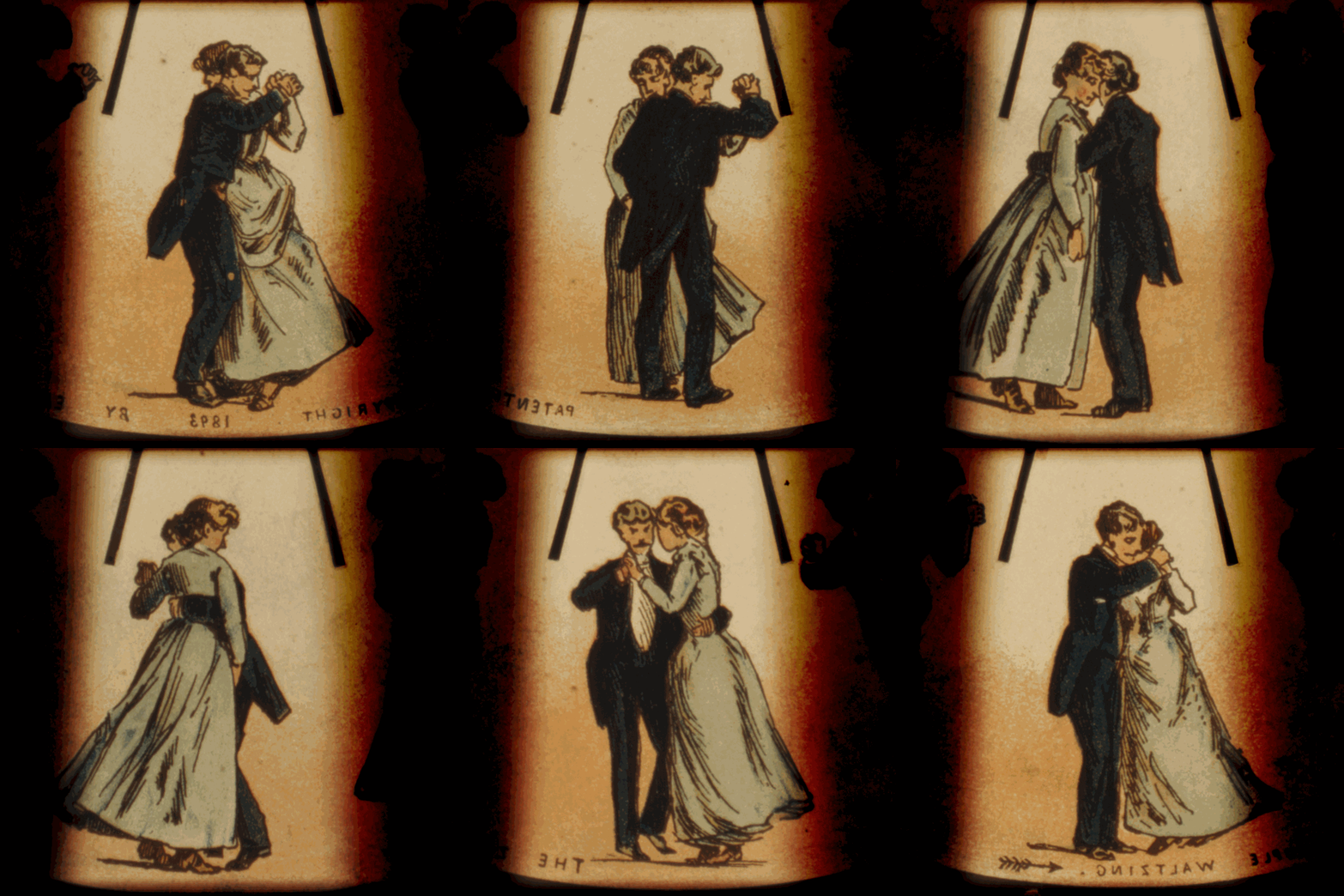
Phenakistoscope_3g07690u

     Phenakistoscope_3g07690b

                  Muggeridge’s dancing phenakistoscope disc (1893)

.

Next week:  Richard Pococke – 18th century antiquarian traveller


Artemus Smith’s Notebooks

I continue my research of the notebooks of Dr Artemus Smith, archaeologist of great courage, determination and fiction. Here is another extract:

I was digging in the Negev Desert in Israel and came upon a casket containing a mummy. After examining it, I called the curator of the local museum.

“I’ve just discovered a 3,000 year old mummy of a man who died of heart failure,” I told him.

To which the curator replied, “That’s a very quick assumption regarding date and cause of death. Bring him in and we’ll check it out.”

A week later, the amazed curator called me. “You were right about the mummy’s age and cause of death. How in the world did you know?”

“Easy,” I replied, and showed him a piece of papyrus that I had found in the mummy’s hand. It read, ‘10,000 Shekels on Goliath’.

art-smth

William Price – the druid who created cremation

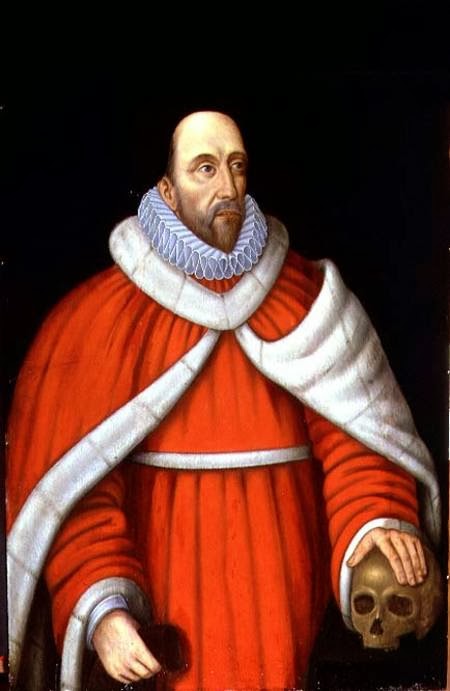
SO THERE I WAS preparing a talk on ‘Human Bones and the Law’ when I came upon this case R v Price 1884. Now the law on ownership of bones dates way-back. Basically no one owns bones, not even if they belong to a member of your family. Sir Edward Coke, Chief Justice in the 17th century, pontificated, “The burial of the cadaver [corpse], that is caro data vermibus [flesh given to the worms] is nullius in bonis [among the property of no person] and belongs to the ecclesiastical cognizance.” [1]

 Coke

Sir Edward Coke (pronounced ‘Cook’) C.J. (1552-1634)

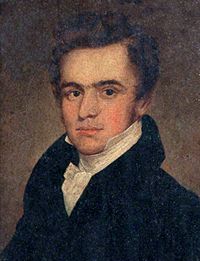
Well, there was this Welshman, William Price (1800-93), who had qualified as a medical doctor and became a member of the Royal College of Surgeons of England (having trained in London). He returned to Wales to work as a GP and, in 1823, became the chief surgeon at the Brown Lenox Chainworks in Pontypridd. So far so good.

William_Price_(physician)

Dr William Price in 1822 as a respectable medical student – ‘so far so good’

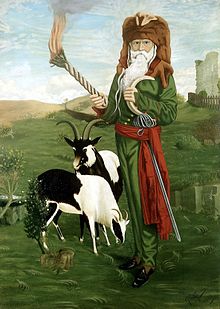
He then became involved in the Chartist movement (believing in votes for all men regardless of status – next there will be votes for women!) which led to an uprising which led to Price escaping to France. In Paris, at the Louvre Museum, he experienced his ‘turning point in his religious life’ when he saw an ancient Greek inscription which, for some bizarre reason, he interpreted as a Celtic bard addressing the moon. Yeah, okay. This was a sign to him to spread the word of the ‘true secrets’ of the Welsh language and free the Welsh from English dominance. Nothing new there. Anyway, as a result he became a druid and founded a new Druidic group which gained many followers. Just to give you an idea of some of his antics: he christened his daughter Gwenhiolan Iarlles Morganwg – meaning ‘Gwenhiolan, Countess of Glamorgan’; he organised an eisteddfod at Pontypridd but no one turned up (bad marketing); he held a Welsh nationalist parade along with a half-naked man called Myrddin (the Welsh name for Merlin) and a goat … of course.

William_Price_1884

Price in his druid gear in 1884

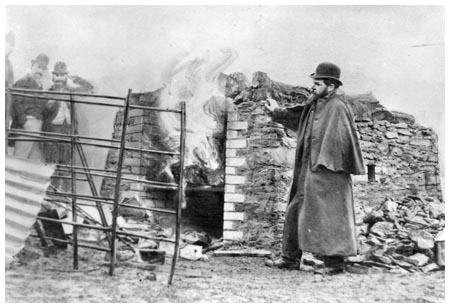
So wacky or what? But I digress, so now to the point. In 1883, when Price was 83 years old, his second wife, who was in her mid twenties (let’s not go there), gave birth to a son whom he named  Iesu Grist (the Welsh for Jesus Christ) as he had ‘great expectations’ for him. Sadly the child died after 5 months. Price’s religious belief prevented him from burying the corpse as it would pollute the earth. So he decided to cremate him on the hill outside his village of Llantrisant which was ‘not the done thing’ then. In fact, many of the villagers saw the smoke of the fire and attacked him. He was rescued by the police and the child was taken from the pyre before it had been engulfed in flames.

William_Price_painting_(2)

Painting of Price in his famous fox-skinned headdress 

Price was then arrested for illegal disposal of a corpse (the police were satisfied that the child had died of natural causes prior to the cremation attempt). At his trial at Cardiff Crown Court, whilst he accepted that cremation was not legal, he argued that there was no law against it either. Going back to Sir Edward Coke (above), the principle here is that if no one owns a body how can it be illegal to do what one wishes with it?  The judge, Mr Justice Stephen, agreed with Price and he was released from custody to much cheering from the people (not the ones from his village obviously). It would appear that cremation was here to stay and on the 14th March Price did, indeed, cremate his son. This led to the newly founded Cremation Society of Great Britain which put sufficient pressure on the government to introduce the Cremation Act 1902 (of which there have been several amended versions since).

Restricted useage

Cremation of William Price

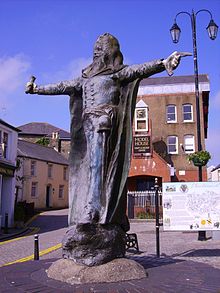
The case made Price famous, so much so that a statute of him was erected in Llantrisant in 1982 by the Cremation Society of Great Britain. His wife produced another boy who was also named Iesu Grist for the same reason as his first, the coming of the second (or third) Jesus Christ – he wasn’t (but that is no surprise). William Price was cremated in 1893 on the same hillside as his first son and was watched by some 20,000 people (see pic above). He certainly made an impression!

220px-Dr_William_Price_-_Statue

Statute of Price at Llantrisant

Footnote

[1] Unless they have “acquired different attributes by virtue of the application of skill, such as dissection or preservation techniques, for exhibition or teaching purposes. It thereby acquires a usefulness or value. It is capable of becoming property in the usual way, and can be stolen.” (See the case of R v Kelly & Lindsay 1998 – stealing bones used for educational purposes by a hospital).

.

Next week: Odd bods: Eadweard Muybridge ….. ‘moving picture-maker’ who got away with murder


Artemus Smith’s Notebooks

I continue my research of the notebooks of Dr Artemus Smith, archaeologist of great courage, determination and fiction. Here is another extract:

 My neighbour, George Shortbrain, came into the public house and sat next to me. An unfortunate name but similar to his nature – a man of limited intelligence. The public house had a television set and was showing the 10:00 PM news. The news crew was covering a story of a man on a ledge of a large building preparing to jump.

George said, “Do you think he’ll jump?”

“Yes he will,” I answered.

“Well, I bet he won’t,” said George. “In fact, I bet you a five pounds he won’t.’”

I agreed to the bet.

Just then the chap on the ledge did a swan dive off the building, falling to his demise.

George was very upset but willingly handed me the five pounds.

I said, “I can’t take your money, George, I saw this earlier on the 6:00 PM news and so I knew he would jump.'”

George replied, “I did too, but I didn’t think he’d do it again.”

I took the money.           


art-smth

The Magna Carta …. and all that

THE MAGNA CARTA was signed 800 years ago (well almost) on 15th June 1215. It means, of course, Great Charter. In fact it was so great that it was redundant by the middle of September of the same year, after having been annulled by Pope by letters dated the 24th August. But it did live on …….

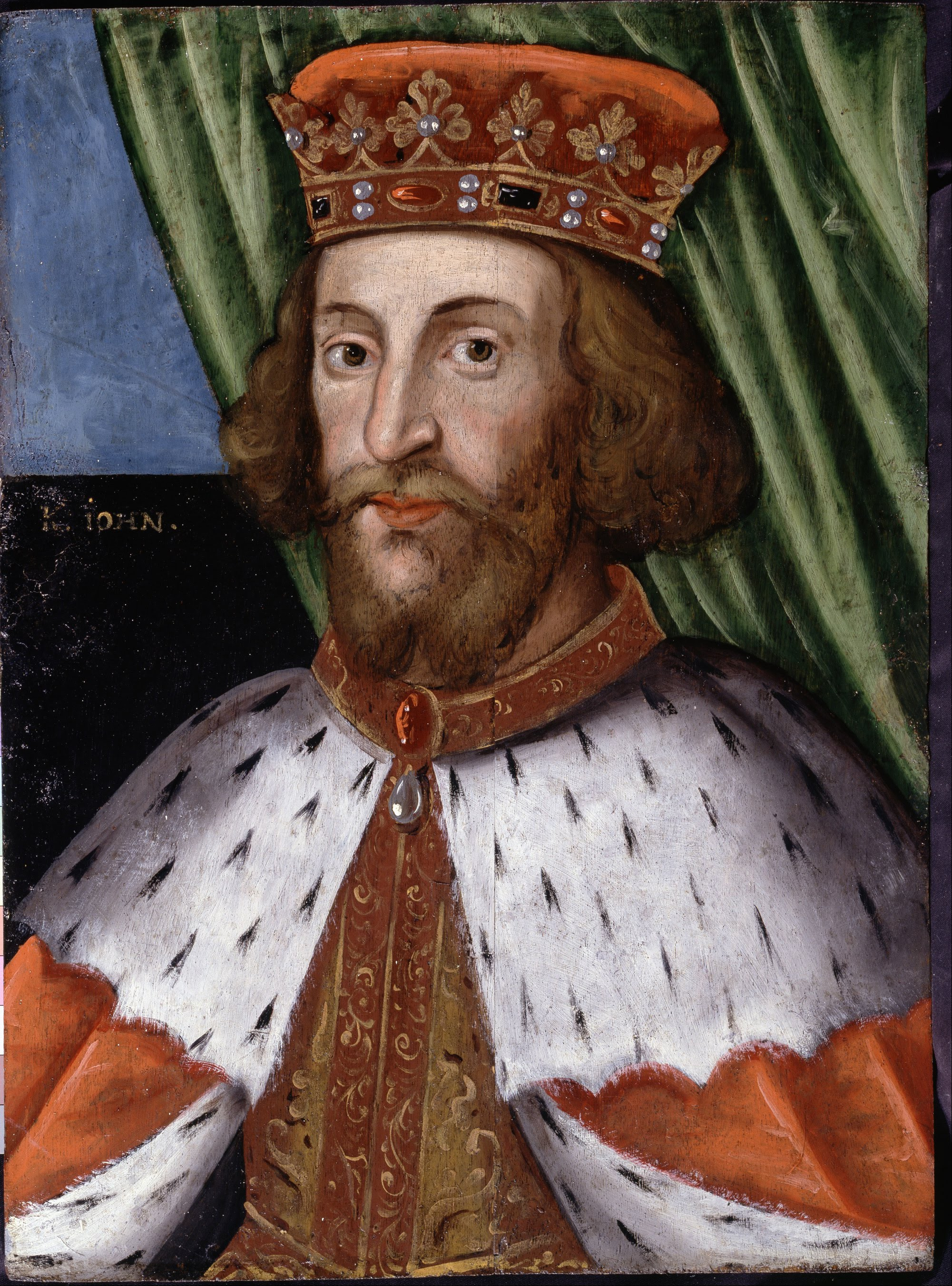
British_-_King_John_-_Google_Art_Project

King John (reign 1199-1216)

Basically King John was a bit of a tyrant king, wanting supreme power over the Church and his barons. Being very silly, by 1204, he had lost most of his ancestral lands in France to Philip II and so he raised taxes on his barons to ‘save-up’ for a conquest of France to retrieve these lands. Result: very miffed barons. It didn’t help that John was a bit naughty with some of these barons’ wives and daughters but we won’t go there.   The barons in the north and east of England ganged together taking an oath to ‘stand fast for the liberty of the church and the realm’ and raised their ‘We Hate John’ banners. Civil war was looming.

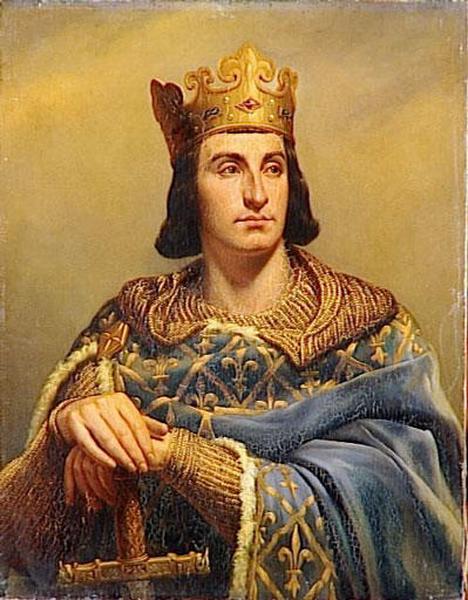
Philip_II,_King_of_France,Philip II of France (reign 1180-1223)

John took an oath to become a crusader trusting that such an action would put him in favour with the Church (remember the Knight Templar crusader monks last week) – or, at least give him some protection under church (papal) law. I bet he had his fingers crossed behind his back when he took that oath.

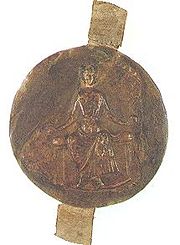
180px-Sealjohn

King John’s seal used to sign the Magna Carta and other documents making other promises he wouldn’t keep

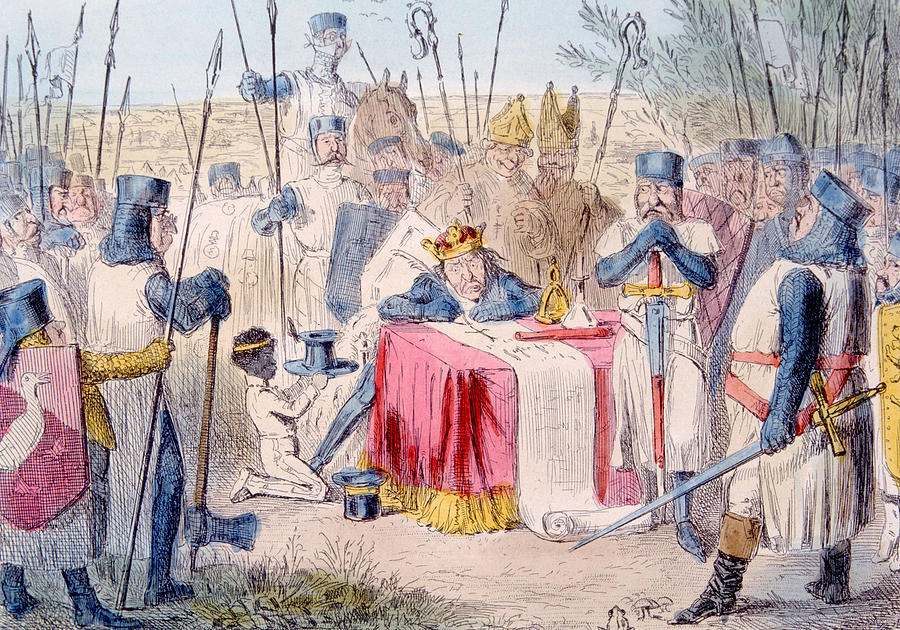
Anyway, to avoid civil war, John and his barons met at Runnymede to sign the Magna Carta which had been drawn up by Stephen Langton, the Archbishop of Canterbury. It was an agreement of 63 clauses including the protection of church rights, prevention of unlawful imprisonment of barons, swift access to justice and limitations on taxes and other feudal payments to the Crown.  Any impeachment of terms by the King would be enforced by 25 barons (the ‘security clause’). It’s known as a liberty agreement but it only affected the higher ranking members of society – about 10-20% of the populace – so a democratic document it was not. In effect, the Magna Carta was a peace treaty between John and his rebel barons.

the-magna-carta-being-signed-by-king-everett

King John (reluctantly) signing the Magna Carta

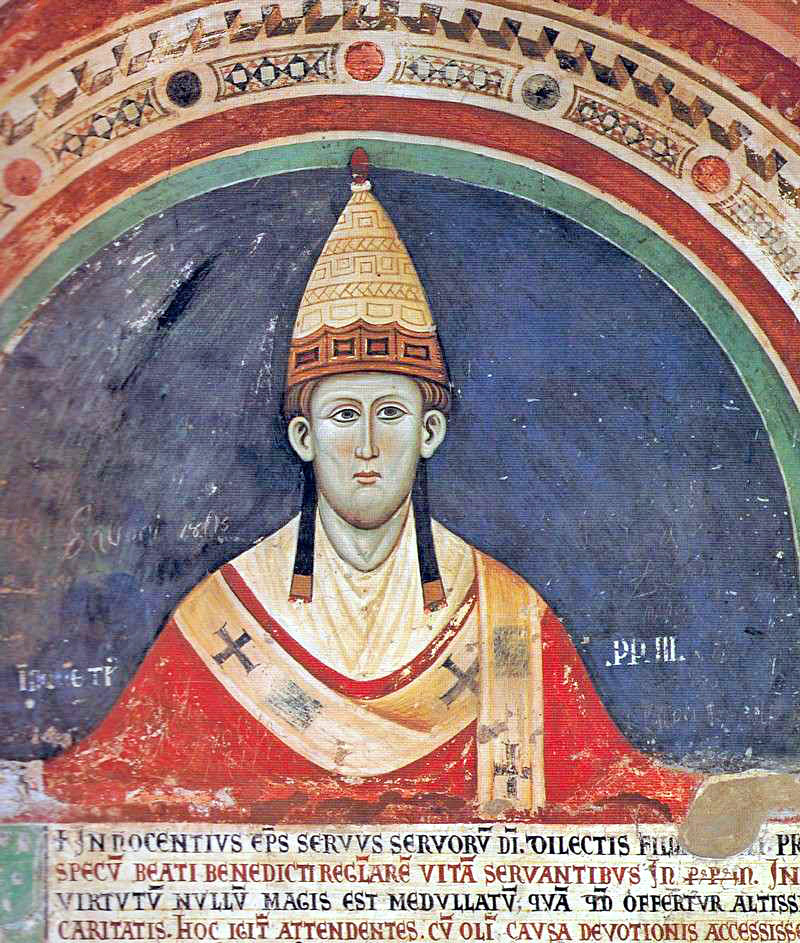
Needless to say, it almost immediately encountered problems. Firstly, the barons refused to surrender London which they controlled; secondly, the agreement forbid an appeal to any higher authority but John complained to the Pope, Innocent III (ironically, because I don’t suppose John accepted the Pope as a higher authority), as Langton (above) refused to enforce an earlier excommunication against the rebel barons (why would he if they had come to a peaceful agreement?!). Thirdly, Langton refused to give up Rochester Castle which was strategically vital as it guarded the access to the coast and a defensive position for any possible invasion by the French at Dover (so John wanted control over it). Then, when the Pope read the Magna Carta he was not impressed, particularly with the ‘security clause’ which implied use of violence which made the agreement unlawful in canon (church) law. That was it and, in August, the Pope sent his papal bull letters denouncing the agreement presumably as a ‘load of old bull’ (sorry).

Innozenz3

Pope Innocent III (1161-1216)

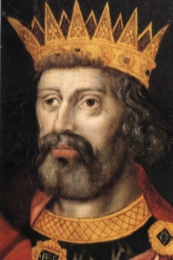
Civil war was inevitable as the barons were convinced (probably even prior to the signing of the charter) that John was going to be impossible to deal with. They allied with King Philip of France who sent them his son, the future Louis VII, to claim the English throne. Well, why not. The conflict achieved very little and John died in October 1216 leaving the crown to his nine year old son, Henry III (and if you remember last week, William Marshall, Earl of Pembroke was his regent). The charter was then resurrected – three times, in fact, during Henry’s reign – in 1216, 1217 and 1225  with Pembroke and the papal legate Guala sealing it whilst Henry was ‘under-age’. On each occasion certain modifications were made to it including the removal of the ‘security clause’. In 1253 it was first proclaimed to the public at large and, as well as its re-issue, Henry promised around a dozen or so times to uphold it. In 1297, Henry’s successor, his son Edward I, reissued the 1225 charter and guaranteed to comply with it on various occasions thereafter, as have the monarchs over the centuries ever since (okay, Charles I was a little difficult with it but there was no need to lose his head over it). It is this 1297 re-issue that sort of remains in force today.

13546_Henry-III

Henry III (reign 1216-1272)

I say ‘sort of remains in force today’ because most of the clauses were repealed in Queen Victoria’s reign and a few more during the 20th century leaving, now, only four in force, 1, 13, 39 and 40. Clause 1 confirms that the English Church shall be free to elect its own dignitaries without royal interference; clause 13 grants ancient liberties and free customs (trade) by land and water and to all other cities and towns;  clause 39 protects against unlawful imprisonment; clause 40 prevents a denial of justice. So there you have it – a great charter minus 59 of its original 63 clauses, although it had a great effect on future monarchs and their relationship with what was to become parliament. It stands for liberty, or, as the esteemed judge Lord Denning described it in 1964, ‘the greatest constitutional document of all times – the foundation of freedom of the individual against the arbitrary authority of the despot’. Well, in principle anyway.

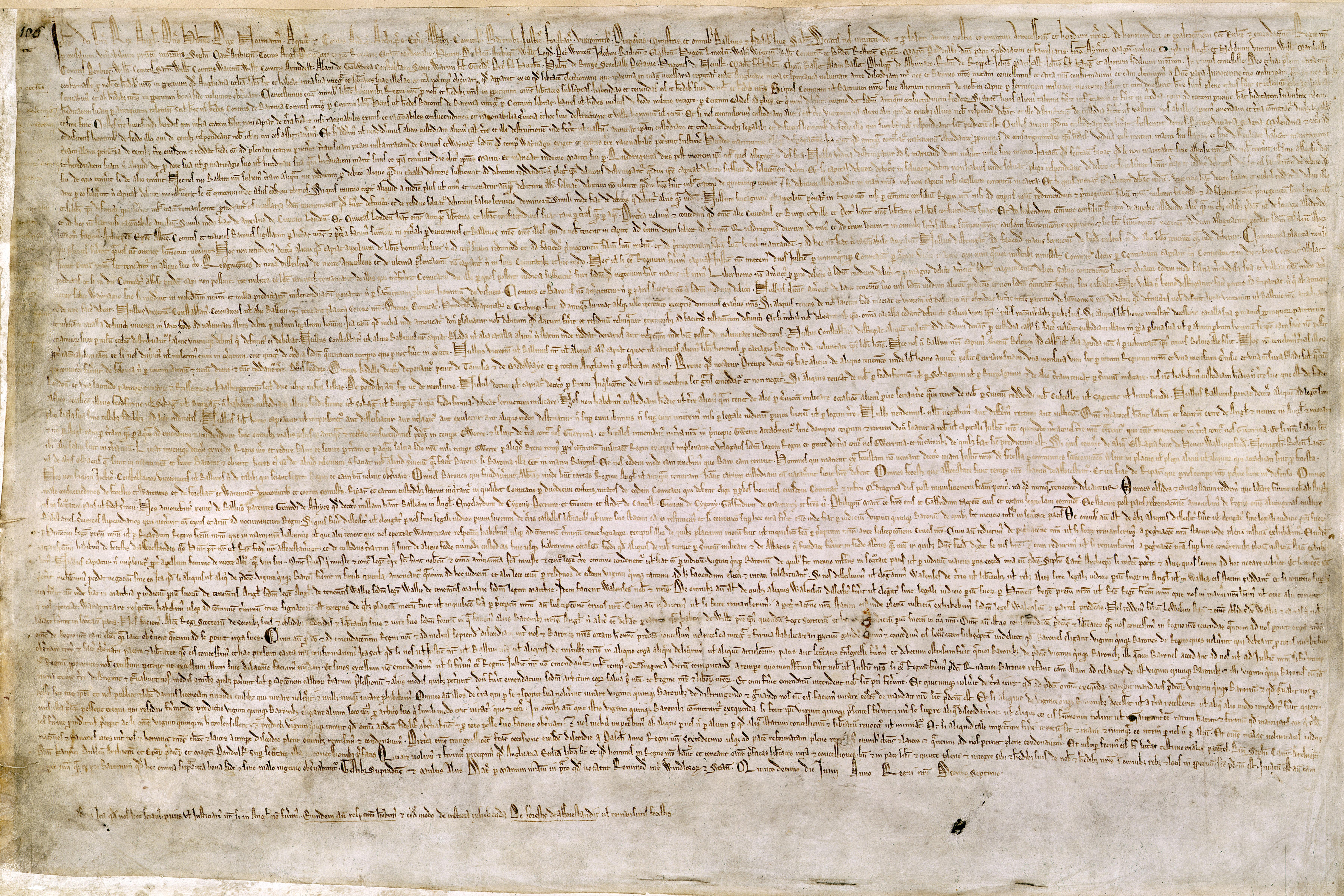
 Magna_Carta_(British_Library_Cotton_MS_Augustus_II.106)

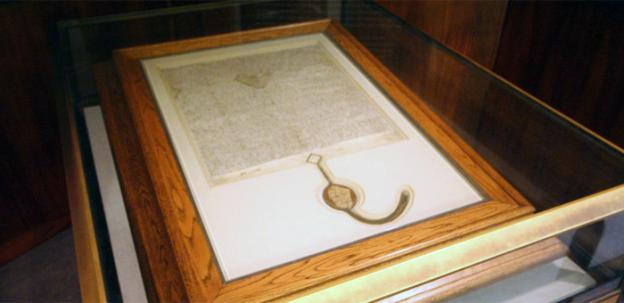
 1216 Magna Carta in the British London

 Many copies of the charter have been made over the centuries but there are very few of the ‘original copies’ around today. The ‘very original’ Magna Carta signed by John no longer exists but several copies were made for distribution around the realm. Only four of these 1215 copies still exist, two are in the British Library in London, one of which has suffered fire damage and is illegible but the only one to retain its seal (the other one, pictured above, was saved by the antiquarian, Sir Robert Cotton, from being cut up by his tailor for use as suit patterns). Another one is in Salisbury Cathedral, and the other in Lincoln Cathedral (both of these have been with these Cathedrals since 1215.  One 1216 original remains and is at Durham Cathedral.  Four 1217 editions still exist, three in the Bodleian Library, Oxford (one with William Marshall’s seal) and one at Hereford Cathedral.  A 1225 edition (the ‘Lacock Magna Carta’) had been hidden under the floorboards of Lacock Abbey in Wiltshire by its owner Miss Talbot in 1939 until 1945 and is now in the British Library. This one was to be loaned to the USA (the English setting up in the New World in the 17th century relied on the liberties of the Magna Carta) and a certain Lt-Cdr Douglas Fairbanks Jr USN set aside a public holiday as  a result (such authority for a movie star!),  but the loan required an Act of Parliament and Parliament couldn’t agree – nothing new there.  However, fear not America, there is a 1297 one in the US which was sold by the Brudenell family (the earls of Cardigan), to the Perot Foundation in the US in 1985, who sold to a US businessman, David Rubenstein, for $21.3 million dollars, who then gave it on permanent loan to the National Archives in Washington. Well done that man.

Magna_Carta_(1297_version_with_seal,_owned_by_David_M_Rubenstein)

The 1297 Rubenstein Magna Carta in Washington US

However, the 1297 Bruton Magna Carta was a bargain compared with the Rubenstein MC as it was sold at auction by the King’s School, Bruton, UK, to the Australian Government for only £12,500, although that was in 1952, and it is now on display in Parliament House in Canberra, Australia. It was not clear how the school came by this document – one suggestion was that it was simply found in a school desk in the 1936! The British Museum wanted to keep it but couldn’t afford it (they were thinking of offering around £2,500). Then there’s the ‘twist’ to the story. Later investigations revealed that the Bruton Magna Carta would have been part of a collection of documents, including a companion to the Magna Carta, the Forest Charter also of 1297 bearing the same sealing, owned by the nunnery at Eastbourne Priory in Sussex. On the dissolution of the monasteries the priory and its documents were transferred into private hands and the documents found their way into the possession of a solicitor, one John Louche of Drayton. In 1905, John Douche’s son granted all these documents to the British Museum.  The documents included the 1297 Forest Charter but not the Magna Carta. It should have been among the documents being a companion to the same-year and same-sealed Forest Charter. It would appear that John Douche may have muddled up the priory documents at some point and the Magna Carta had been accidentally ‘filed’ away with papers that eventually found their way to King’s School Bruton. So,  in reality, it was highly likely that the British Museum should have had the Magna Carta free of charge. Hmmm …… solicitors!

2.22.12news-wikimedia-magna-carta-edit

  The 1297 Bruton Magna Carta on display in Canberra, Australia

.

Next week: Odd bods: the druid who created cremation ……


Artemus Smith’s Notebooks

I continue my research of the notebooks of Dr Artemus Smith, archaeologist of great courage, determination and fiction. Here is another extract:

I was acquainted (not by friendship I must add) with a solicitor of rather undesirable habits, one of which was his continual boasting of his powers of negotiation.

 He met his match the other day with a good friend of mine, a barrister, Soames Maltravers.

 Now Maltravers had a great legal mind and would charge £100 for each question he answered. The solicitor was determined to negotiate a better deal. He asked Maltravers, “Can I ask you two questions for £150?”

 Maltravers responded, “Indeed you may. What’s the second question?”

art-smth

Middle Temple and Temple Church

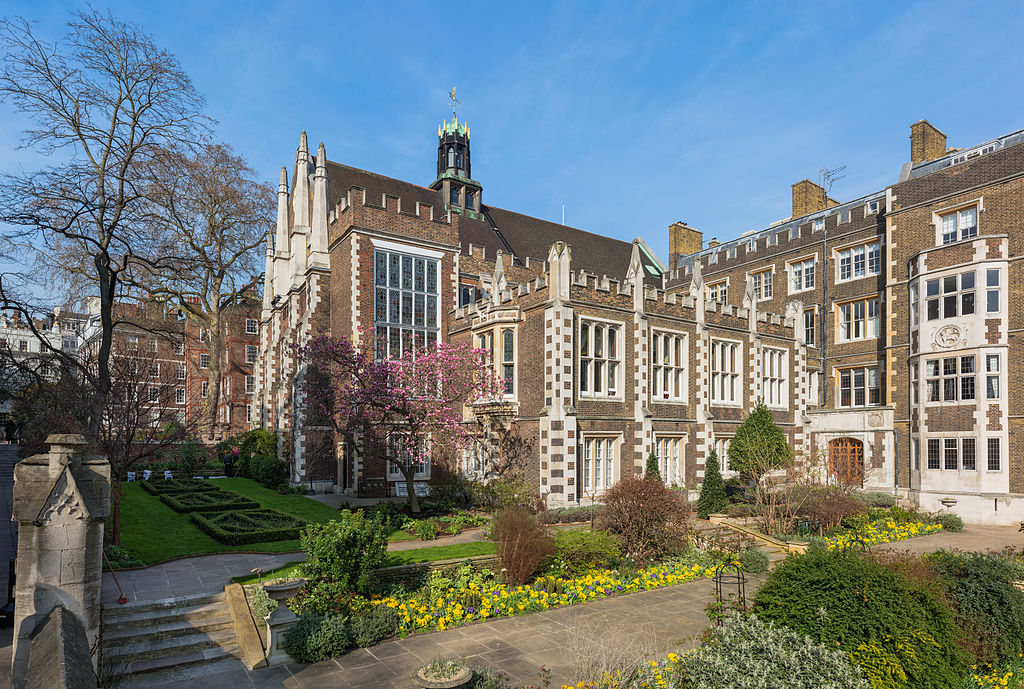
ONE OF THE four Inns of Court in London is Middle Temple – or more formally known as the Honourable Society of the Middle Temple. The other three are Inner Temple, Lincoln’s Inn and Gray’s Inn, all in close proximity of each other, and they are where barristers work and, in some cases, live – in fact, in the early days it was were many of them did live communally, hence the name ‘Inn’. Middle and Inner Temple were once referred to as Middle Inn and Inner Inn of the Temple. I’m only going to talk about Middle Temple because it’s my Inn of Court, so there.

Middle_Temple_Hall_Exterior,_London,_UK_-_Diliff

Middle Temple Hall

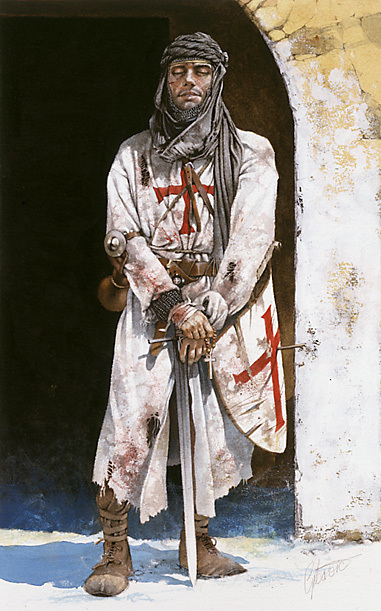
 It’s called Middle Temple because the land it stands upon was once owned by the Knights Templars. In fact, the Temple Church which stand in the grounds today (see below) was built by them in 1185. The Knights Templar (they were mainly English and French) came into existence 895 years ago almost exactly. How many days more depends when you are reading this as it was Christmas Day 1119 that nine knights took monastic vows to protect pilgrims travelling from Western Europe to the Holy lands of the Levant. This was as a result of conflict between Christians and Muslims (nothing much has changed in nearly 1000 years). These knights were initially called the Poor Fellow-Soldiers of Christ and the Temple of Solomon – Knights Templar for short. They came to an end in 1312 (Friday 13th October in fact – hence Friday 13th being supposedly bad luck) when King Philip IV of France, who was in with the Pope Clement V, persuaded the General Council of Rome to suppress the Order of the Templars. Philip was in great financial debt to the Templars – get rid of the Templars, get rid of the debt. Nice one Phil. It’s not what you know …… Anyway, in England the Templar properties were given to another military monastic order, the Hospitallers (or Knights of St John). For more on Templars click here.

templarKnight Templar

Cutting a long story short, the King’s courts moved from York to Westminster in 1339 and the judges needed to be nearby – and that is when the four Inns of Court were set up. At that time it was judges of the Inns that ‘Called’ advocates to the Bar to follow them in the King’s court (then the Common Pleas or Commons Bench). These advocates were called serjeants-at law (servientes ad legem) but they ‘went-out-of-use’ in the late 19th century and were replaced by senior barristers known as Queen’s Counsel (QC) and junior barristers (who are all ‘Called’ into their respective Inns).

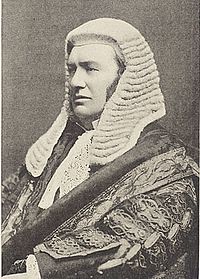
 LordLindley_cropp

Middle Templar Lord Lindley was the last sergeant-at-law to be appointed – he became a QC in 1874

Middle Temple was rented to the lawyers by the Hospitallers until the Reformation of Henry VIII in the 16th century. The Crown then became its landlord until the reign of James I in 1608 when it obtained clear title to the land. Hooorah! Sir Walter Raleigh was a Middle Templar; Sir France Drake was not – but the cover hatch to his Golden Hind is still used today as the table to which Middle Temple barristers are Called to the Bar having qualified. Fine piece of useless trivia. And more – William Shakespeare’s Twelfth Night was first performed in Middle Temple in 1602 (there are several ‘Inn’ jokes to be found in the play).

 golnf hin2

 Hatch of the Golden Hind used a a table but actually called the ‘cupboard’ (don’t ask)

 mid temp 2

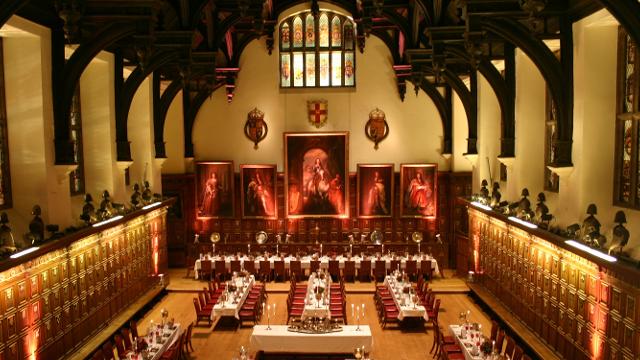
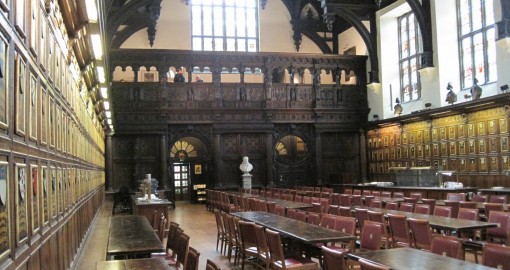
Western interior of Middle Temple hall for dinning  … smart, eh?

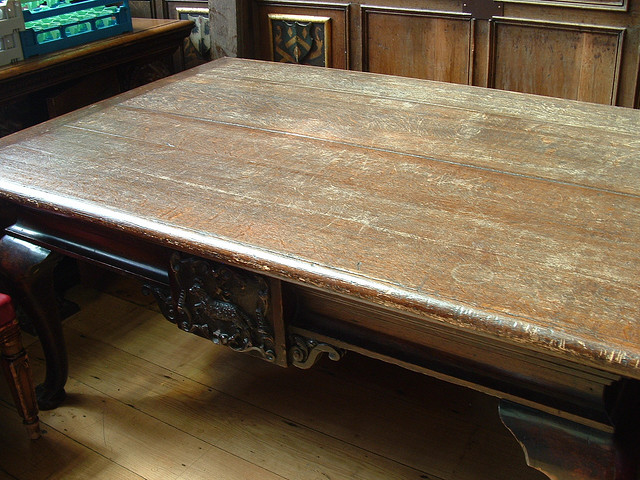
Middle Temple Hall was built between 1562 and 1574 under the guidance of the Treasurer, Edmund Plowden. He employed the services of Sir John Thynne’s chief carpenter, John Lewis, to construct the hammer-beam roof (similar to the one he had created at Longleat). By the late 16th century the four Inns of Court were known as the third University (after Oxford and Cambridge, of course) and Middle Temple was the centre of education for potential lawyers of that Inn (and children of the nobility). Much of the learning was achieved by attending moots (mock trials) and dinners to discuss law – both traditions still continue today wherein student barristers have to attend 12 dinners in Hall before they can be Called to the Bar and mooting is a competitive activity.

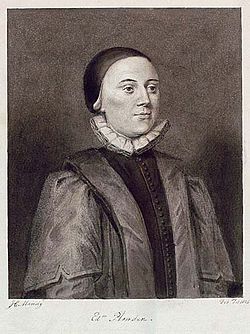
Edmundplowden15181585

Edmund Plowden (1518-85)

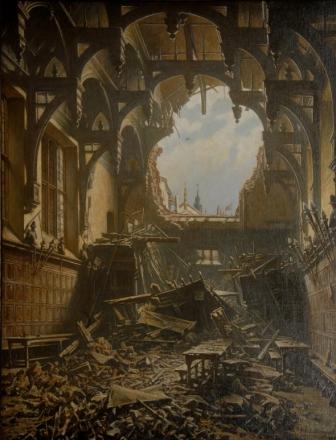
During the Second World War, on 15th October 1940, a landmine on a parachute destroyed the eastern gable of Hall and the Elizabethan minstrel’s gallery. It was painstakingly restored and reopened in July 1949. In fact, Middle Temple as a whole suffered quite badly due to bombing during the war – it lost 122 of its 285 sets of chambers (sets of ‘offices’ where barrister work). But it’s all better now.

The eastern gable and minstrel’s gallery in Hall ………  1christodoulou-beresford-war-damage-to-hallbefore (in October 1940)   (painting by Frank Beresford now hanging in the minstrel’s gallery)       

middle-temple-hall

…. and after (that’s Plowden’s statue in the middle)

You can also hire the Hall and for more info on the place click here

Temple Church

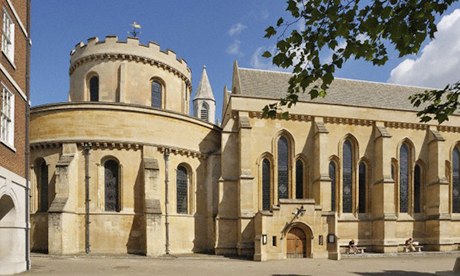
As mentioned above, Temple Church was built in 1185 and is one of the oldest churches in London. Templar churches were always built to a circular design to remind the Templars of the Church of the Holy Sepulchre at Jerusalem, which has a round dome above the site of the sepulchre where Jesus was buried. The church is still used today as a place of worship by both Middle and Inner Temple members and guests on Sundays. It’s well worth a visit and it’s open most days to the public.

 Middle Temple Church

Temple Church 

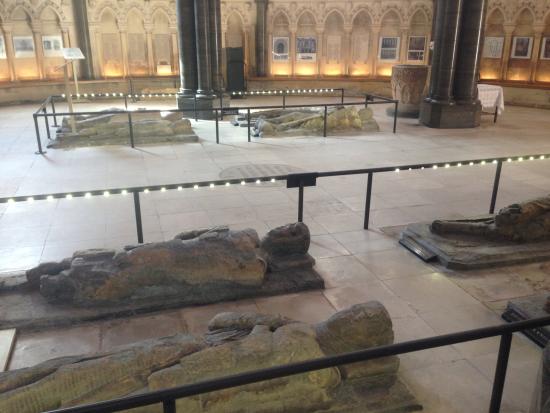
The film buffs among you will recognize it from its appearance in Dan Brown’s The Da Vinci Code. Hanks & Co are looking in the church following the clue: “In London lies a knight a Pope interred. His labour’s fruit a Holy wrath incurred. You seek the orb that ought be on his tomb. It speaks of Rosy flesh and seeded womb.” I forget what they found – other than trouble, but ‘the knight a Pope interred’ would have been one of the effigies of the Knights Templars that are on the floor of the circular part of the church. They include William Marshall, first Earl of Pembroke, and his son, William Marshall, second Earl of Pembroke. The first earl was chief adviser to King John and regent to Henry III until he came of age; the second earl was a witness to King John signing the Magna Carta in 1215 (more on that next week).

stone-knights

Effigies of Knights Templars in Temple Church (situated in the circular part) – the Marshalls are far right background

Temple_Church,_Temple,_London_EC4_-_Effigy_of_a_knight_-_geograph.org.uk_-_1223114

The Earls of Pembroke (dad to the left)

Next week: it will be 2015 – 800 years since the Magna Carta …..


Artemus Smith’s Notebooks

I continue my research of the notebooks of Dr Artemus Smith, archaeologist of great courage, determination and fiction. Here is another extract:

I received a letter from my good friend Joshua Barts-Hofner, a bit of a wit and jolly good rugger player. The letter read as follows:

My dear Artemus,

It was our thirtieth wedding anniversary last week and my adorable lady-wife asked me to describe her after all these years. I looked at her for a while, then said, “You’re an alphabet wife ….. A, B, C, D, E, F, G, H, I, J, K.”

She asked … “What on earth does that mean?”

I said, “Adorable, Beautiful, Cute, Delightful, Elegant, Fabulous, Gorgeous, and Hot”.

She smiled happily and said … “Oh, that’s so lovely, but what about I, J, K?”

I said, “I’m Just Kidding!”

The swelling in my eye is going down and I’m darn glad I took out dental insurance.

Yours, etc

art-smth

Brasenose – an Oxford College

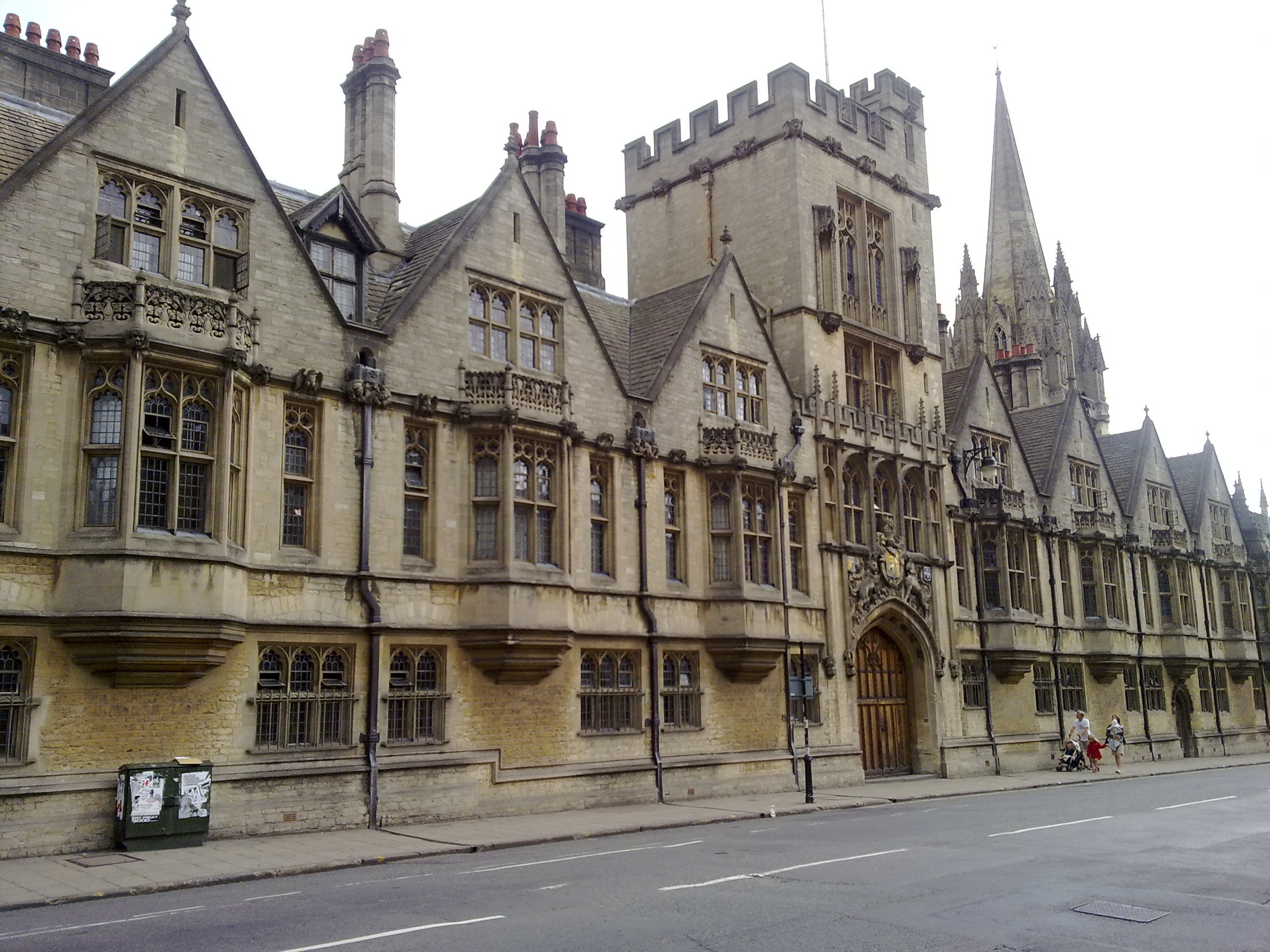
Brasenose_College_from_the_High_Street

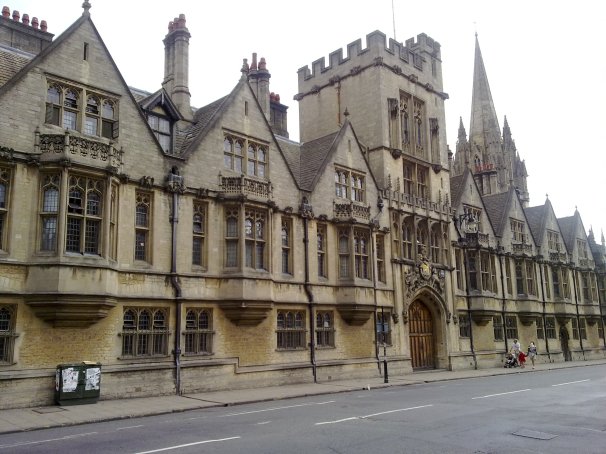
Brasenose College from the High Street (late 19th century frontage)

LET ME introduce you to an Oxford College – Brasenose College – my old College in fact. It boasts alumni such as Sir Arthur Evans (he of Knossos fame – see my June blogs), Sir William Golding (Lord of the Flies), John Buchan (Thirty-Nine Steps), William Webb Ellis (for rugby fans – he invented the game), Colin Cowdrey (for cricket fans), Michael Palin (for Monty Python fans), oh, and David Cameron (for …..er …., well, he was there).
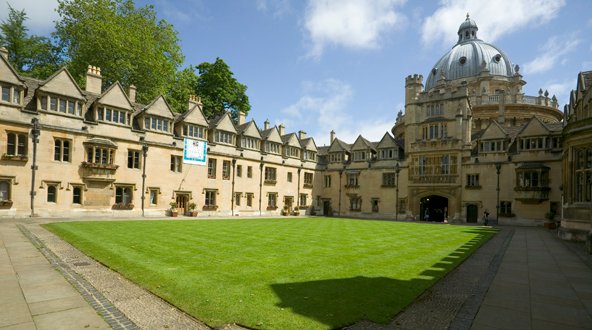
bncsplash1

The Old Quad (16th century) – sun dial (1719) on left wall often recognized in Morse episodes (the dome top right is not part of BNC, it’s the Radcliffe Camera outside in Radcliffe Square)

Brasenose began life as Brasenose Hall around 1219, but it was founded as Brasenose College (BNC) in 1509 by Sir Richard Sutton, a barrister (who acquired the property for the site), and William Smyth, Bishop of Lincoln (who provided for the expenses of the building) and it received its Royal Charter in 1512 with the full name of ‘The King’s Hall and College of Brasenose’.
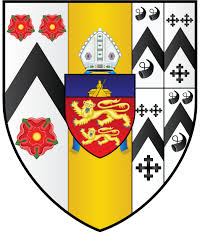
bnc               BNC coats of arms – to left is Smyth’s, to right is Sutton’s and in the centre is the See of Lincoln’s (the diocese in which Oxford lay in when the College was founded)
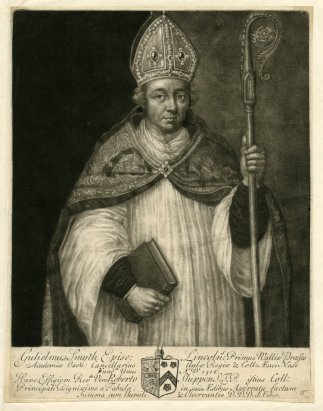
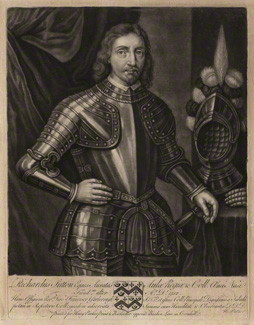
Portrait_of_William_Smith_founder_of_Brasenose_College_Oxford_by_John_Faber_the_Elder      NPG D4337; Sir Richard Sutton by John Faber Sr, after  Unknown artist

 William Smyth (1460-1514)                                          Richard Sutton (? – 1524)

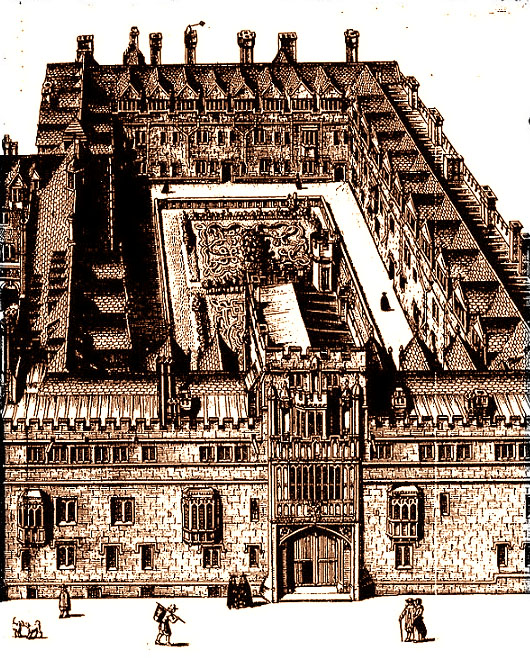
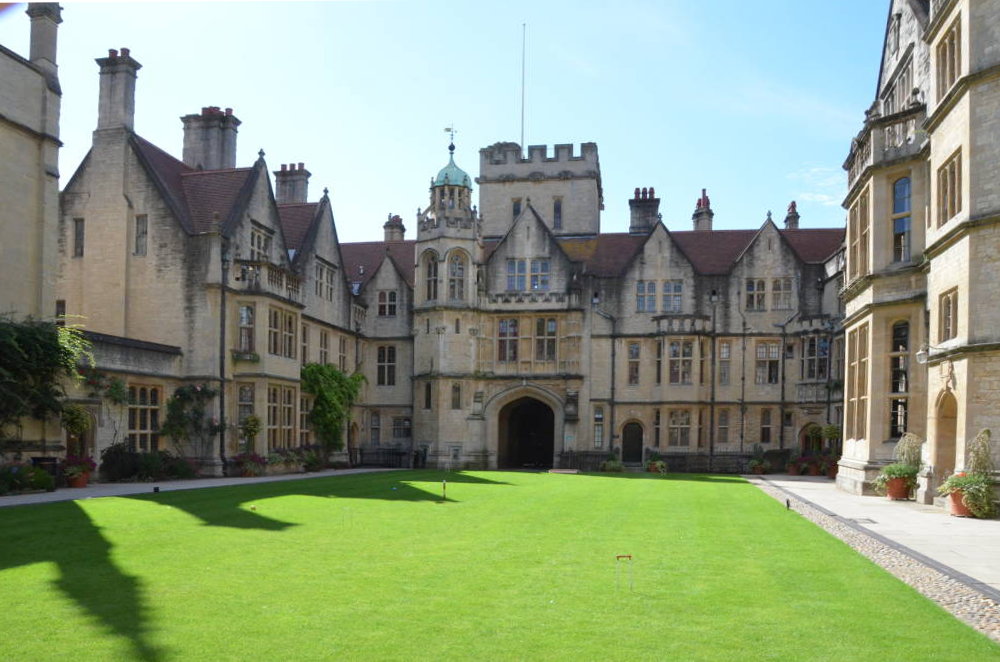
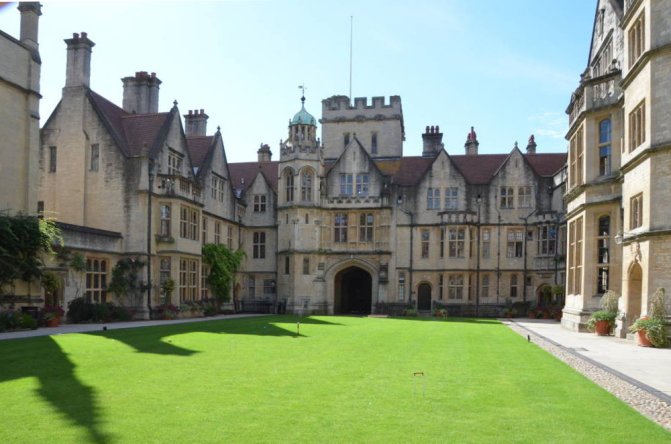
The Old Quad (pictured above) is the original 16th century building, but then of just two floors.  A third floor with dormer windows was added in 1635. The oldest part of the College is the 15th century kitchen from when it was part of the earlier Brasenose Hall (see below) – it has since been update once or twice – in fact, very recently. Between 1657 and 1666 the Deer Park (very small area and supposedly named as a sly dig at the massive Magdalen Deer Park), the New Library and the New Chapel were added to the south of the Old Quad building. Nothing much happened to the place during the 18th century due to lack funds (well, it had funds but most of them seem to end up in the pockets of the Principal and Senior Fellows – much to the annoyance of the Junior Fellows who complained bitterly ….. until they became Senior Fellows). Then towards the end of the 19th century the High Tower and New Quad adjacent to the High Street began to take shape (see pics at beginning and end).
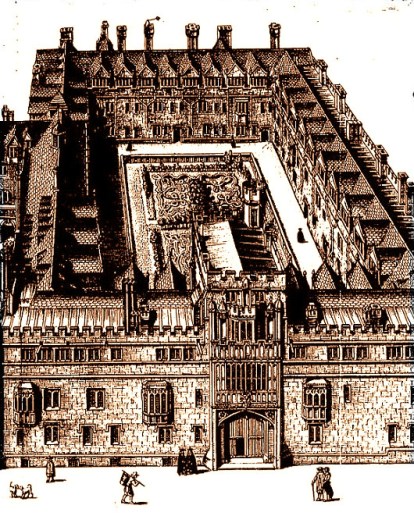
 bnc-17th-c

Extent of BNC  from the 16th century to early 17th century (north to the right)
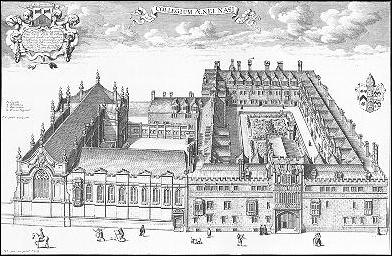
Brasenose_College_from_Loggan's_Oxonia_Illustrata

BNC in 1674

deer-park-bw-272-01

Part (about half) of the Deer Park in foreground (I said it was small) with the New Chapel in the background

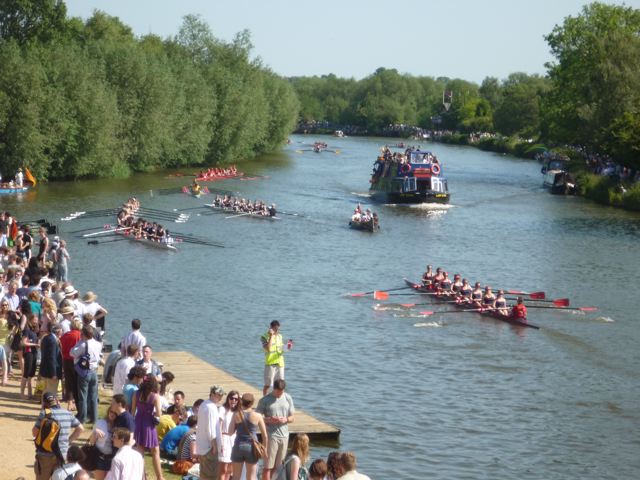
Interestingly, sport was rarely played by any of the Oxford Colleges before the 19th century – young men of Oxford in the 18th century, particularly, were of the drinking sort rather than the sporting sort (or even academic sort – only a few bothered with actually obtaining a degree in those days!). Sport began, unsurprisingly, with rowing, then, wot ho!, cricket. BNC acquired a good reputation in these two activities in the early days. In fact, since the races began in 1815, BNC runs 3rd with 23 victories as the ‘Head of the River’ (Oriel is 2nd with 30, Christ Church is 1st with 33).
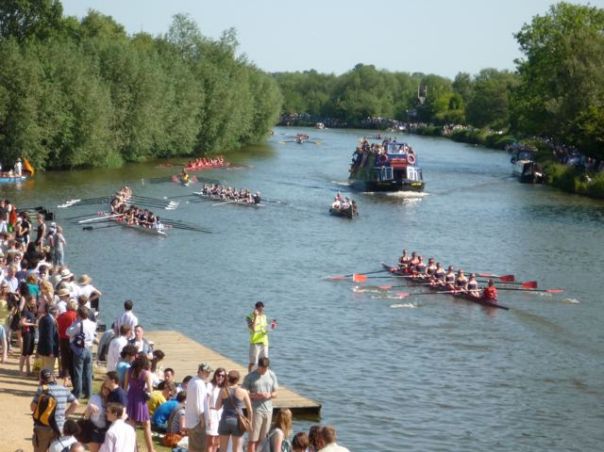
bnc rowing

A Saturday afternnon in May, end of Eights Week, the rowing viewed from the balcony of BNC boat club (with Pimms) is always a good crack

The College’s, shall we say, unusual name refers to a 12th century ‘brazen’ (brass or bronze) door knocker in the shape of a nose. The door knocker is said to date back to the 13th century and, from around 1279, marked the entrance to Brasenose Hall (an academic hall – independently leased in 1381 – before BNC became a College in 1509). In 1333, it is believed that the door knocker was removed by a band of rebellious students who migrated to Stamford in Lincolnshire. This rebellion was, in due course, suppressed and the students were ordered to return to Oxford – but without the knocker. In 1880, a house in Stamford came up for sale – it had been known as ‘Brasenose’ since the 17th century due to its door knocker which was thought to be the very one taken by the migrating students in the 14th century. BNC purchased the house to recover the door knocker! Well, spare no expense!
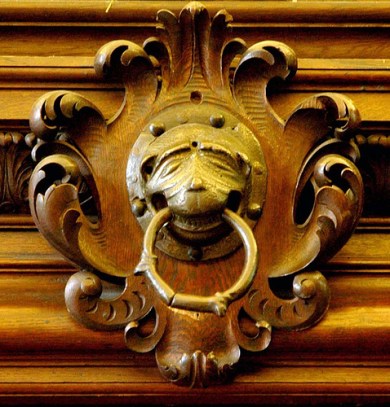
bnc1

BNC’s 13th century door knocker now displayed  in Hall

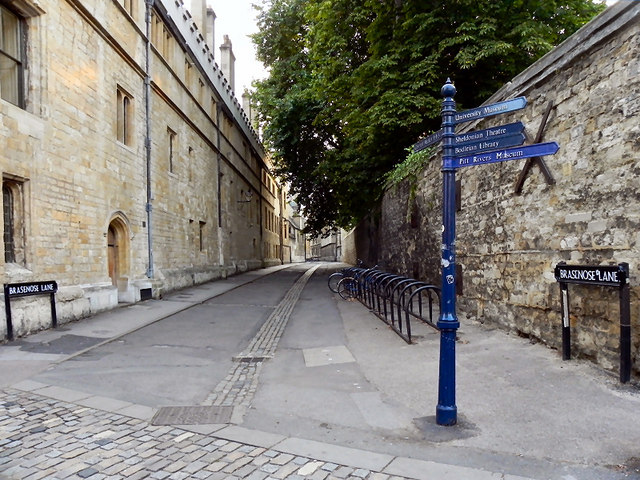
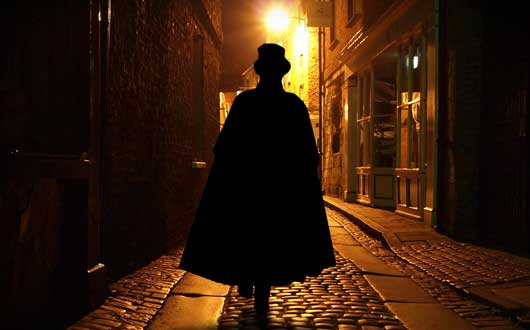
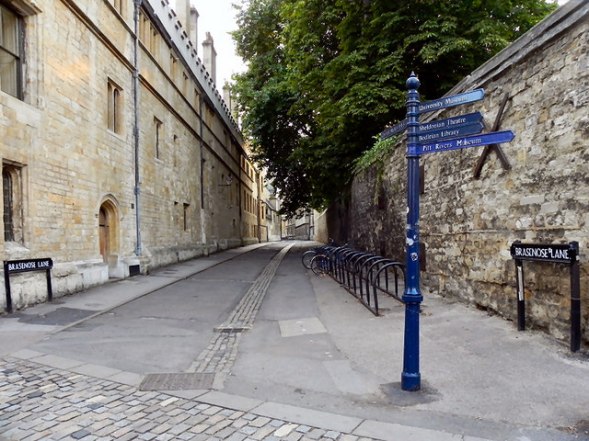
DON’T READ THIS PARAGRAPH AT NIGHT (you have been warned): BNC also has its legends. One of the more ‘infamous’ is the alleged brief composition of the Hell Fire Club (HFC) wherein demon worship – and a good deal of drinking – supposedly (well, only with regard to the former) took place. So, nearing midnight on a December eve in (reportedly) 1828, on returning to College via a dimly-lit Brasenose Lane, a Fellow of BNC noticed a tall character dressed in a long black cloak pulling a person through a ground floor window which was not only protected by upright iron bars but also reinforced with stout wire-netting (to prevent students sneaking out at night). The window was that of a known and degenerate member of the HFC. Preposterous of course. However, on hastily rounding the corner of the Lane and entering the College, the Fellow encountered much shouting and then took sight of a rush of a group of terrified gentlemen appearing into the Quad from the staircase containing the very room with the window just described above. The legend concludes by suggesting that the owner of the room had been mid-way through a blasphemous speech when he fell dead with a broken blood vessel. It may be inferred that the tall man in the black cloak was the Devil Himself coming to collect the soul of his own (this tale is recorded in the 1872 journal Odds and Ends). Of course, no mention was ever made of the identity or the alcoholic state of the Fellow who ‘witnessed’ the tall man in the black cloak performing this devilish deed.
jack-the-ripper-york-main

Soulless visitor to BNC

Not finished yet. The ‘legend’ then moves to archived fact. On the 3rd March 1834, Edward Leigh Trafford, a 21 year old undergraduate who had ground floor rooms with windows facing Brasenose Lane, and who, by tradition, was a president of the HFC, died of delirium tremens (the DTs – okay, ‘the horrors’!). Spooky, eh?
bnc lane

Brasenose Lane (BNC to the left) – avoid it at midnight, in case of drunken Fellows

During the 17th century BNC found itself in financial difficulties which worsened in the Civil War when Charles I made his headquarters in Oxford. He borrowed as sum of money from BNC for the conflict against the Parliamentarians. This, along with the 8% interest was never paid back – until November 2008…. by me in recognition of the 500 years of BNC (needless to say the sum is not comparable to today’s values and I did not include the interest as I had no statutory evidence that BNC was registered as a moneylender in the 17th century and therefore able to lawfully charge interest – that’s my story and I’m sticking to it!). I had read about the debt in Joe Mordaunt Crook’s 2008 book on Brasenose and the, then, Principal at BNC, Professor Roger Cashmore, wrote to me to say my contribution had been ‘immortalized in two speeches’ by him introducing the book on two occasions, but I’m still awaiting a note of appreciation from the present Royal Family …..

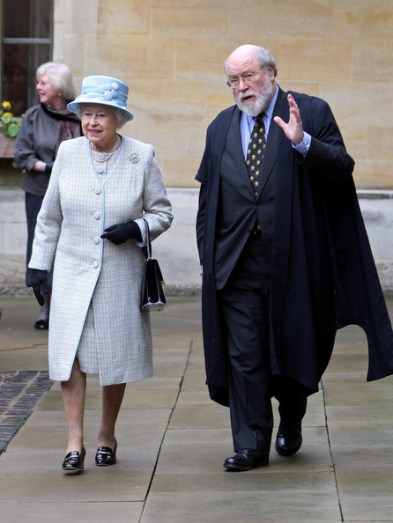
Talking of which, also to celebrate 500 years of BNC, the Queen visited BNC on 2nd December 2009 and was shown around the College by Roger Cashmore.
Queen+Elizabeth+II+Visits+Brasenose+College+_FL16Rty3gtl

Roger Cashmore reminding Her Majesty of my generosity
bnc2

The New Quad (behind the High Street – completed by 1911 – modern by BNC standards!)


Next week: Let’s go look at an Inn of Court


ASIDE

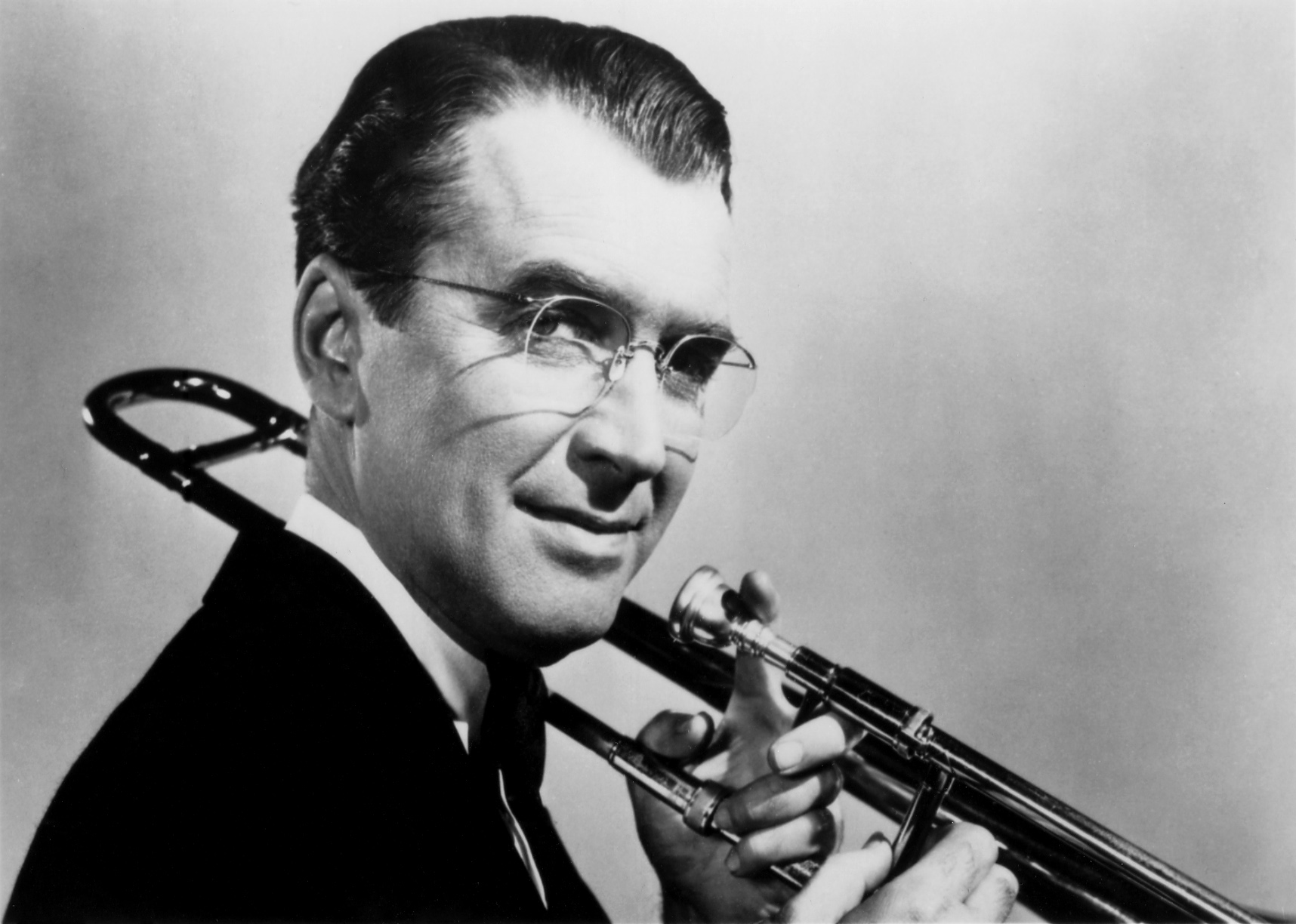
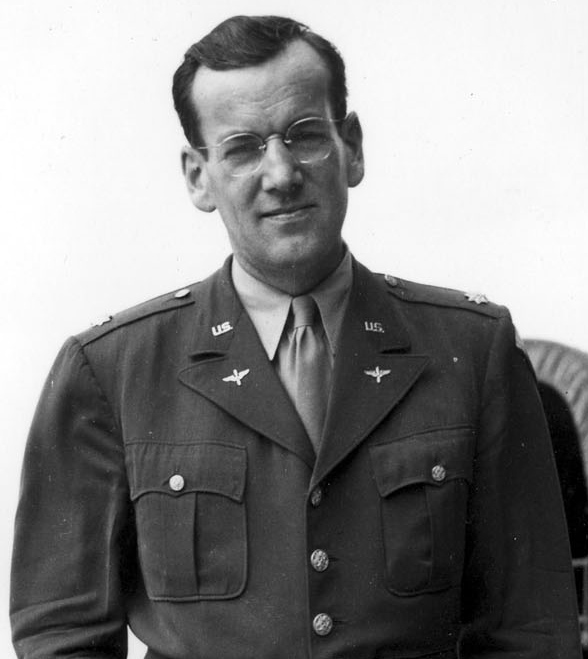
Did you know it was 70 years (and 5 days) since we sadly lost, as a result of a plane cash, the very talented Jimmy Stewart ……. sorry, Glenn Miller (I’m of the generation – I think most of us are now – that can never think of Glenn Miller without seeing James Stewart who memorably (obviously) played him in the 1954  film The Glenn Miller Story). Anyway, 15th December 1944, he (Miller not Stewart) was flying from an RAF base at Twinwood Farm, Clapham, Bedford, in the UK, to Paris to play to the troops, when his plane disappeared over the English Channel. It has been suggested that the most likely theory for the disaster is that the carburetor froze up in the cold weather. In fact, this was the cause of my father’s crash in his Wellington Bomber in 1940 resulting in him ending up in Stalag Luft III (of ‘The Great Escape’ fame – see end of that blog beginning of August).

Len Goodman of Strictly Come something is doing a radio prog on Miller which may be worth a listen. Click here,
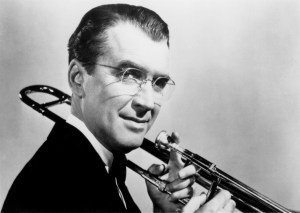
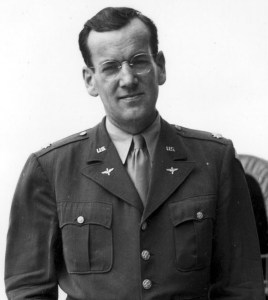
- Stewart, James (Glenn Miller Story, The)_01                 Maj. Glenn Miller

Jimmy Stewart as Glenn Miller and Glen Miller as himself (which is which? – obvious when you see them!)


Artemus Smith’s Notebooks

I continue my research of the notebooks of Dr Artemus Smith, archaeologist of great courage, determination and fiction. Here is another extract:

I was in church with my old tutor from Oxford and we were just chatting whilst waiting for the start of the service, when, strap me, Satan himself suddenly appeared.  Many of the congregation screamed to see God’s arch enemy and they all ran from the building.  I was too astounded to consider a plan of action but simply exclaimed to my old friend (my tutor, not Satan), “Good Lord, what a scoundrel; damned impertinence, if you ask me!”

My tutor nonchalantly suggested that we stay where we were as there was no need for concern.

Now this clearly confused Satan and he walked up to my tutor and said, “Don’t you know who I am?”

My tutor replied, “Indeed I do.”

Satan asked, “Are you not afraid of me?”

“Not at all,” replied my tutor.

Satan was a little perturbed at this and queried, “Why not?”

My tutor calmly replied, “My dear fellow, I have been married to your sister for over 48 years.”
art-smth

Ye Olde Castle Inn, Bramber

castle pub

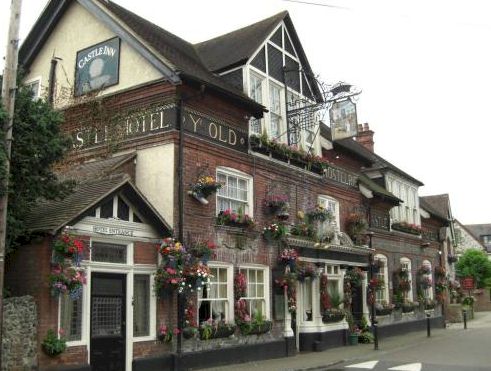
Ye Old Castle Hotel

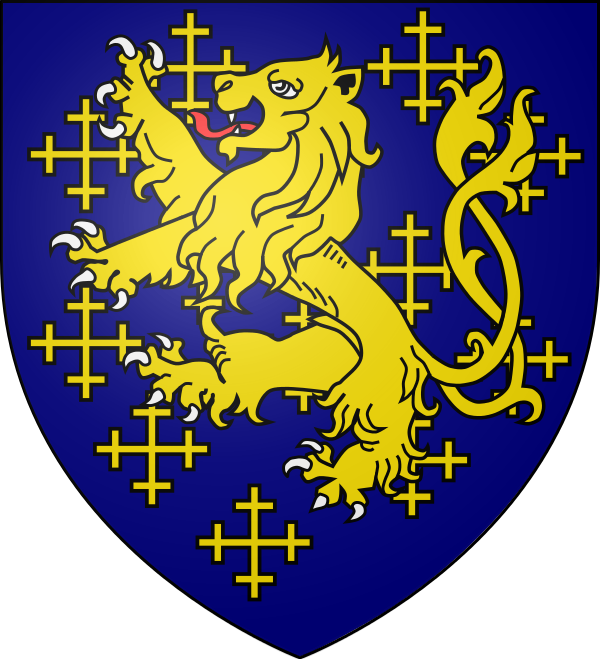
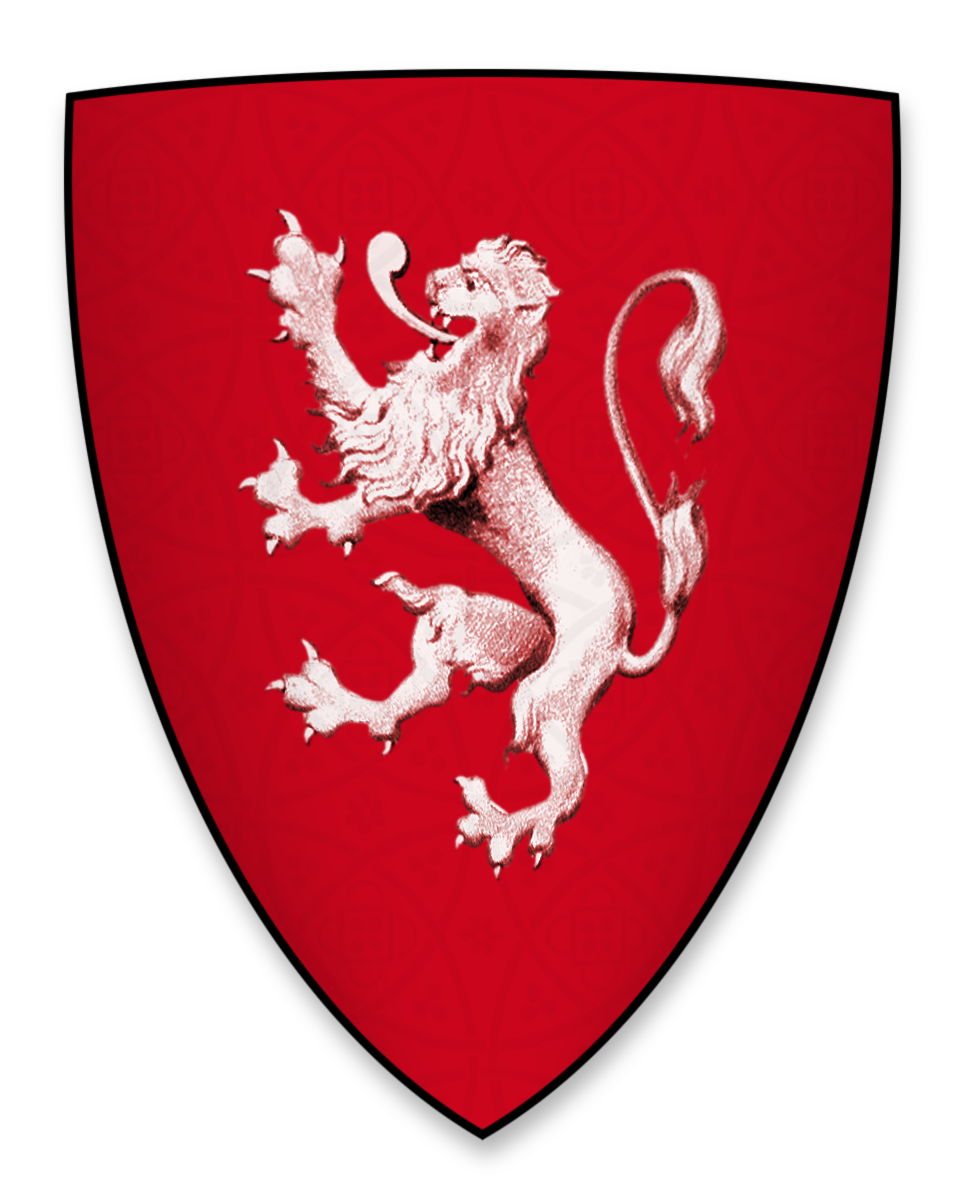
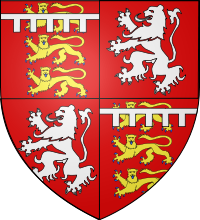
ONCE UPON A TIME there was this Inn in Bramber, West Sussex, called the White Lion. Today it’s my local pub and called the Castle Hotel. How did that happen? Well, it’s first mentioned, as the White Lion, in Henry VIII’s time in the 16th century (1526, as ‘dispensing alcohol’) but it could go back further than that. In the ‘olden’ days, Inns took their names from the local Lords’ family crests and Bramber’s Lord after William the Conq was William de Braose (see my blog on Bramber Castle way back in April) and the crest of his son, Philip de Braose, (c 1096-1135) was a lion – but a gold one. The coat of arms of William de Mowbray (1173-1222) was a white lion and Bramber became part of the de Mowbray estate by marriage in 1298, when John de Mowbray married Aline de Braose. The two lions merged when de Mowbray became Duke of Norfolk in 1397, so the pub could date back to sometime then …… oh yes it could.

philip_de_Braose,_coat_of_arms,_Falkirk_Roll_svg           de_Mowbray,_

Philip de Braose’s coat of arms                         William de Mowbray’s  coats of arms

 Mowbray2

De Mowbray/Duke of Norfolk coat of arms at the end of the 14th century

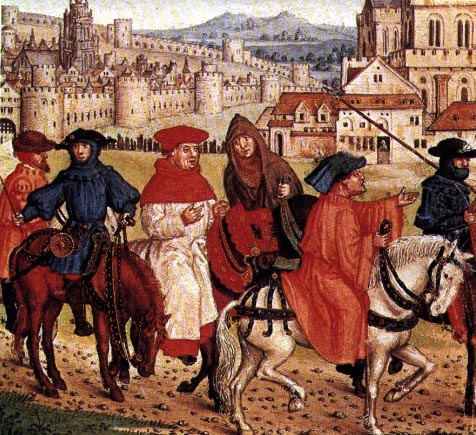
It would, of course, have been quite a popular Inn as it was on the main Pilgrims road from Canterbury to Winchester (and vice versa) so would have been a stopping off point for travellers throughout the Middle Ages. So, a Pilgrims’ Progress – to a pie and a pint. Nothing much has changed there.

canterburyIIIdI

Pilgrims progress on route, with silly hats; “Mine’s a pint at the White Lion” says the guy on the white horse

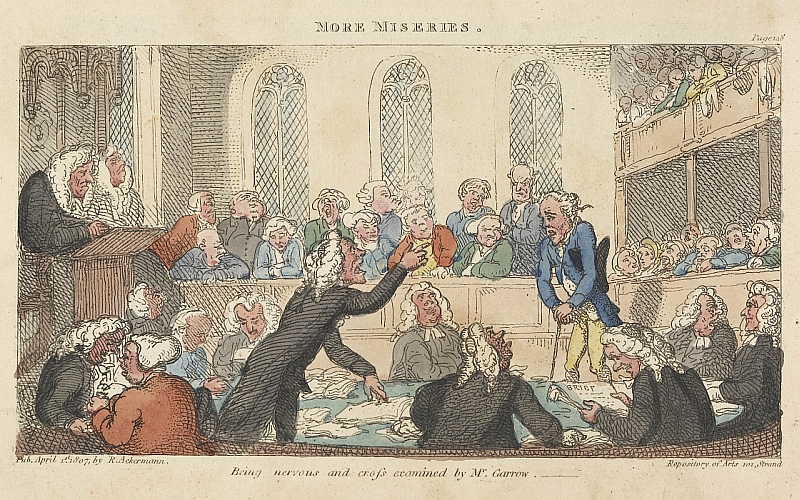
The White Lion doubled up as the Bramber court house which was most likely a room on the first floor. In fact, in 1552, the County Coroner and 14 jurors gathered at the court house to decide whether the innkeeper of the White Horse, William Battner, should be tried for assaulting a Joan Davyd, the servant of the innkeeper of the ‘other public house’ in Bramber (wherever that may have been).  Joan had been fighting with William’s son, John, when William’s dogs had been attacking pigs belonging to the ‘other innkeeper’ (widow Kayne); the pigs had been causing damage on Battner’s land – get it? Anyway, Joan died as result of John wacking her ear with his hand. The jury of the inquest held that Joan died of a natural death because she had been suffering from black jaundice and was already weakened, so the blow did not cause her death (don’t try this at home as today it would be manslaughter. Don’t say you haven’t been warned).

GarrowIntimidating3

“You deserve a clip round the ear as well, sir – but it’s your round!”

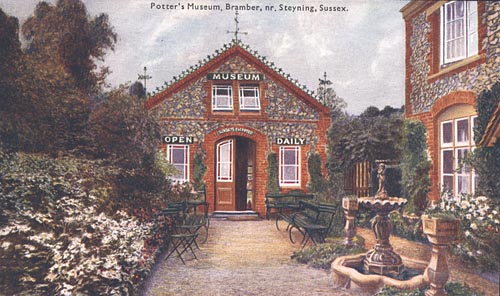
By the 17th century the Inn was sleeping around fourteen people and this increased to around twenty by the early 18th century. There were four ground floor rooms and five on the first floor (including the court ‘house’) and a stable yard at the back (now the new family restaurant, formerly the games room). From 1780 to 1833, the Inn was owned by the Gough family who, from 1713-1860, also owned St Mary’s Tudor House along the High Street. So the Goughs were obviously an affluent bunch who dabbled in Inn-keeping (well, Inn-ownership … I don’t suppose they got their hands too dirty). From 1841 to 1871 the White Lion was owned by James Potter whose son, Walter, displayed his stuffed animals at the Inn from 1861. He was, later (1880), to set up the Potter’s Museum (for more info click here) in, what is now, the gardens of Bramber Villa .

potters

Potter’s Museum along from the Castle Hotel

It was when the Inn changed hands from James Potter to Henry Kelcey in 1871 that it changed its name to the Castle Hotel. This was as a result of the many visitors to the ruins of Bramber Castle, assisted by the opening up of the railway in 1861. Picnicing up at the Castle ruins led to Kelcey selling refreshments up there, so the change of name was a promotional ‘thing’. When the Duke of Norfolk sold Bramber Castle, the 1925 advert included a reference to a £70 per year rental paid by the Kemp Town Brewery (in east Brighton) which meant that the Castle pub was then a tied house of the brewery but continued to make money up at the Castle ruins. And why not. Now we just get the ice-cream man.

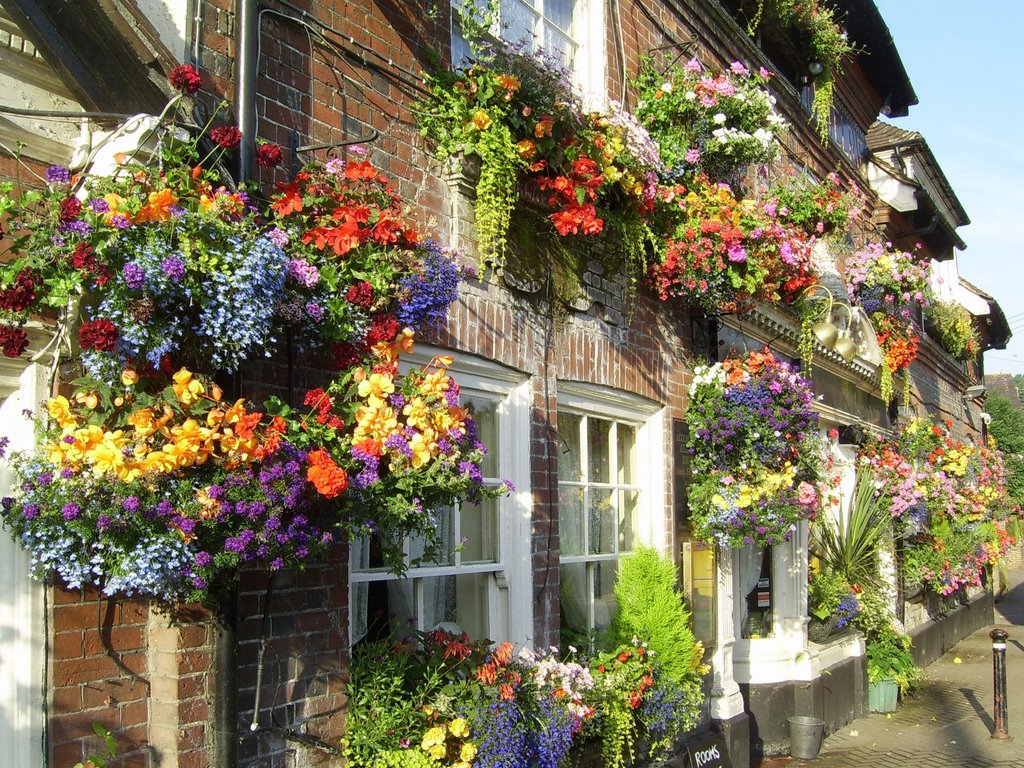
 castle2
The Castle Hotel in recent flowering glory

For more info on the Castle Hotel/pub today click here

.

Next week: Brasenose – an Oxford College


ASIDE

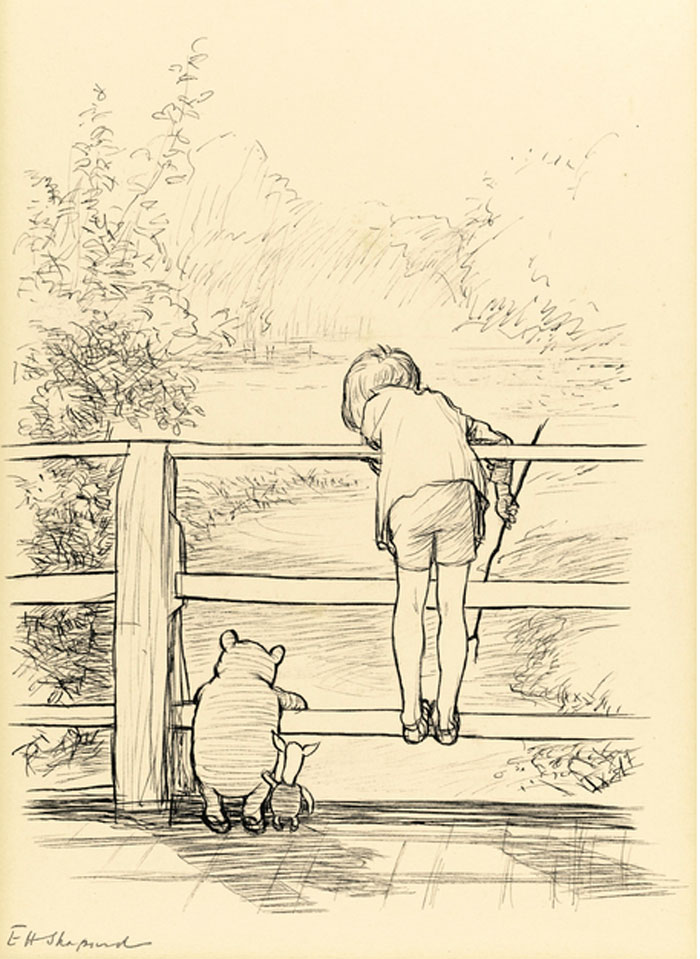
I mentioned last week that Lawrence of Arabia’s motor bike sold at auction for a record £315,100. Well, keeping up with such prices, E.H. Shepard’s signed drawing of Winnie the Pooh et al playing pooh sticks sold at Sothebys this week for £315,500 – a record for any book illustration. I think I’m in the wrong buisness.

poohsticks3

Pooh, Piglet and Christopher Robin – bargain at 300k!


Artemus Smith’s Notebooks

I continue my research of the notebooks of Dr Artemus Smith, archaeologist of great courage, determination and fiction. Here is another extract:

My fine friend, Christian de Belvedere, called in on my rooms the other day sporting a shiner of a black eye. “My dear fellow, what happened to you?” I enquired with deep concern.

“Well, old boy,” he replied, “I made bit of a faux pas. The wife said to me, ‘If I pass away before you I imagine you will find someone else in due course, but you won’t share our house with her will you?’ 

‘No, no, my dear,’ I replied.

Then she said, ‘You won’t give her my car will you?’

‘Good Lord, no, no, my dear’ I replied.

Then she said, ‘You won’t give her any of my clothes will you?’

‘Certainly not, my dear,’ I replied.

Then she said, ‘You won’t give her my golf clubs will you?’

‘Definitely not, my dear,’ I replied, ‘she’s left-handed ……..’ aagh!”

art-smth

Thomas Spratt RN : Travels in Lycia and the Fellows’ Marbles (so, not just Elgin ….)

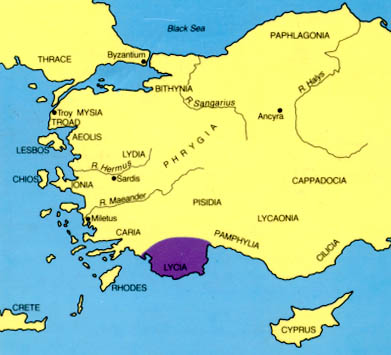
SEVERAL BLOGS AGO I waxed lyrical about Thomas Abel Brimage Spratt in Crete (‘Crete: the island that tipped’). Well, now I’m gonna tell you a little about him in Lycia (that’s southwestern Turkey – see map at end) and his involvement in the procuring of the Xanthos Marbles …..

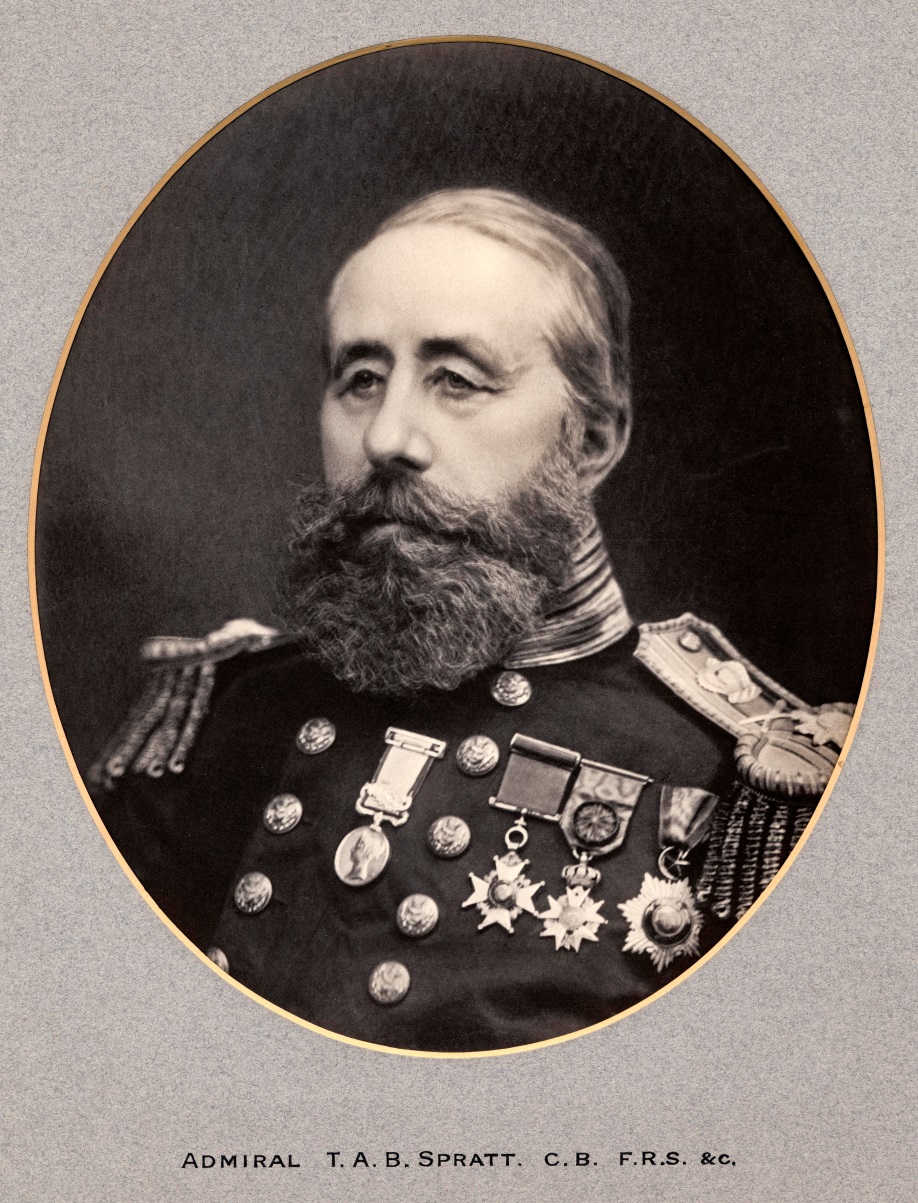
spratt

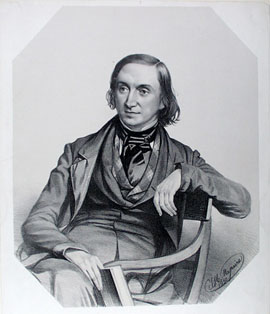
Thomas Spratt (1811-1888) … remember him?

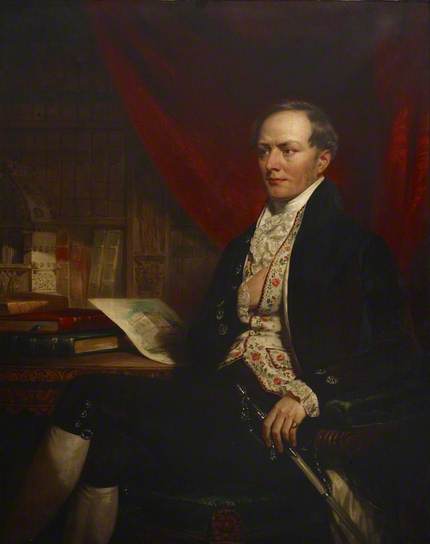
In April 1839 the antiquarian Sir Charles Fellows travelled to Lycia in search of antiquities and ancient sites. Perhaps the most spectacular of his discoveries was the ruins of the city of Xanthos. The date of these remains he considered to be ‘a very early one’ and the walls ‘Cyclopean’. He did not clarify how early but three temples at the site have since been dated to the Classical 5th century BC.

(c) British Museum; Supplied by The Public Catalogue Foundation

 Sir Charles Fellows (1799-1860)

The Royal Naval hydrographer, Thomas Spratt and his two colleagues, the naturalist Edward Forbes and the historian the Rev E.T. Daniell, joined Fellows in January 1842 just before the completion of the latter’s work. Spratt’s ship, HMS Beacon then under the charge of Captain Graves, had been “commanded to bring from Syria [actually Anatolia] the remains of antiquity discovered at Xanthos by Sir Charles Fellows.” This may not have been considered an entirely popular venture by some in England as Forbes, although not clarifying, commented:
“There had not been a little discussion too, in London circles, with regard to the doings of the ‘Beacon’ when procuring the Xanthus marbles, and the part Captain Graves took in that expedition had been much misinterpreted.”
Xanthos_Nereid_Monument_by_FoxStox

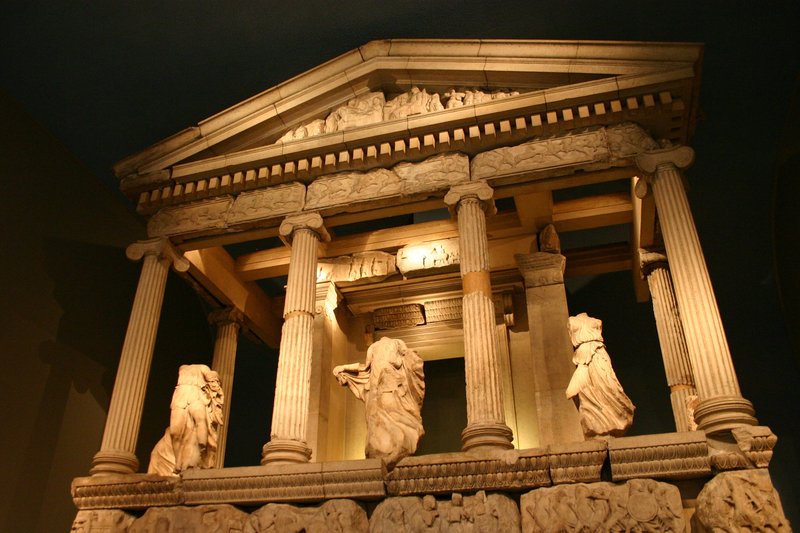
Xanthos Neried Monument now in the British Museum (courtesy of Fellows)

It would appear that the monuments of Xanthos were causing as much controversy as the Elgin Marbles had done forty years earlier. Along with Graves, both Spratt and Forbes appeared uneasy about this mass clearance of a site and its removal to England. Spratt himself was to send items back to the British Museum and the Fitzwilliam Museum in Cambridge but not to this scale. In fact, Graves had given orders that two of the large tombs (Harpy and Payava) should not be dismantled until further instructions had come from Malta to construct suitable boats for their transportation down river. These orders were ignored.

 paava

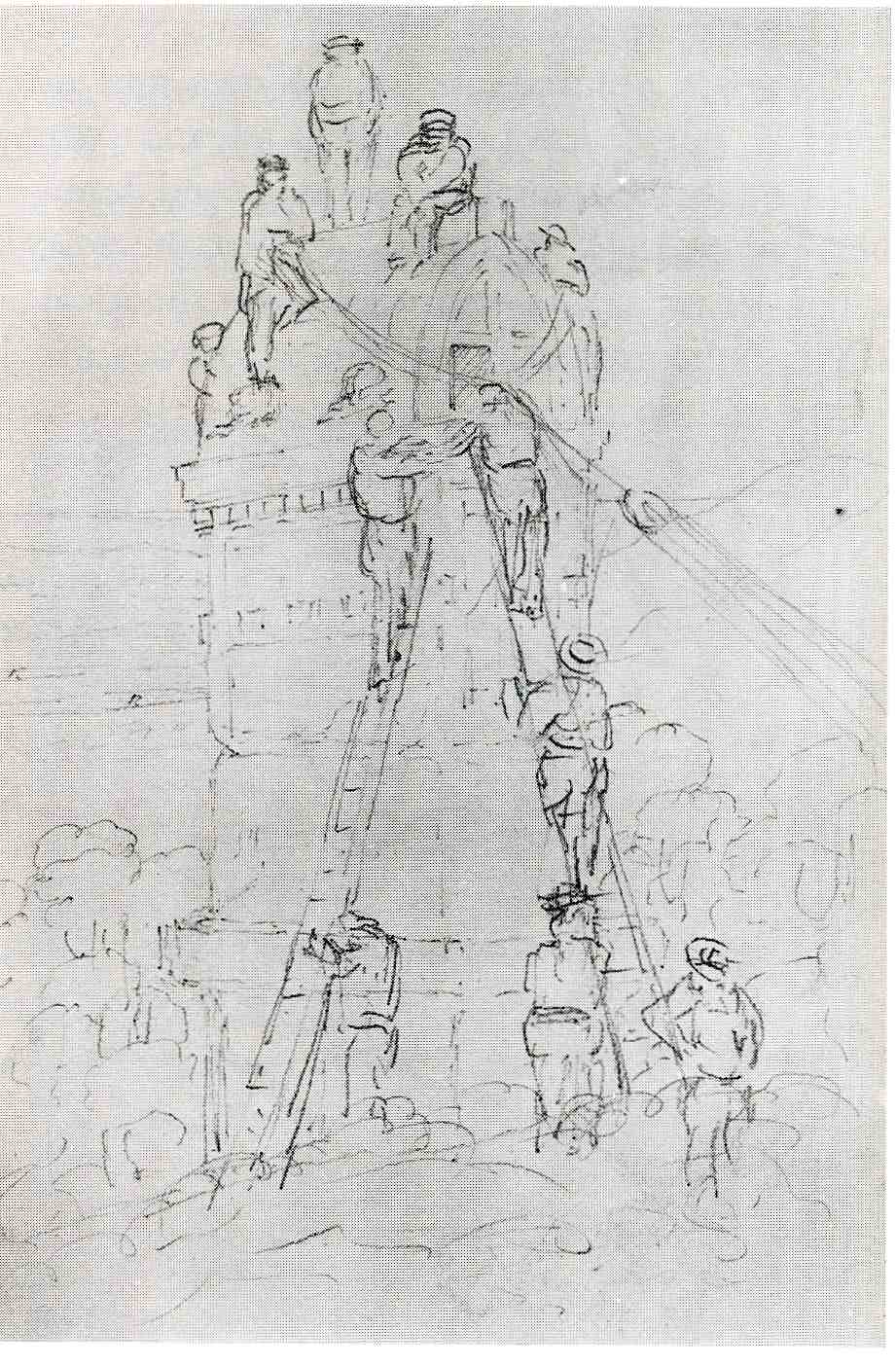
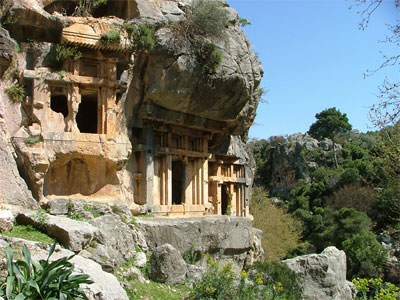
Sailors dismantling the Tomb of Payava at Xanthos despite Capt Graves’ orders (drawn by Charles Fellows)

Tomb_of_Payava

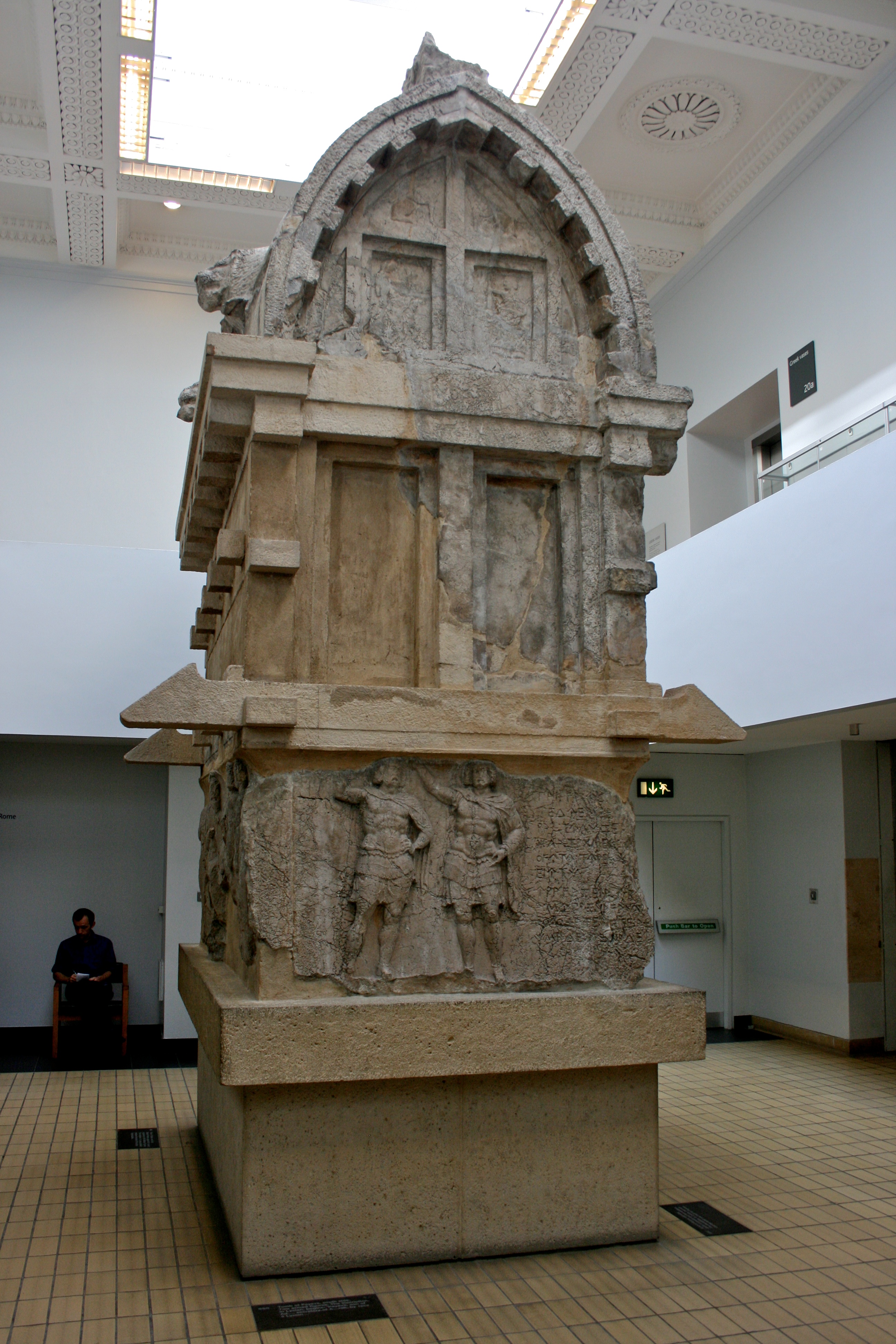
Tomb of Payava resituated in the British Museum

Spratt, Forbes and Daniell intended to travel to Lycia for surveying, naturalist and antiquarian purposes respectively. They came upon some eighteen ancient major cities and several other minor sites and managed to trace the marches of Alexander the Great through Lycia. Unfortunately Daniell was taken ill with malignant malaria and died before the completion of the expedition.

edward-forbes-1-sized

 Edward Forbes (1815-1854)

They began their tour at Makri harbour (ancient Telmessus), the nearest safe anchorage to Xanthos, and travelled to neighbouring Caria. It was not long before they came across the Cyclopean conglomerate stone architecture of Pinara. More Cyclopean walls were discovered at Arneae but unlike many other ancient walls of Lycia they bore no inscriptions, possibly indicating an earlier phase of architecture. Likewise at Cyaneae, where they reported, “within the walls was a confused row of buildings of early and late date; but we saw no sculptured fragments, columns or inscriptions.”
pinara-tomb-a

5th century BC Tombs at Pinara

Spratt’s and Forbes’ findings were published in their book Travels in Lycia (1847). However, Spratt was obviously unimpressed with the lack of credit he had received for his work in Lycia as his colleague, William Leake, wrote to Sir Roderick Murchison, the President of the Royal Geographical Society (RGS) on the 15th January 1854:

“Capt Spratt complains that his discoveries geographical and archaeological in Lycia and the adjoining parts of Asia Minor have never [been] noticed by any President [of the RGS] in his annual address, and I think he complains not without reason, those discoveries having been some of the most important that have been made in that country and of a nature particularly fitted to the objects of our Society.”

lycia

Lycia in Turkey

Poor old Spratt. In fact, very little has been written about his achievements – until my excellent book, Dawn of Discovery, that is (go to ‘MY PUBLICATIONS’ tab on this blog or just click here).

.

Next week: Ye Olde Bramber Castle Inn – a Pilgrim’s Progress

.


Artemus Smith’s Notebooks

I continue my research of the notebooks of Dr Artemus Smith, archaeologist of great courage, determination and fiction. Here is another extract:

I was in a restaurant the other day and a customer was bothering the waiter. First, he asked that the air conditioning be turned up because he was too hot, then he asked it be turned down cause he was too cold, and so on for about half an hour. Surprisingly, the waiter was very patient as he walked back and forth and never once got angry. So finally, I asked him why he didn’t throw out the pest. “Oh, I really don’t care or mind,” said the waiter with a smile. “We don’t have air conditioning.”

art-smth