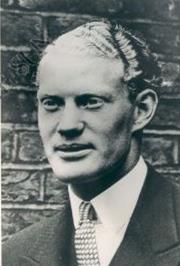
George Jeffreys: The Hanging Judge

LAST WEEK I made mention in a footnote of George Jeffreys, 1st Baron Jeffreys of Wem, otherwise known as ‘The Hanging Judge’. Well, I thought I would elaborate. Was the ‘hanging judge’ a fair description of the fellow? And who was he?

His grandfather was John Jeffreys who had been Chief Justice of the Anglesey circuit of the Great Sessions, and his father, also John Jeffreys, served as High Sheriff of Denighshire.  His brother, Thomas, was the English Consul in Spain, and his other brother, William, became Vice-Dean of Canterbury. So authority and ambition was certainly in the family. George went to Trinity College, Cambridge, but only lasted a year, leaving without a degree. He entered Inner Temple (remember ‘My Cousin Ralph’, a couple of posts ago?) in 1663 and began his legal career in 1668.
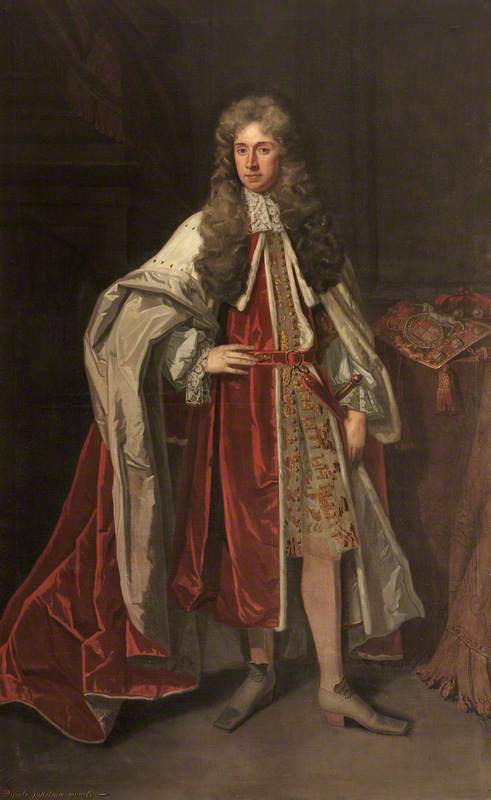
George Jeffreys (1645-89)

In 1671 he was appointed Common Serjeant-at-Law of London (what?) [1]. Trust me , pretty fast promotion. He was knighted in 1677 and became Recorder of London [see fn 1, if you haven’t already] the following year.  By 1680 he had become Chief Justice of Chester and Counsel for the Crown at Ludlow and Justice of the Peace for Flintshire. Charles II created him a baronet in 1681, and by 1683 he was Chief Justice of the King’s Bench and a member of the Privy Council.  He was a busy boy (I would say he didn’t ‘hang around’ but that’s an awful pun bearing in mind his nickname … so I won’t say it).

It was when Jeffreys became Lord Chief Justice from 1683 that his conduct began to cause some unease. He presided over the trial of one Algernon Sydney who had been charged with conspiracy to assassinate King Charles II under the Rye House Plot. To establish treason two witnesses were required but the prosecution only had one. However, this didn’t seem to bother Jeffreys much and he ruled that Sydney’s own  writings on republicanism were a sufficient ‘second witness’.  Sydney was found guilty and executed. Good old 17th century justice.

Jeffreys as Lord Chancellor, 1685

By 1685 he had been appointed Lord Chancellor and this is when he picked up the ‘Hanging Judge’ tag. But really due to no fault of his own. He was also made a peer, Baron Jeffreys of Wem (Wem is near Shrewsbury in Shropshire … but you knew that).  In Autumn of 1685, in Taunton, he presided over the trials of the rebels of the Monmouth Rebellion (a West Country plot to overthrow James II – Charles II had died in February of that year). Of the 1381 defendants, it has been suggested that some 700 were found guilty and sentenced to death. In fact, it appears that the more likely figure is between 160 and 170. Regardless, Jeffreys sentenced them all to hang and this event became known as The Bloody Assizes.

Baron Jeffreys of Wem

Why ‘The Hanging Judge’ tag is a little unfair is because Jeffreys had no choice but to sentence them to hang as that was the law at the time for punishment for treason. If anything, the tag should be aimed at (I was going to say ‘hung on’, but …..) the king, James II. He had the Royal Prerogative to reprieve the sentences (which was not unusual) but he chose not to use it on this occasion.

Jeffreys was a very able lawyer but he did have a bit of a reputation as a bad tempered vindictive individual who was often a little worse for wear in court due to drink. He had a painful kidney disease which his doctor suggested he take alcohol to dull the pain (my kind of doctor!) and this may account for his behaviour.

I mentioned the Glorious Revolution in the Outlander post (last month). This is where Parliament passed legislation to prevent a Roman Catholic ruling as king of England and so deposing James II. Well, this took place in 1688 and was not good for Jeffreys, being a ‘James II man’. He tried to escape but was captured disguised as a sailor outside the ‘Town of Ramsgate’ public house in Wapping in London. He was sent to the Tower of London and died of his kidney disease the following year.

So, George Jeffreys, ‘The Hanging Judge’ – fair or what?    You judge …….

.

Footnote

[1] The Common Serjeant-at-Law of London is one of the High Officers of the City of London (established in 1291 – the title not London). He is the second most senior permanent judge of the Central Criminal Court after the Recorder of London, acting as deputy to that office, and sitting as a judge in the trial of criminal offences. The 81st incumbent is His Honour Judge Richard Marks, QC, who was appointed on 3rd March 2015.

.


Artemus Smith’s Notebooks

I have discovered another volume of Artemus’ notebooks (followers will recall Dr Artemus Smith was an archaeologist of great courage, determination and fiction). Here is another extract:

One of my students was telling me that neither he nor his parents had ever left their small village until last year.  They had saved money to travel to Oxford for the son’s interview. It was their very first time in a city. They visited a shopping mall and while the mother was shopping, the father and son were standing in awe in front of a lift (or elevator as some call it), having no idea what it was.

As they watched, an elderly lady walked into the strange silver doors and the doors closed. The father and son watched as the numbers went up, and then back down. When the doors opened a beautiful young woman walked out.

My student said that his father leaned over and whispered to the him, “Son, go get your mother!”

art-smth


The Life and Times of Judge Roy Bean: Hollywood fact or fiction?

LET’S GO BACK to the Wild West (remember Wild Bill Hickok, Buffalo Bill of previous posts?) and meet Judge Roy Bean. The 1972 film starring Paul Newman in the lead and Ava Gardner as Lillie Langtry, is, shall we say, very loosely based on the facts and leave it at that.

bean

So, who was Judge Roy Bean? What of his past? Well, he was born in 1825 in Mason County, Kentucky. At the age of 16 he was obliged to flee to San Antonio in Texas (those of you who read my post on The Alamo last august will recognise that name) and joined his brother, Sam, hauling freight. By 1848, he and Sam had set up a trading post in Chihuahua in New Mexico, but Roy was forced to flee again after shooting and killing a Mexican desperado. He ended up with another brother, Joshua, who had been elected mayor of San Diego in California in 1850.

Roybean2.jpg

Judge Roy Bean

All was well until he had a disagreement with a Scotsman named Collins in 1852. The latter challenged Bean to a pistol-shooting match on horseback and gave Bean the option of targets. Bean chose to shoot at each other. Well, why not! Bean won the contest by wounding Collins in the arm but was arrested for assault with intent to murder. Bean escaped incarceration in April and ended up in San Gabriel, still in California, as a bartender in a saloon owned by brother Joshua. In November, Joshua was murdered and Roy inherited the saloon.

In 1854, Bean’s girlfriend was kidnapped and forcibly married to a Mexican officer. Bean tracked him down and challenged him to a duel and killed him. The officer’s colleagues captured Bean and left him on his horse with  a noose around his neck. The horse failed to bolt and Bean’s ‘no longer-kidnapped’ girlfriend cut him free. He was left with a permanent rope burn on his neck and a permanent stiff neck – think himself lucky!

bean2

Bean had had enough of California – not proving so lucky – and headed to New Mexico and brother Sam again who had been appointed the first sheriff of Dona Ana County. By 1861 they both ran a store and saloon in Pinos Altos. However, they were then interrupted by the Civil War. Roy joined the Confederates and ran a blockade by hauling cotton from San Antonio to British ships off the coast at Matamoros, then returning with supplies. After the war he remained in San Antonio for the next 20 years working as a teamster in haulage. He combined this work with other activities not entirely legal or successful (he tried a dairy business but watered down the milk; he tried a butchers’ business by rustling stock – you get the idea). By the late 1870s he was running a saloon in Beanville (don’t ask) but this wasn’t to last – he was paid to leave (well, bought out for $900) by a disgruntled store-owner who did not approve of his unscrupulous activities.

Come 1882 he had purchased a tent by the Pecos River (still New Mexico) and set up a saloon for the railroaders. He called the bar the Vinegaroon. This was untamed territory and the nearest court was at Fort Stockton, some 200 miles (320km) away.  Then, in August 1882, he was approached by a Texas Ranger to set up a courthouse and introduce some law and order. This ominous task he accepted and he was ‘appointed’ (perhaps better described as self-appointed) justice of the peace for the new Precinct 6 in Pecos County, and, along with his one and only law book, the 1879 edition of the Revised Statutes of Texas [1], he did, indeed, deal out justice – of a kind – and called himself ‘The Law West of the Pecos’.

Judge Bean with beard behind bicycle front wheel 

I always thought he had a bit of a reputation as a hanging judge [2]. In fact this was not so at all. It appears that he only ever sentenced two men to hanging and one of them escaped. The death penalty was standard for horse thieves but Bean let them go provided they returned the horse [3]. Anyway, trials were always good for business as he insisted all jurors (chosen from his best customers) bought drinks during a court recess.

On a legal technicality note, a saloon-owner competitor of Bean’s sold land at Langtry (as it was to be called) to the railway with a contractual term that no land was to be sold or leased to Bean. Bean got around this by setting up his saloon tent (he called the Jersey Lilly after Lillie Langtry) on a railway right-of-way not covered by the contract, and here he squatted for the next two decades. This legal loop-hole was not of his own discovery but by an Irishman, Paddy O’Rourke, who was repaying Bean for freeing him after he had murdered a migrant worker.

Jersey Lilly Saloon, Judge Roy Bean holding court in 1900. Bean is in the centre of the photograph, wearing hat, sitting on a barrel and holding open his law book. 

There was no jail in Langtry so Bean only ever fined culprits, the money he kept for himself. He calculated some amounts of fines based on how much the defendant had in his pocket at the time. His court did not have the power to grant divorces but this minor detail did not stop Bean. He would charge $10 for a divorce and again pocket the’ fee’, along with $5 for weddings. I wonder if he ever offered a package deal?

The saloon is still there today!

Bean won re-election to his post in 1884, but was defeated in 1886. The following year, the commissioner’s court created a new precinct in the county and appointed Bean to be the new justice of the peace. He continued to be elected until 1896. Even after that defeat, he refused to surrender his seal and law book and continued to try all cases that suited him in his own ‘precinct’. It’s not quite clear what the justice who was elected was doing.

In March 1903, after a bout of heavy drinking in San Antonio, he died peacefully in his bed, aged 77-78. Could have been worse …..


Footnotes:

[1] When newer law books showed up, Bean used them as kindling.

[2] The real so-called ‘hanging judge’ was a Welshman called George Jeffreys, 1st Baron Jeffreys of Wem (1645-89).

[3] Reminds me of the Artemus Smith extract from 28th July 2014 post (following ‘House of the Virgin Mary)!

.


Artemus Smith’s Notebooks

I have discovered another volume of Artemus’ notebooks (followers will recall Dr Artemus Smith was an archaeologist of great courage, determination and fiction). Here is another extract:

I encountered my good friend, Professor Rolande Circumspeque, in the Senior Common Room the other day in fits of laughter. I enquired as to the reason for such mirth and he showed me an article in The Monthly Planet, an aerospace journal he was perusing. It read:

‘When NASA first started sending up astronauts, they quickly discovered that ball-point pens would not work in zero gravity.
To combat this problem, NASA scientists spent a decade and $12 million developing a pen that writes in zero gravity, upside down, underwater, on almost any surface including glass and at temperatures ranging from below freezing to over 300° C.’

“Interesting,” I commented, “but why do you find that so amusing.”

He replied, “The Russians use a pencil.” 

art-smth


My Cousin Ralph

IN AN EARLIER POST (December 24) I talked about my Inn of Court, Middle Temple. Well, a distant cousin on my father’s side, one Judge Ralph Reynolds Garlick, was a member of Inner Temple. So let’s say something about Inner Temple – it has a fine Hall which, although originally dated back to the Middle Ages, had been demolished in 1868, just before the birth of Cousin Ralph. It was rebuilt only to be destroyed by bombing in the last war (as was Middle Temple) and then rebuilt again to an impressive standard in 1952.

Inner Temple Hall today

Anyway, let me tell you about Cousin Ralph. He was born in Stratford-upon-Avon in 1876 and was educated at the King Edward VI School and went on to study a BA at Pembroke College, Oxford. He was admitted as a student to the Inner Temple on the 7th April 1910 at the age of 34 (a late starter like me – nothing wrong with that). So he would have witnessed Inner Temple Hall as the 1868 rebuild. Having qualified as a barrister, he went forth to India in 1900 and served in Bengal as assistant magistrate. Five years later he was transferred to Eastern Bengal and Assam, but returned to Bengal in 1912 and, a year later, became a district and session judge. In 1928 he held an appointment as an officiating judge of the Calcutta High Court.

The medieval Inner Temple Hall – being taken down here in 1868 and replaced by a larger Gothic Hall which was later destroyed by enemy action in 1941

In December 1930 in Calcutta, a Bengali rebel, Dinesh Gupta, murdered Lieut-Colonel Simpson, the British Inspector General of Prisons (admittedly infamous for the brutal oppression on the prisoners in his jails). Gupta was captured after trying to shoot himself and, in February the following year, Cousin Ralph was a member of the tribunal that sentenced Gupta to death by hanging.

Dinesh Gupta 1.jpg

Dinesh Chandra Gupta (1911-1931)

Sometime in mid-July 1931, Cousin Ralph received a letter threatening his life. As a result two police sergeants and several detectives were stationed in his courtroom. Ralph was undeterred by such threats and resolved to carry on his work regardless.

ralph

Cousin Ralph in Stratford-upon-Avon before moving to India

On the 27th July, in Alipore, Calcutta, Judge Ralph returned to his courtroom after lunch to resume an earlier case. As he did so, Bimal Das Gupta (a Bengali architect) drew a revolver and fired at the judge from the far end of the court. The shot missed its mark but Gupta rushed up the court to the witness-box and fired again killing Cousin Ralph instantly with a bullet to the head.

The trial room, Alipore Sessions Court

According to the newspaper reports the police opened fire and the assassin was killed on the spot, although one policeman was injured. Bimal Das Gupta was a ‘wanted’ man following the murder of a somewhat unpleasant Mr James Peddie, district magistrate at Midanpore, in April.  A letter found in Gupta’s pocket stated that the murder was intended as a reprisal for the sentencing to death by Mr Ralph Garlick of Dinesh Gupta (Dinesh was Bimal’s mentor). The letter simply read, “Thou shalt be destroyed. This is the reward for the injustice done to Dinesh Gupta” and was signed by Bimal.

A short time before Cousin Ralph had decided to apply for leave preparatory to retirement and would have been coming home in the not too distant future.

The Court House at Calcutta (Illustrated London News)

William Wedgwood Benn, 1st Viscount of Stansgate, Secretary of State for India, (and father of Tony Benn – remember him?), read a telegram in the House of Commons announcing the murder: “Regret to have to report that Judge Garlick, Session Judge, Alipore, was shot dead to-day in court by assassin at present unknown, who was himself killed by guard.”  Benn added, “The House, will, I am sure, desire to express its sincere sympathy with the relatives of this officer.”

William Wedgewood-Benn.jpg

William Wedgwood Benn, Secretary of State for India, 1929-31

Interesting the telegram said ‘assassin at present unknown’.  As late as 18th September 1931, The Straits Times (‘India, Burma and Ceylon Week by Week’) ran an advertisement saying:    “MR GARLICK’S MURDERER   Rs. 500 for identification of photograph.     A reward of Rs. 500 is offered for the identification of the photograph of the murderer of Mr R. R. Garlick, late District and Sessions Judge of 24 Pergannas.  The amount originally announced was Rs. 150, but it has now been increased to Rs. 500.”

Bearing in mind the authorities were already looking for Bimal Das Gupta for the suspected murder of Peddie and found the aforementioned note referring to revenge for the death of Dinesh Gupta in Cousin Ralph’s assassin’s pocket, it all rather pointed to Bimal. And the newspaper reports clearly blamed him at the time. However, Bimal’s father denied that the body of the assassin was his son’s – hence the offer of the reward.

In fact, in a 2012 report, The Revolutionaries, by Rhituparna Basu, it appears that Bimal Das Gupta (Dasgupta) volunteered to assassinate the head of the European Association at the Writers’ Building (an anti-Indian independence organisation). Bimal only wounded his target and was arrested and tried for the murder of Peddie. Although no witnesses came forward he was still found guilty but spared the death penalty and sentenced to life-imprisonment on the notorious Andaman Islands penal colony. The report does not mention the date of the incarceration but goes on to say that Bimal was set free in 1939 when political events led to a release of political prisoners.

So, who shot Cousin Ralph?

Well, according to Manoshi Bhattacharya (in her books, Chittagong: Summer of 1930, published 2012; and sequel Eye of the Tiger: Chittagong, published 2014) it was Kanai Bhattacharya who pretended to be Bimal Das Gupta (Dasgupta) and killed Ralph Garlick.  Also she says the assassin was not shot by the police but died by taking a cyanide pill before he was overpowered. I’m not entirely sure what Kanai hoped to achieve by this deception. But that’s politics – or something.

Although I followed Cousin Ralph’s footsteps to Oxford and to the Bar as a barrister, I’m not planning to follow them any further by becoming a judge (no point in pushing my luck ….)

 .


Artemus Smith’s Notebooks

I have discovered another volume of Artemus’ notebooks (followers will recall Dr Artemus Smith was an archaeologist of great courage, determination and fiction). Here is an extract:

I had advertised for a new undergraduate researcher in archaeology for my College. I was reaching the end of the interview with one young hopeful, fresh out of university, when I asked him, “And what starting salary are you looking for?” He replied, “In the region of £60,000 a year, depending on the benefits package.”

I replied, “Well, what would you say to a package of ten weeks paid vacation, full medical and dental care, company matching retirement fund to 50% of salary, and a company car leased every two years, say, a Porsche Boxster?”

The young lad sat up straight and said, “Wow! Are you kidding?”

I responded, “Yep, but you started it.”

art-smth

200 years of Oxford rowing

IT IS BELIEVED that recreational rowing at Oxford began around the 1760s but the first Summer Eights (eight rowers, one cox) Head of the River race took place between my College, Brasenose (see December 20 post) and Jesus College in 1815, exactly 200 years ago, a few months before the Battle of Waterloo. Brasenose won to become the very first ‘Head of the River’. To commemorate the anniversary of this achievement there was a ‘re-enactment’ of the event at Oxford this weekend (Saturday 30th May). I say ‘re-enactment’ – it was not intended to be an exact re-enactment as Jesus (College that is) had every intention of winning this time around. Well, they didn’t. In fact they rather lost it right in front of their own boathouse (‘caught a crab’). So Brasenose were victors again but it was all in good fun.

bnc race

Brasenose crew (foreground) on their way to victory; Jesus (background) about to ‘catch a crab’ in front of their own boathouse

At the end of this post you can click on a link for a video of a brief part of the race

The crews dressed in true 1815 style and used wooden boats of that era. Back in the 19th century the ‘bumps’ (see below) races began within Iffley Lock and ended at a finishing line marked by a flagpole on Mr Isaac King’s barge off Christ Church Meadow (not far from the current finishing line).

P1000474

Before the race: the crews dressed in 1815 style kit (Brasenose, left, discarded their black and gold stripey jumpers for the race –  as can be seen in photo above)

There had been previous races but they had been between professional watermen (such as Ranelagh Regatta of 1775) but the 1815 race was the first recorded between two boat clubs. So Brasenose College and Jesus College Boat Clubs are the oldest known competitive amateur rowing clubs in the world. The two Colleges raced again the following year in 1816 and again Brasenose won. In 1817 they were joined by Christ Church who won three years running. There is no record of the race in 1820 but in 1821 there was no Christ Church boat and it was just Brasenose and Jesus again with another victory for Brasenose. In 1822 Brasenose were bumped by Jesus but the Brasenose crew continued rowing and attempted to haul down the Jesus flag. Bit unsporting – but there were no definite rules then! A rematch took place and Brasenose won. Christ Church returned in 1824, along with Exeter College, and the tradition of Eights was established and as the years went on more Colleges became involved. (My thanks to William O’Chee and Christopher Seward for this info).

Oxford_Eights_cropped

‘The earliest-known scene of a race between two eight-oared boats at Oxford University. It has been suggested that the picture shows the “disputed bump” of the 1822 race between Jesus College and Brasenose College’

Now obviously the River Thames that flows through Oxford is far too narrow for boats to actually race side-by-side (around 30-40 m in width), so in 1826 bumping rules were devised. This means that each boat starts 130 feet in front of another and the idea is for the one behind to catch the one in front and ‘bump’ it. When this happens the two boats swap places for the next race (next day) and boats can work their way up the order over a week (which is why it’s called ‘Eights Week’). The one at the head at the end of the week is ‘Head of the River’.

Postcard dated 1915 – 100 years ago and 100 after Brasenose v Jesus

Initially all racing stopped behind the first boat to be bumped and only the boats ahead carried on to try and achieve their own bump. After 1840 a new system of bumping was introduced: when a boat was bumped it had to pull over to the river bank so boats still racing behind could continue. During the 1870s, the 20 or so Colleges competing were divided into two divisions. In 1908 Colleges were able to submit second crews of eight. Now all 39 Colleges are involved with three or four teams and there are seven men’s divisions and six women’s divisions. This, of course, makes it more difficult to become Head of the River. Brasenose last managed this in the 1930s and now it is presently in Division II. I was told on Saturday that it will be at least 16 years before it could contest for the Head of the River again based on the bumping rules. However, in case you didn’t read my December post on Brasenose, I would mention that since the races began in 1815, Brasenose runs 3rd with 23 victories as the ‘Head of the River’ (Oriel is 2nd with 30, Christ Church is 1st with 33).

Rowing in Oxford – early days

Women’s rowing had existed at the University since the 1920s (and some women were allowed to join the men’s crews) but there were no solely women’s crews until 1969 when St Hilda’s College entered with an all women crew. Then, after all-male Colleges began admitting women in the mid-1970s, a women’s division was introduced in 1976. Women have been coxing men’s crews for many years (and vice-versa).

ox boathses

Some of the College boathouses (Brasenose to the left with the white & yellow flag hanging from the balcony)

So there you have it. I’m sure you were aching to know all about Oxford rowing races. I did try it once but they didn’t ask me again (okay, I was a little older than the average student).

bnc grdn prty

 30th May 2015: The Brasenose and Jesus Garden Party opposite the river to commemorate the race 200 years before

 Click here for a brief part of the race – just as Jesus ‘catch a crab’


DSC_0835

Don’t you just love Oxford – well, Sarah and I do …….

.


Artemus Smith’s Notebooks

I have discovered another volume of Artemus’ notebooks (followers will recall Dr Artemus Smith was an archaeologist of great courage, determination and fiction). Here is an extract:

The wife of one of my colleagues is an maths teacher to 11-12 year olds.  She had asked her class a mathematical question:

“A wealthy man dies and leaves ten million pounds. One-fifth is to go to his wife, one-fifth is to go to his son, one-sixth to his butler, and the rest to charity. Now, what does each get?”

After a very long silence in the classroom, young Morris raised his hand.

My colleague’s wife called on young Morris for his answer.

With complete sincerity in his voice, young Morris answered, “A lawyer”

art-smth


The other ‘Great Escape’

LAST August I talked about the Great Escape from Stalag Luft III and the film (‘Hollywood fact or fiction?’). I’ve since found another ‘Great Escape’ which I thought I might share with you. It’s mentioned in the Book of Heroic Failures under ‘The Worst Prison Guards’.

The escape of 124 prisoners from the Alcoentre maximum security prison near Lisbon in Portugal took place in July 1978. This was half the prison’s population and a record for the largest number of convicts to escape simultaneously from a prison (only 70 from Stalag Luft III but they were not, of course, convicts but POWs). If you read my August post on the Stalag Luft III escape you will recall the remarkable list of missing items undetected by the Germans. The Alcoentre list was nothing like as impressive but it did include 220 knives, a large quantity of electric cable, spades, chisels, water hoses and electric drills. A  guard explained, “Yes, we were planning to look for them but never got around to it.”

Estabelecimento Prisional de Alcoentre (the prison)

What else the guards had not noticed were gaping holes in the wall which had been covered over with posters (reminiscent of the The Shawshank Redemption?). The night before the breakout one guard realised that only 13 of his 36 prisoners in his block were present. He said that was normal because inmates sometimes missed roll-call or hid but usually came back in the morning.  (That’s very good of them).

Poster covering hole in wall in The Shawshank Redemption – nothing new with that

A warder then announced, “We only found out about the escape at 6.30 the next morning when one of the prisoners told us.” (I’m surprised there was one left to tell anyone). Then the warder added, “The searchlights were our worst enemy because they had been directed at the guards’ faces and dazzled them making it impossible to see anything around the prison wall.” Easy mistake to make.

Picture2

What escaping prisoners?

By way of explanation, the Portuguese Justice Minister, Dr Santos Pais, claimed that the escape was ‘normal’ and part of the “legitimate desire of the prisoner to regain his liberty.”   Oh, that’s all right then.

.

Then there was the most unsuccessful escape. In Northern Mexico, 75 prisoners carefully planned an escape from Satillo Prison. In the November of 1975 they began digging a secret tunnel designed to bring them up on the other side of the prison wall. 5 months later, and guided by sheer genius, they emerged in the nearby courtroom where most of them had been sentenced. The surprised judge returned them all to their confinement.

DaveDig

We’re free …..Oh


Artemus Smith’s Notebooks

I have discovered another volume of Artemus’ notebooks (followers will recall Dr Artemus Smith was an archaeologist of great courage, determination and fiction). Here is an extract:

Three of us were chatting about funerals and one of my companions asked,”When you are in your casket and friends and family are talking about you, what would you like them to say?

I said, “I would like to hear that I was a great and enterprising archaeologist with outstanding knowledge.” 

My first colleague said, “I would like to hear them say that I was a a wonderful lecturer who made a huge difference to the students of my time.”

My other colleague said, “I would like to hear them say … ‘Look, he’s breathing!'”

art-smth

Outlander – and the Jacobite Rebellion

HAVE YOU been watching Outlander?  It’s on Amazon Prime and I don’t normally watch Sci-Fi but I sort of got drawn into this one. It’s about a woman who, on her honeymoon in Scotland just after the 2nd World War, visits a mysterious ancient stone circle and is transported back to 1743 (I’m sure it happens all the time). She finds herself embroiled in the build-up to the Jacobite Rebellion. Coincidently (or not) she meets up with an ancestor of her husband’s who turns out to be a nasty piece of work (the ancestor not the husband). She ends up with a motley bunch from the Clan Mackenzie but marries Jamie, a member of the Clan Fraser (it’s complicated). The lawyer in me idly wondered if you could be guilty of bigamy if you married ‘again’ but some 250 years before your first husband was born ….


Now, about the future …. 

Just in case one or more of you may also have recently appeared from another time warp, the Jacobites (Jacobus – Latin for James) were supporters of Charles Edward Stuart (aka Bonnie Prince Charlie [1]) and his desire to regain the English/Scottish throne for the Stuarts. The Stuarts came to the English throne under James I (formerly known as James VI of Scotland) following the death of Elizabeth I (who left no Tudor heirs). The Stuarts reigned until the Glorious Revolution of 1688 when Parliament passed legislation prohibiting Roman Catholics from the throne of England, Scotland and Ireland [2]. James II was accordingly deposed as king as a result. The Stuarts sort of continued (as queens) with James’ daughter, Mary (II) and her husband, William III (of Orange) (both Protestants) and thereafter Anne II (Mary’s sister). The Stuart line then came to an end on Anne’s death in 1714 and along came the House of Hanover with George I.  At the time of the Jacobite Rebellion of 1745, George II was on the throne.

Lost Portrait of Charles Edward Stuart.jpg

Bonnie Prince Charlie (1720-1788)

Anyway, back to Outlander. I think I can see where this is all going (although I have not yet finished the 1st series and the 2nd series has not been completed and I have not read any of the 8 books – yes 8!). At some point it’s going to encounter the infamous Battle (or massacre) of Culloden in April 1746 …. and will reflect on who of our Scottish ‘heroes’ gets killed. Will Jamie or wont he?  Will any of the motley Mackenzies survive?  Bearing in mind that the total number of Jacobites killed was between 1500-2000 out of some 6000 (compared to the Government losses of about 50) you may want to work out the odds. There’s just one issue – and I don’t want to spoil it for you so, SPOILER ALERT – for those of you who have not turned away:  none of the Mackenzies were at Culloden. This was because they had already been attacked and defeated by the pro-British Government force, the Mackay and Sutherland Independent Highland Companies, at the Battle of Littleferry (aka skirmish at Golspie). This prevented the Mackenzies from an appearance at Culloden (probably just as well for them). Soon after the Littleferry fracas, George Mackenzie, 3rd Earl of Cromartie, and his son were captured at Dunrobin Castle and the Earl was sentenced to death but pardoned with his title forfeited. Some other Mackenzies, including a Kenneth Mackenzie, Lord Fortrose, actually took the side of the British Government.  No mention of Outlander’s Colum or Dougal Mackenzie.

3rdEarlOfCromarty.jpg

George Mackenzie, 3rd Earl of Cromartie (1703-1766)

The Frasers of Lovat were at Culloden. The Chief, Simon Fraser, the 11th Lord Lovat, was captured, tried for treason and executed in London the following year. His son, also Simon, escaped and was later pardoned (then joined the British forces in the fighting in Canada in 1750 – a ‘turncoat redcoat’).  Charles Fraser was killed at Culloden; David Fraser of Glen Urquhart (who was deaf and mute) was captured and died in prison; John Fraser (‘McIver’) was wounded and put before a firing squad but a sympathetic British officer, Lord Boyd, who had seen enough killing, rescued him. Good man, Boyd. The Fraser’s residential home, Castle  Dounie, was burnt to the ground.  But no mention of Outlander’s Jamie Fraser …..

Stone memorial to the Frasers at Culloden

What do you mean, didn’t I know it’s only fiction? The Jacobite Rebellion was not fiction; Bonnie Prince Charlie was not fiction; time-travel was not ….. okay, some of it may be fiction.

.

Footnotes:

[1] My maternal grandmother was convinced that she was a distant relative of Bonnie Prince Charlie – along with hundreds of others I suspect – but I can’t remember why she had that belief (I thought you would like to know that – now you know were I get it from ….).

[2] The monarchs of England and Scotland came together as monarchs of Great Britain under the Acts of Union 1707 (but you knew that).


ADDENDUM

When I wrote the above post I was about three-quarters the way through the series of Outlander and it was plodding along quite slowly but quite amicably. I have now seen it to the end. Really, the last two episodes are rather unnecessary and not recommended viewing in my opinion. It all ends with somewhat of an anti-climax and we are not yet at Culloden. And yes, our heroine is intent on trying to change the future (or is that the past?); and no, I probably won’t bother with the 2nd series.


Artemus Smith’s Notebooks

I have found a scrap of paper which may have fallen from Artemus Smith’s notebook as it relates to another of his tales (followers will recall Dr Artemus Smith was archaeologist of great courage, determination and fiction):

A police officer colleague of mine told me of a time when he was waiting in a lay-by on the A22 ready to catch speeding drivers. He saw a car puttering along at well under the 30 mile per hour limit. Says he to himself: “This driver is just as dangerous as a speeder!” So he went in pursuit of the car and pulled it over.

In the car he noticed that there are five old ladies, two in the front seats and three in the back …. all wide eyed and white as ghosts. The driver, obviously confused, said to him, “Officer, I don’t understand, I was doing exactly the speed limit! What seems to be the problem?”

“Ma’am,” he replied, “you were not speeding, but you should know that driving slower than the speed limit can also be a danger to other drivers.”

She responded proudly, “Slower than the speed limit? No sir, I was doing the speed limit exactly, 22 miles an hour!”
My colleague, trying to contain a chuckle, explained to her that A22 is the road number, not the speed limit. A bit embarrassed, the lady grinned sheepishly and thanked him for pointing out her error.

He then said, “But before I let you go, Ma’am, I have to ask, is everyone in this car OK? Your passengers seem awfully shaken, and they haven’t made a sound this whole time.”

“Oh, they’ll be all right in a minute officer. We’ve just come off the A120.”

art-smth

17th century British Travellers to Crete

I have introduced you to some early British travellers to Crete (Spratt and Pashey in the 19th century, Pococke in the 18th century – see January posts) but now let’s go back even further to the 17th century and give you a taster of a couple of others.


William Lithgow (1582-1645)

Although the son of a wealthy burgess and educated at Lanark grammar school, Lithgow was not destined to be a scholar. Possibly to escape the ill-treatment by his brothers, he chose to travel and earn a living from his writings. He visited Crete in 1609 and recorded his travels in his Painefull Peregrinations (1632) but his tales and experiences on the island are mainly of woe. On his very first day he was robbed and nearly killed; he then rescued a French slave only to be chased and nearly slain by the slave’s ‘owners’; he was nearly bitten by three snakes having been led to believe that no such venomous reptiles could live on the island; and was to be the near-victim of an Englishman’s desire for the revenge of his brother killed at the hands of a Scotsman (Lithgow was a Scot). His action-filled narrative is somewhat exaggerated at times and it is never very clear which incidents, if any, are actually invented.

William Lithgow, by Hector Gavin, circa 1800 - NPG D28046 - © National Portrait Gallery, London

Lithgow dressed as a Turk whilst at ‘Troy’ (well, Old Illium)

He was disappointed with Greece having believed it to be a land of heroes now subdued by the Ottoman Turks and the same could apply to his view of Crete. He commented (keeping his early spelling):

“In all this countrey of Greece I could finde nothing to answer the famous relations, given by auncient Authors, of the excellency of the land, but the name onely; the barbarousnesse of Turkes and Time, having defaced all the Monuments of Antiquity: No shew of honour, no habitation of men in an honest fashion, nor possessours of the Countrey in a Principality. But rather prisoners shut up in prisons, or addicted slaves to cruell and tyrannicall Maisters.”

Title page to his 1632 book

If you go back to one of my June posts, you’ll see my reference to the labyrinth at Gortyns. Lithgow was there and he saw the entrance into ‘the labyrinth of Daedalus’ but did not venture into the cavern: “… I would gladly have better viewed, but because we had no candle-light we durst not enter, for there are many hollow places within it. So that if a man stumble or fall he can hardly be rescued.” He positioned it “on a face of a little hill, joining with Mount Ida, having many doors and pillars.” This must have been the site at Gortyns which is in the south east foothills of the Mount Ida range.

Lithgow and his attendant

In his Travelers to an Antique Land (1993), Robert Eisner said of Lithgow’s writing, “he does not, as they say in creative-writing curricula, bring scenes alive, but instead summarizes, ignores the particulars of the ruins he visits, generalizes, adds historical commentary, and then digresses.” In fact, his description of his fifty-eight days, travelling four hundred miles, is exceedingly brief and uninformative as far as any information regarding the island historically. His work was entertaining but not offering much to the learned traveller. But there we go, can’t all be perfect.


George Sandys (1578-1644)

Son of an Archbishop of York, Sandys was educated at Oxford as a gentleman of the University at the age of 11 in 1589, entering St Mary’s Hall but soon after transferring to Corpus Christi. He ‘grew into a gentleman famed for his learning in Classics and foreign languages.’ He was, as were several of his brothers and cousins, admitted to membership of Middle Temple (see one of my December posts) but he was not Called to the Bar as a barrister. Then, he would have had to have trained as a clerk for seven years but it appeared that he left after about a year to marry Elizabeth Norton. His uncle, Myles Sandys, was Treasurer of Middle Temple from 1588-1595. He travelled to Crete two years after Lithgow, in 1611.

                                                                                     George Sandys

R.B. Davis (George Sandys, poet-adventurer: a study in Anglo-American culture in the seventeenth century, 1955) was of the opinion that Sandys did not actually visit Crete, “the ship did not put into any port on Crete, though Sandys does describe country dancing on the island as though he had seen it.” Davis possibly took this view because Sandys’ brief but stylistic report on the island made several references to ancient sources but no mention of visiting any sites or actually landing on the island. Sandys said he was “Much becalmed, and not seldom crossed by contrary winds … until we approached the South-east of Candy, called formerly Creta.”

Replica of 17th century Dutch East India Company ship – in search of Crete(?)

However, Sandys must have gone the island as, in his book,  A Relation of a Journey Begun An. Dom 1610 … etc (1615), he described certain specific areas, such as Mount Ida and Gortyns and its labyrinth. He visited the labyrinth in 1611 but was a little vague as to whether it was actually at Knossos or Gortyns, although his reference to Ida would imply Gortyns as (as mentioned above) the latter is in the foothills of the former:

“For between where once stood Gortina and Gnossos at the foot of Ida, under the ground are many Meanders hewn out of rock turning this way & now that way … But by most this is thought to have been a quarry where they had the stone that built both Gnossos and Gortina being forced to leave such walls for the support of the roof, and by following of the veines to make it so intricate.”

labyrinth

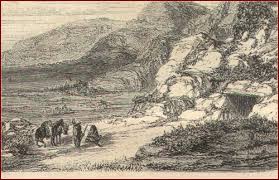
Entrance to Gortyns Labyrinth around the 18th/19th century

Warren believed that Sandys was the first investigator of the cave when he remarked, “Sandys appears as the first British traveller actually to enter the Labyrinth.” Warren obviously didn’t count Lithgow’s visit in 1609 as he didn’t go into the cave (and rightly so – can’t get credit for doing things by halves).

Sandys’ references to other sites are rather limited and Warren’s comment of Sandys leaving a “full description of Crete in his book of 1615, packed with Classical scholarship and ancient history …” is somewhat of an exaggeration. He was certainly interested in Classical literature, having translated Ovid’s Metamorphoses and Book One of Virgil’s Aeneid, but of his travels, generally, he had little to say of antiquities, being more interested in mythology.

Mythology of Theseus and the Minotaur in the Cretan labyrinth

.


Artemus Smith’s Notebooks

I have now come to the end of my research of the notebooks of Dr Artemus Smith, archaeologist of great courage, determination and fiction. Here is the last extract:

I was obliged to write a reference for a member of my archaeological unit.  It read as follows:


Casper Dempsey-Smythe can always be found

hard at work. He works independently, without

wasting the unit’s time talking to colleagues. He never

thinks twice about assisting a fellow employee, and always

finishes given assignments on time. Often he takes extended

measures to complete his work, sometimes skipping coffee

breaks. He is a dedicated individual who has absolutely no

vanity in spite of his high accomplishments and profound

knowledge in his field. I firmly recommend that he be

promoted to executive field officer, and a proposal will be

executed as soon as possible.


Addendum: The darn fool was standing over my shoulder whilst I wrote this reference, which I sent to you earlier today. Kindly re-read it, referring only to the odd numbered lines.

art-smth


Charles I – above the Law?

SHOULD Charles I have been tried by a Court of Law or is the Monarch above the law? His trial – well, it wasn’t much of a trial – in January 1649 lasted three days, but not three full days; it was  a bit of a non-event actually. Basically he refused to enter a plea against the charges arguing that ‘the Court’ had no authority to charge him as he was top dog being king. Today, if you refuse to enter a plea it is assumed you are saying you are not guilty and the State (aka the Crown Prosecution) must prove you ‘done it’. In the days of Charley boy, in the 17th century, it was the reverse – if you didn’t enter a plea it was assumed you were guilty.

charles-i-

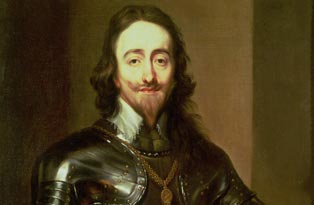
Charley boy (1600-1649)

The Court in question was the High Court of Justice (not the same High Court as we have today) sitting at Westminster Hall. The judges were the Parliamentary Commission and its President was John Bradshaw who did most of the talking (when the king wasn’t). Bradshaw was a barrister, called to the Bar at Grays Inn (one of the Inns of Court – see my previous blog in December on another one, Middle Temple). The prosecution was led by John Cook, also a barrister from Grays Inn, and it was his task to read out the charges. He would then have had to prove the case against Charles but that was to be unnecessary as Charles saved him the bother.

John Bradshaw (1602-1659)

The trial began on the afternoon of Saturday 20th January. Cook was continually interrupted by the king in his attempts to read out the charges. Cook: “My Lord, on behalf of the [House of] Commons of England and of all the people thereof, I do accuse Charles Stuart here present of high treason and high misdemeanours, and I do, in the name of the Commons of England, desire the charge may be read unto him.” As Cook was about to read the charges, Charles tapped him with his silver-headed cane, saying, “Hold on.” Cook declined to hold on but, instead, carried on reading the charges.  ‘Tap, tap’. Cook ignored the tapping. ‘Tap, tap’ – then the silver head of the cane fell off. Cook ignored it and continued reading. It’s a bit like a comedy show……. Then Bradshaw gave the king a telling off, insisting that the charges had to be read without further interruption. Charles obeyed like a good little king.

‘Fictitious portrait called John Cook’ by Robert Cooper

When the charges had been completed the king was ask how he pleaded to them. He simply replied, “I would know by what power I am called hither. I would know by what authority, I mean lawful… Remember I am your King.” He rattled on a bit more but basically he was saying that this Court had no authority to try him.

Bradshaw responded, “In the name of the people of England, of which you are elected king.” Ooooops, mistake. Charles came back, “England was never an elective Kingdom, but a hereditary Kingdom for near these thousand years.” This went on awhile – same questions on authority by Charles, same answers by Bradshaw. Eventually Bradshaw called an end to the proceedings and adjourned the Court until Monday, at which time he hoped the king would answer the charges. Well, Monday came and went with the same results – the king demanding on whose authority was he being charged and Bradshaw responding with “We are satisfied with our authority…They [the members of Commission] sit here by the authority of the Commons of England.” Charles objected, “The Commons was never a Court of Judicature, I would know how they came to be so.”  Whoa, good point Charley; indeed, the House of Commons was not a Court but Parliament was (and the Commons is part of Parliament). Anyway, stalemate. So Bradshaw adjourned again to the next day to give the king one last chance. Tuesday came and Charles didn’t relent on his point of view so Bradshaw, along with his fellow judges, treated his obstinacy as a guilty plea.

Charles (sitting, wearing hat, with back to you) in ‘the dock’ at Westminster Hall

On the 27th January, the Commissioners (68 of them) reassembled to pass sentence. It was at this stage that Charles attempted to refute the allegations made against him, saying, “I would desire only one word before you give sentence; and that is that you would hear me concerning those great imputations that you have laid to my charge.” A bit late now – and Bradshaw told him so. The clerk (possibly Andrew Broughton) rose to his feet and began reading the Commissioners’ decision, “Charles Stuart, as a Tyrant, Traitor, Murderer and public enemy, shall be put to death, by the severing his head from his body.”  Again the king tried to speak but was told he could not be heard after sentence. On the 30th January 1649 the king was executed. Regicide rules OK.

The idea of criminal law in the UK is that we are judged by our equals. Hence judgements by members of the public (generally) in the Magistrates Court (magistrates are not lawyers, they are members of the public) and likewise with juries (12 members of the public)  in the Crown Court (what do you mean you don’t know about these courts? – to be enlightened, click here). And ‘in the ‘good old days’ aristocratic peers (Lords) had to be tried by the House of Lords. So who is equal to the Monarch to try him/her? Is the Monarch above the law? Obviously not in the 17th century. It hadn’t been tried (excuse the pun) before or since.


POSTSCRIPT

John Bradshaw died in 1659, aged 57. Charles II came to the throne in 1660 and the following year, on 30th January, the 12th anniversary of his father’s execution, he had Bradshaw’s and Oliver Cromwell’s (he had died in 1658) remains exhumed and displayed in chains at the gallows at Tyburn where official hangings took place. The following day, their heads were put on spikes outside Westminster Hall and their bodies thrown into a common pit. Charles also had his father’s prosecutor, John Cook, put on trial for high treason for which he was found guilty and hung, drawn and quartered. There’s justice for you.

.


Artemus Smith’s Notebooks

I continue my research of the notebooks of Dr Artemus Smith, archaeologist of great courage, determination and fiction. Here is another extract:

I met my good friend Dr Armani Haberdasher the other day. He said his wife had been complaining about him going to the pub every night so she decided to join him. When they arrived he asked her what she would like to drink. Not being much of a drinker she said she didn’t know so would have whatever he was having. He ordered two whiskeys. When they arrived he knocked his back in one. She took a sipped and exclaimed, “Aaaagh, that’s horrible!”

He turned to her and said, “Well there you go. And you thought I was down here enjoying myself every night.”

art-smth


The Mary Rose

I KNOW, quite a lot has been written about the Mary Rose, but I haven’t written it and you may not have read it. However, I feel bound to say something of this great ship because I’m one of her Flag Officers (sounds grand but it just means I’ve donated some money to her conservation) and I think she is a fab project …. and I give talks on her every so often (or when anyone wants to listen).

The only image we have of the Mary Rose from the Anthony Roll of 1546

As for her history, she was built on the order of Henry VIII when he came to the throne in 1509 and completed in 1511 and named after his favourite sister (Mary not Rose). Then she was of 500 tons and one of the first war ships to have on board  heavy canons. Before such usage of heavy guns, naval warfare was simply sailing up to your opponent, boarding and battling it out hand to hand (‘fighting-by-the-sea’, I expect you could get postcards). Anyway, two French Wars came and went and then, in 1536, the Mary Rose was refurbished and uprated to 700 tons. The third French War arrived in 1544 and a year later, at the Battle of the Solent (although not much of a battle), the Mary Rose went to the bottom of the sea.

cowdray2

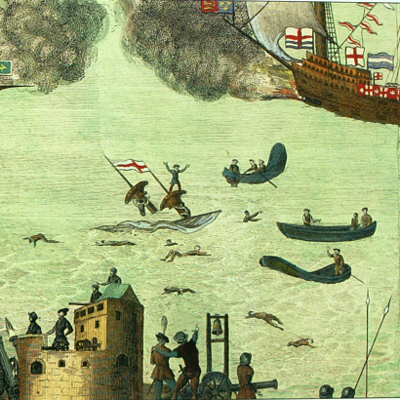
The Cowdray engraving of the sinking of The Mary Rose – you can just see the top of her mast circled in red (see pic below)

KONICA MINOLTA DIGITAL CAMERA

Cowdray engraving: mast of the Mary Rose (centre) with a survivor raising his arms

Why did she sink?  Good question. There are a couple of theories. The first is that she was hit by a French canon ball from one of the French barges firing on the British fleet. We reject this out of hand as in no way will we accept that the French can take any credit for the ship’s demise.  The second, and more feasible, is that she turned abruptly, was caught by the wind and veered over so far that her open gunports filled with water causing her to sink. That her gun ports were still open during this manoeuvre must have been a human error. Either she turned too quick for the orders to be given to close them or orders were given but ignored (wouldn’t a captain wait until such orders were fulfilled before turning?). Her admiral, Sir George Carew, was reported as saying to his uncle, Gawen, “I have the sort of knaves I cannot rule”. This would imply that his crew were far from organised – and isotope analysis (science stuff) of human bones recovered suggests that some were from around Spain and so may not have understood orders in English (a minor difficulty one might imagine!). Regardless, some 450 crew drowned, including Carew and his captain, Roger Grenville (the anti-boarding netting over the open deck area prevented most of the crew from abandoning ship). There were only around 30-40 survivors.

George Carew-painting by Holbein.jpg

Sir George Carew

Tudor attempts to raise her failed and she succumbed to a watery grave, being covered, over the years, by silt. She was briefly discovered in 1836 by John Deane who had invented diving equipment and was investigating fishing nets being caught under the sea – they were being caught on the Mary Rose. Over four years Deane recovered some guns and other artifacts but the location of the wreck was soon forgotten.

John Deane’s diving gear

In 1965, Alexander McGee went in search of the wreck. He had found her rough location in 1966 on an Admiralty chart and by using a newly invented sub-profiling apparatus (science stuff again) he eventually discovered the wreck’s exact whereabouts in 1971. The site of the wreck was subsequently protected from ‘treasure seekers’ by the Protection of Wrecks Act 1973. It was surveyed between 1971 and 1979 whereafter the Mary Rose Trust was set up to consider bringing her to the surface. This happened on the 11th October 1982 and watched on television by some 60 million people.

Portrait of Alex McKee OBE (1918-1992)

a A  a B    a C

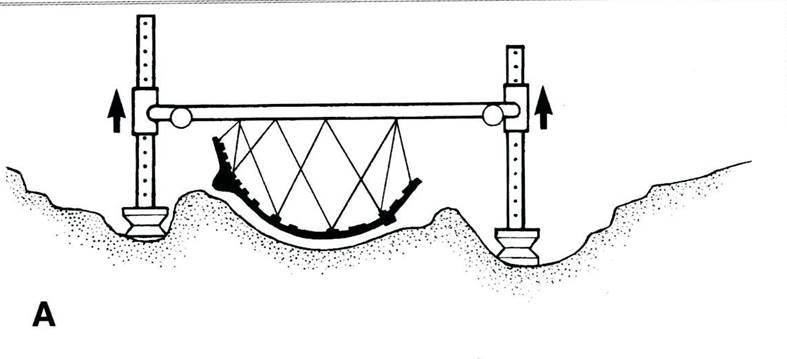
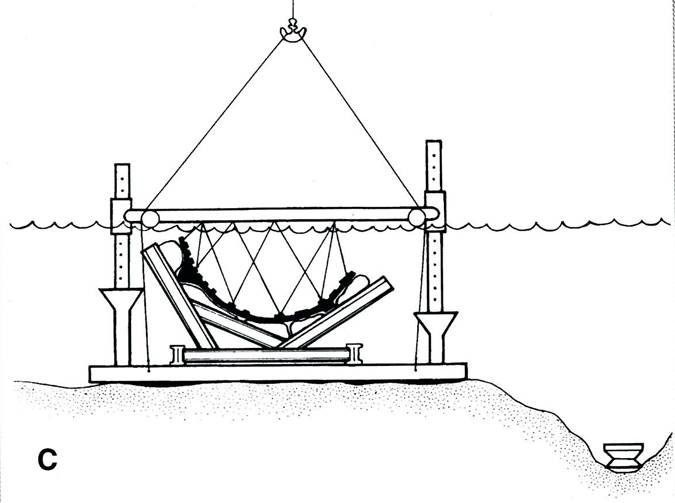
Raising of the Mary Rose: A. attaching it to the lifting gear; B. lifting it towards the frame, C. lowering it into frame which was then raised to the surface

In the region of 3000 timbers were recovered from the Mary Rose. Once out in the fresh air the wood of the ship had to be preserved. Under the water the centre cells of wood are eaten away and so the wood is hollow. Left too long in the air the wood will just collapse. So these hollows had to be filled. From 1982 t0 1995, the hull was sprayed with chilled water; from 1995 to 2004, it was sprayed with low grade polyethylene glycol (PEG) to penetrate inner layers; from 2004 to 2012, it was sprayed with high grade PEG to penetrate outer layers; in the the final phase, from 2012 to 2016, it is undergoing air drying.

Mary Rose undergoing wood preservation treatment

The Mary Rose has produced some phenomenal artifacts – a real taste of the Tudors which we knew nothing about until the discovery of the wreck. Over 130 Tudor longbows (no Tudor longbow had ever been seen before) and something like 3500 arrows were part of some 19,000 finds – a real ‘treasure chest’ of Tudor life. You can see many of them on the internet.

bow_sg

Sarah and I were lucky enough to be able to ‘go behind the scenes’ at the original museum and handle some of the rare finds including a Tudor longbow

The new Mary Rose Museum which opened on 31st May 2013  – well worth a visit

Prince Charles officially opening the new Mary Rose Museum on 26th February 2014 – I put this photo in because I was invited to this opening and was standing right in front of him ……

Find out how to support the Mary Rose – or go and see her – by clicking here

.

Next week: Stonehenge and the Druids


Artemus Smith’s Notebooks

I continue my research of the notebooks of Dr Artemus Smith, archaeologist of great courage, determination and fiction. Here is another extract:

I watched with astonishment as a farmer of my acquaintance, Gerald G. Giles, was feeding his pigs. He held a pig in his arms and lifted it to an apple tree whilst it ate sufficient apples to satisfy its appetite. When the pig’s appetite was satisfied Gerald put it down and held another to the tree to eat. I said to him, “Gerald, old boy, why don’t you just shake the tree, let the apples fall and allow the pigs to eat them at their leisure. What you are doing is a terrible waste of time.” He turned to me with frowned expression and replied, “What’s time to a pig?”

art-smth


Herstmonceux Castle

CONTINUING my long overdue visitations of some Sussex sites (last week the Booth Museum, Brighton), I came upon Herstmonceux Castle, near Hastings in East Sussex. Actually, some Canadian students had recently attended a talk I had given on Maritime Archaeology at the Brighton Divers Club at Brighton Marina and I had met up with Dr Scott Mclean who teaches Archaeology and History at the Castle. Teaches at the Castle? Yes, in fact it’s the Bader International Study Centre of Queen’s University in Canada. In 1992, Alfred Bader wanted to buy the Castle for his wife (some people just buy their wives flowers) but she complained that there were too many rooms to clean!  And she would be cleaning them??  Bader, an alumni of Queen’s University, then liaised with the Principal of the University and ‘hey presto’, the International Study Centre was set up in 1994 (its name was changed to incorporate Bader’s name in 2009).

Herstmonceux Castle

The Castle’s name derives from the owners of the original building around the 12th century. A Norman nobleman, Ingelram de Monceaux, was married to one Idonea de Herst and the manor was called Herst de Monceux (makes sense). The Castle (although it’s not really a defensive castle – more of a palace) as it appears today in its red brick was built in the Tudor period in 1441  at the cost of £3000 by Sir Roger Fiennes (a familiar name), who was the Treasurer to Henry VII. 100 years later in 1541, Sir Thomas Fiennes, aka Lord Dacre, was unceremoniously hanged having been found guilty of the death of a gamekeeper of a neighbouring estate (naughty Sir Thomas had been poaching deer from his neighbour). Although the house/castle was confiscated by Henry VIII, it was returned to the Fiennes family after the King’s death and remained so until 1708 when Thomas Leonard, 15th Baron Dacre (and 1st Earl of Sussex) sold it to a lawyer, George Naylor. George’s half-brother, Robert, took possession of it in 1775 and began dismantling it leaving only its external walls (don’t even ask why).

 Fiennes,Thomas Baron Dacre.jpg

Naughty Sir Thomas Fiennes, 9th Baron Dacre (1515-1541)

Whilst still a ruin in 1807, it was bought by Thomas Read Kemp whose father (Thomas Kemp Sr) owned a farmhouse in Brighton rented by the Prince of Wales – the same building which was to become the Royal Pavilion (quiz trivia for you). It (the castle not the Royal Pavilion) remained a ruin until 1911 when it was purchased by the MP Lt Colonel Claude William Henry Lowther who began to restore it. This restoration was not completed until 1933, when it was under the ownership of Sir (Herbert) Paul Latham (whose architect, Walter Godfrey, wrote various books and articles on Sussex history published by, among others, the Sussex Archaeological Society). Now Latham was an interesting – if that is the correct word – character. In 1931 he became MP for Scarborough and Whitby and, even though he was exempt from military service during WWII, he joined the army only to be arrested for ‘improper behaviour’ with three soldiers and a civilian. He was the first MP to be court-martialled for ‘indecent conduct’ (10 charges) for over 100 years. He attempted suicide by riding his motorbike into a tree – attempted suicide was illegal then and so he was charged and found guilty of that as well. He was dishonourably discharged from the army and spent two years in prison and, needless to say, resigned his seat in Parliament. Not a very successful career.

latham
Unsuccessful Sir (Herbert) Paul Latham (1905-1955) 

In 1946, the Admiralty purchased the Castle and, in 1957, made use of the observatory in the grounds. It remained the Royal Greenwich Observatory until that moved to Cambridge in 1988. The Castle then sat lonely and empty until its banner was taken up by Alfred Bader who refurbished it into the magnificent building it is today.

observ2

The Observatory in the grounds of the Castle

The Castle and grounds are also open to the public – click here. For more info on the Bader International Study Centre at the Castle, Click here

.

Next week: The Mary Rose


ASIDE

Spooky or what?

I was at a talk on the First World War the other day and it was mentioned that the number plate of the car in which Archduke Franz Ferdinand was in when he was assassinated was AIII 118.  That is A 11 11 18 – Armistice 11th November 1918


Artemus Smith’s Notebooks

I continue my research of the notebooks of Dr Artemus Smith, archaeologist of great courage, determination and fiction. Here is another extract:

I was visiting a jungle outpost to meet a retiring colonel CO. After a welcoming (gin and tonic), the retiring colonel said, “You must meet my Adjutant, Captain Jameson. He’s my right-hand man, and he’s really the strength of this office. His talent is simply boundless.”

Jameson was summoned and introduced to me and I was very surprised to meet a humpbacked, one eyed, toothless, hairless, scabbed and pockmarked specimen of humanity, a particularly unattractive man less than three feet tall.

The colonel said, “Jameson, old man, tell Smith about yourself.”

“Well, sir, I graduated with honours from Sandhurst, joined the regiment and won the Military Cross and Bar after three expeditions behind enemy lines. I’ve represented Great Britain in equestrian events, and won a Silver Medal in the middleweight division of the Olympics. I have researched the history of…..”

Here the colonel interrupted, “Yes, yes, never mind that Jameson, he can find all that in your file.  Tell him about the day you told the witch doctor he was a joke.”

art-smth